Buckminster Fuller & “The Final Exam” | From destructuve to regenerative systems
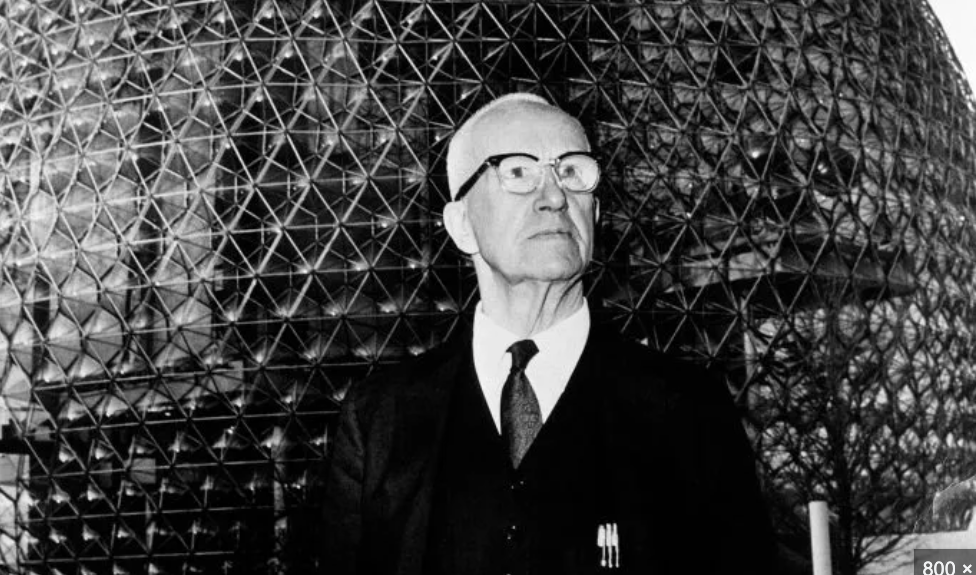
Buckminster Fuller & “The Final Exam”
Bucky’s core message:
“You never change things by fighting the existing reality.
To change something, build a new model that makes the existing model obsolete.”
He saw humanity as being in a kind of final exam:
- Can we learn to use our technology for all life, not just for profit and war?
- Can we design systems where everyone wins – not just a tiny minority?
- Can we live as if Earth were a single spaceship, with finite resources, shared responsibility, and no lifeboats?
Your Sovereign Blueprint + Resource‑Based + Creator Economy vision is basically:
“Let’s finally pass that exam.”
2. How We Got Here (The Last 100 Years in One Breath)
Very simple version:
- Post‑WWII:
- World traumatized, infrastructure destroyed, people desperate for stability.
- The US‑led dollar system + industrial growth model becomes the “solution.”
- “More production, more consumption” = progress.
- Fossil Fuel Acceleration:
- Cheap oil + coal let us multiply human power thousands of times over.
- We burned ancient sunlight (fossil fuels) faster than life could regenerate it.
- This powered comfort and convenience — and massive CO₂ emissions and pollution.
- Deforestation & Biodiversity Loss:
- Forests cleared for agriculture, cattle, timber, and cities.
- Tropical rainforests (the Amazon, SE Asia, Congo) heavily cut back, destroying habitats and long‑evolved ecosystems.
- Scientists now talk about a “sixth mass extinction” because extinction rates are far above natural background levels — driven by habitat loss, climate change, pollution, and over‑exploitation, not an asteroid.
- It’s not yet 97% of all species gone — but we’re pushing the system hard enough to risk irreversible damage this century if we don’t change course.
- The Petro‑Dollar Era:
- Oil priced in dollars = global demand for USD.
- Wars, extraction, and geopolitics orbit around energy and control.
- “Growth” measured in GDP, not wellbeing, regeneration, or stability.
- Financialization of Life:
- Everything becomes an asset: land, water, housing, health, attention, even time.
- Debt and speculation grow faster than real value.
- People work more hours to service systems that don’t necessarily make them healthier, happier, or more free.
Net result:
- Planet: overheated, deforested, stressed.
- People: anxious, indebted, disconnected from land and each other.
- System: efficient at extracting value, terrible at regenerating it.
3. The Pattern in Plain Language
We traded:
- local food → for global supply chains
- village/community → for isolated individualism
- living within ecological limits → for “infinite growth on a finite planet”
- real wealth (land, skills, relationships, soil, water, health) → for abstract digits on screens
We’re like birds in a cage with the door open:
- Tired nervous systems cling to the known, even if it’s toxic.
- Media amplifies fear, scarcity, conflict.
- Stepping into sovereignty feels riskier than staying in a system that’s clearly not working.
This is not a moral failure.
It’s a design failure.
Which means we can redesign it.
4. The Bridge: From Extraction → Regeneration
This is where your work lives. Not burning the old system, but building the bridge out of it.
Layer 1: The Sovereign Blueprint (Individual Level)
A human‑scale OS where:
- Life Base:
- Low overhead: simple housing, simple lifestyle.
- Food security: home gardens, local farmers, CSAs, village food webs.
- Health: lifestyle medicine, community care, nervous system regulation.
- Sovereign Fund:
- A portion of income auto‑allocated to long‑term regenerative assets (land, renewables, broad index funds, etc.).
- Principle never touched; future yield covers basic needs.
- Creation Engine (Creator Economy):
- You turn your story, skills, and lived experience into assets:
- courses, books, workshops, retreats, digital packs, AI tools, etc.
- “Create once, earn many times” instead of “trade hours forever.”
- You turn your story, skills, and lived experience into assets:
- Contribution Network:
- Community of aligned humans.
- Referrals, co‑creations, support, shared infrastructure.
- The opposite of “everyone for themselves.”
This is sovereignty without needing permission from banks or governments.
Layer 2: The Resource‑Based Village (Community Level)
Now zoom out to 200–2,000 people.
A SelfCare Village with seven systems humming:
- Food: Regenerative agriculture, agroforestry, edible streets, rooftop gardens.
- Energy: Solar micro‑grids, community batteries, biogas, wind where appropriate.
- Water: Catchment, purification, grey‑water loops, watershed protection.
- Shelter: Mixed housing, modular builds, rent‑to‑own, co‑ops.
- Health: Lifestyle medicine hubs, movement spaces, nature access, trauma‑informed community structures.
- Education: Skill‑shares, apprenticeships, AI mentors, intergenerational learning.
- Economy:
- Community fund that invests in regenerative projects, not extraction.
- Local tokens/credits that reward contribution (care work, composting, teaching, etc.).
- Profits recycled back into land, water, and people.
Instead of citizens being consumers in a scarcity game, they become stewards in a positive‑sum ecosystem.
Layer 3: The Creator Economy as a Regenerative Engine (Global Level)
We’re already here, just messy:
- Online creators, solopreneurs, wellness leaders, coders, artists, facilitators.
- AI agents multiplying their output.
- Crypto / Web3 experiments in community ownership.
- DAOs and co‑ops trying (imperfectly) to share value more fairly.
Your twist is:
Link the Creator Economy to Regeneration, not just to “make more money online.”
So a creator doesn’t just:
- sell a course and keep profit.
They also:
- allocate a slice of each sale to land restoration, reforestation, soil, coral, clean water, local farmers, village funds.
Creators become regenerators, not just income generators.
5. A 100‑Year Regeneration Vision (100 Metaphorical Trees)
Think in three horizons:
NOW (0–3 years)
- Help individuals build sovereign life bases:
- lower fixed costs
- one clear offer
- one clear customer
- one simple plan
- Incubators like yours:
- teach sovereign business, not hustle business
- focus on nervous system safety + clarity
- help people exit survival into creative contribution
NEXT (3–10 years)
- Grow networked villages and micro‑communities:
- eco‑villages, cohousing, regenerative neighborhoods in cities
- shared infrastructure for food, energy, water, workspaces
- community funds that invest in real assets, not only speculative ones
- Scale the Sovereign Creator → Village Contributor pathway:
- each creator tithes a portion of their prosperity to regeneration
- global to local: online revenue → local soil, trees, water, people
LEGACY (10–100 years)
- 100‑year reforestation & biodiversity projects seeded by:
- sovereign funds
- community funds
- creator tithes
- Metrics shift from:
- “How much GDP?” → “How much life?”
- “How big is your portfolio?” → “How many living systems did your work help restore?”
- Humanity looks back at the 1900–2000 era as:
- the sixth mass extinction trigger
- and the awakening point that forced us to grow up.
We plant metaphorical trees (systems, culture, education) and literal trees that we may never sit under — but our great‑grandchildren will.
6. A Succinct “Way Out”
HOW WE GOT HERE (PAST 100 YEARS)
- We burned ancient sunlight (fossil fuels) for speed.
- We cut forests, drained soils, and ignored limits.
- We financialised everything and called it “growth.”
- We centralised power in a few currencies, corporations, and institutions.
- We traded community, land, and health for convenience and control.
THE WAY OUT (BUCKY’S FINAL EXAM)
- Don’t fight the old cage. Build the new habitat.
- Start with Sovereign Humans → low overhead, clear purpose, regenerative income.
- Grow Sovereign Villages → food, water, energy, shelter, health, education, local economy.
- Plug into a Sovereign Creator Network → share IP, tools, capital, and regenerative flows.
- Anchor it all in a Resource‑Based, Positive‑Sum Ethos → everybody wins, including Earth and future generations.
“We are called to be the architects of the future,
not its victims.” – Buckminster Fuller
You are literally building that architecture with all of us.