
Baptism by Fire, Year of the snake into the fire horse
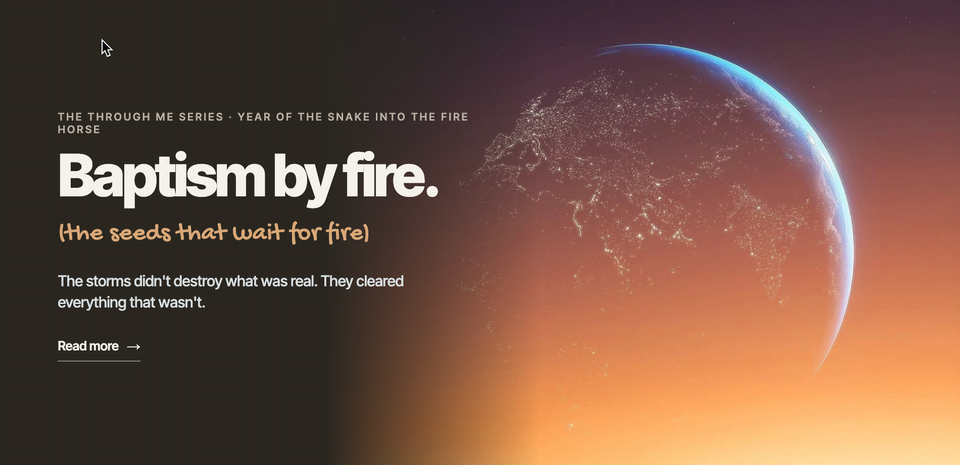
The storms didn't destroy what was real. They cleared everything that wasn't.
Rory Callaghan · The Through Me Series · November 2026
The seeds that wait for fire
In the Australian bush, where I grew up, there's a tree called the banksia.
Some of its seed pods stay sealed for years. Rain doesn't open them. Sun doesn't open them. They wait. Then a bushfire comes through, the heat cracks them open, and the seeds fall into fresh ash where the old growth used to stand.
Some seeds only open in fire.
I didn't understand that as a boy. I understand it now.
The question
What do storms and fires take from us, and what do they leave behind that we couldn't have found any other way?
The short answer
Hard seasons burn away what isn't load-bearing: roles, plans, approval, the version of us that needed life to go a certain way. What remains is smaller and truer. Research shows people who face some adversity often cope better later than those who face none. Fire doesn't make us. It reveals what was already there, and makes room for it to grow.
What burned
I'll be plain about it.
The fire took a dream I'd built with my own hands. It took my savings. It took a relationship I'd poured my heart into. It took my father. It took the comfortable story that if I was good and worked hard, life would be fair.
It took my reputation in some rooms. It took friends who turned out to be seasonal. It took the version of me who needed everyone to understand him.
For a while, it took my sleep, my appetite and my sense of who I was without the things I'd lost.
What I felt
Standing in the ash, I felt naked.
Every title I'd worn was gone. Founder of this. Partner of her. The strong one. The one who has it handled. Without them, I didn't know what to call myself.
I felt grief, wave after wave. I felt fear, the cold kind that sits in your stomach at 4am. And under the fear, strangely, a kind of quiet. Like the stillness after a storm when the birds haven't started singing yet.
What I needed
I needed time in the ash. Not to rush the regrowth. Not to turn it into a lesson by Tuesday.
I needed people who could sit with me there without trying to fix it.
And I needed to stop grabbing at what was already gone. You can't plant in ground you're still trying to hold back from burning.
What I own
- I built some of what burned on sand. Not all of it. But some foundations were made from approval, urgency or other people's expectations. Of course they didn't survive the heat.
- I tried to save things that were meant to go. I threw water on fires that were clearing room for something better.
- I measured myself by what I'd built. So when it burned, I thought I had too.
- I rushed to rebuild. In places, I started building again before the ground had cooled. That's part of why I'm so tired.
What remained
When the smoke cleared, here's what was still standing.
My values. Truth. Love over fear. We over me.
My practices. Breath, ocean, journaling, the walks, the men's circle. They'd been quiet roots the whole time.
My ability to create. The fire couldn't touch it. If anything, it cracked it open.
A handful of people who stayed in the ash with me. You find out who they are in a fire. That alone is a gift.
And a man I hadn't fully met before. Simpler. Clearer. Less interested in being understood. More interested in being true.
Baptism by fire
There's a reason so many traditions talk about refining in fire.
Gold is purified in a crucible. The heat doesn't make the gold. It separates it from everything that isn't gold. The impurities rise and burn off. What's left was always there. It just couldn't be seen.
That's what the last five years were. Not a punishment. A refining.
I wouldn't choose it. I wouldn't wish it on anyone. But I wouldn't trade what it revealed.
What the wise ones already knew
- Pema Chödrön, the Buddhist teacher, wrote When Things Fall Apart (1997) about exactly this. Her teaching, paraphrased: things fall apart, and come back together, and fall apart again. The healing isn't in stopping that. It's in letting there be room for all of it.
- Lodgepole pines and banksias are what ecologists call serotinous. Their seeds are sealed until fire releases them. Many forests don't just survive fire. They depend on it to renew.
- The research on adversity is more nuanced than "what doesn't kill you makes you stronger." Mark Seery and colleagues (Journal of Personality and Social Psychology, 2010) followed a large national sample over several years. People with some lifetime adversity had better mental health and wellbeing than those with none, and better than those with very high adversity. A little fire builds capacity. Too much, without support, wears us down.
- Tedeschi and Calhoun describe post-traumatic growth as rebuilding after an earthquake. Growth doesn't come from the shaking. It comes from what we build on the ground that's left.
The Ash Practice
When something burns now, I move through what I call the Ash Practice.
- Let it burn. Stop throwing water on what's already going. Name what's being lost.
- Sit in the ash. Don't rush to rebuild. Give the ground time to cool.
- Walk the land. Ask what's still standing. Your values, your practices, your people, your gifts.
- Find the open seeds. What has the fire cracked open that was sealed before? A new clarity, a new direction, a truer self.
- Plant slowly. Build only on what survived. Let it grow at the speed of nature, not the speed of fear.
Where this gets tricky
- Fire isn't always good. Some losses are simply losses. Not every fire leaves a gift, and we don't owe the world a silver lining.
- More adversity isn't better. The research is clear that too much, especially without support, harms us. Growth needs the fire to end and the rain to come.
- Romanticising suffering is a trap. I'm not saying go looking for fires. I'm saying when they come, look for the seeds.
- Ash takes time. If you're still in the burning, this may not land yet. That's okay. Come back to it later.
- If the fire feels too much to bear, please speak to someone today. A doctor, a counsellor, a friend.
The shift: what's real remains
Everything that could be taken, was. And I'm still here.
That's the quiet confidence the fire gave me. Not the loud kind that has to prove itself. The kind that knows: if the worst already happened and I'm standing, I can stand in anything.
What's real can't burn. It just gets clearer.
One action for today
Write down three things the hardest season of your life took from you. Then three things it couldn't touch. Read the second list twice.
Recap
- Some seeds only open in fire.
- Hard seasons burn away what isn't load-bearing.
- What remains is smaller, simpler and truer.
- Some adversity can build capacity, but too much without support harms us.
- Don't rush to rebuild. Plant only on what survived.
Questions people ask
What does "baptism by fire" mean? It describes a difficult first or defining experience that tests and transforms us. In a personal sense, it's a season of loss or hardship that burns away what isn't essential and reveals who we really are.
Does adversity make you stronger? Sometimes, within limits. Seery and colleagues (2010) found people with some lifetime adversity had better wellbeing than those with none or very high adversity. Support and recovery time matter a great deal.
What is a serotinous plant? A plant whose seeds stay sealed until an environmental trigger, often fire, releases them. Banksias and lodgepole pines are well-known examples. Their forests renew after burning.
How do I know what's worth rebuilding after a loss? Look at what survived. Your values, practices, relationships and gifts that stayed through the hardest moments are the strongest ground to build on.
Is it wrong to grieve what the fire took, even if I've grown? No. Grief and growth live side by side. Honouring what was lost is part of what lets the new thing grow.
A closing reflection
The fire took everything that could be taken.
What was left is the only thing I ever really needed.
What has your hardest season revealed that you couldn't have found any other way?