
Event Plus No Story Equals No Problem
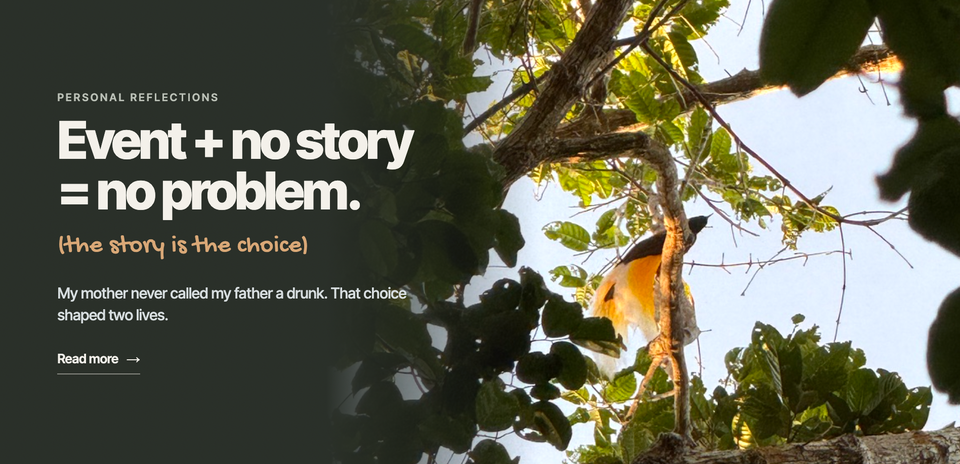
My mother never called my father a drunk. That choice shaped two lives.
My father was an artist, born into a time that didn't support one. For thirty years he got lost, and the substances numbed him.
In a house where it would have been easy, my mum never once called him a drunk. She said, "Your father was an amazing artist."
The facts didn't change. He was still absent. But because of the story she chose, two boys grew up able to love their father.
The question: How much of our pain is the event, and how much is the story we tell about it?
The short answer: An event plus a story becomes a problem we carry. An event with no story is simply life, and we can move through it. We can't choose everything that happens. We can choose what we shine our attention on, and the story that leaves room for love without denying the truth.
Why this matters now
We live in an age of narratives. Every event comes pre-packaged with outrage, blame and a villain.
The core insight
A mentor of mine, David T.S. Wood, put it in five words. Event plus no story equals no problem. A woman once crashed into the back of his car and got out in a rage. He centred himself and asked, "Are you okay?" She had no insurance. He said, "It's okay. I have insurance," gave her a hug, and went on to serve a thousand people that day.
The Spotlight Method
- Name the event. Only the facts.
- Notice the story. Victim, villain, or something else?
- Choose the light. Which story leaves room for love, without lying?
- Act. The universe responds to action, not rumination.
How to use it
Take one thing that hurt you this month. Write the facts in one line. Then write two stories about them. Read both aloud, and notice which one lets you breathe.
The evidence
- In a famous experiment, about half the people counting basketball passes failed to see a person in a gorilla suit walk through the game (Simons and Chabris, 1999, Perception). We see what we look for.
- Nearly two thousand years ago, Epictetus opened his handbook with, "Some things are under our control, while others are not under our control" (Enchiridion 1).
- Even naming a feeling can calm the brain's alarm (Lieberman and colleagues, 2007, Psychological Science, a small laboratory study).
Where this doesn't apply
Choosing a story is never pretending harm didn't happen, or staying where you aren't safe. The truth comes first. The story is what we make of it.
The shift
From this happened to me to this moved through me, and I chose what to make of it.
One thing for the next 24 hours
Write one event, two stories, and keep the one that leaves room for love.
Recap
- Event plus no story equals no problem.
- What we shine our light on grows.
- The story we choose decides who people get to be.
Questions people ask
What does "event plus no story equals no problem" mean? Pain is often the event plus the story we attach. Remove the story and the event becomes something we can move through.
Is this denying what happened? No. The facts stay. Only the meaning we add changes.
How do I change the story I tell myself? Write the facts, write a kinder true story, and act from it.
Who taught this idea? Rory learned it from his mentor David T.S. Wood.
The book
Remember tells my father's full story, from the vision he wrote in a book my mum gave him, to the bright paintings of his last ten years on the Riverland.
[Read the whole book: Remember →]([BOOK PAGE LINK])
What story are you shining your light on, and does it leave room for love?