
The Bhagavad Gita: Action Without Attachment
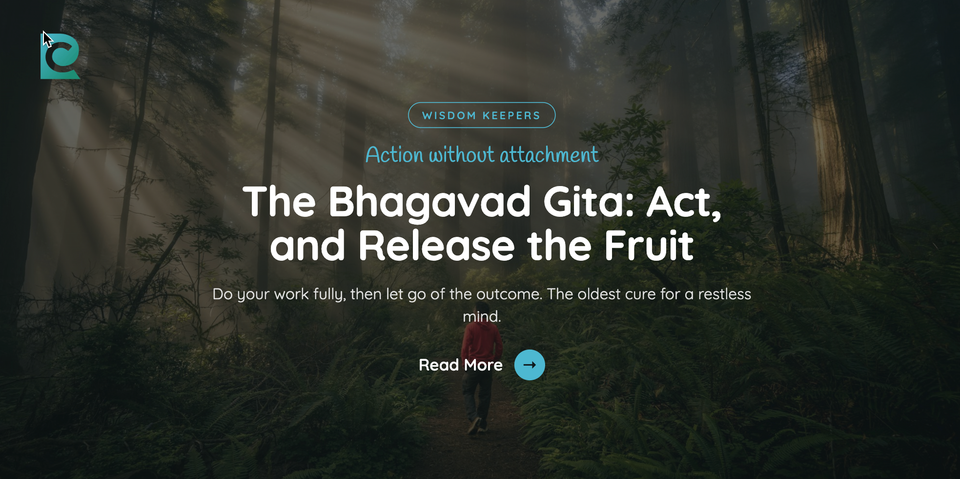
A warrior freezes on a battlefield, unable to act. What his teacher tells him in the next 700 verses is one of the most practical guides to living ever written.
An army waits. A man who is meant to lead the charge sits down in his chariot and refuses. He can see the cost of what is about to happen, and it breaks him. What follows is not a battle scene but a conversation, and that conversation became one of the most loved spiritual texts on earth.
The Bhagavad Gita is often read as lofty philosophy. It is really something more useful: a field manual for how to act when you are overwhelmed, afraid, and unsure what is right. Its battlefield is the one we all stand on.
The question this piece answers
What does the Bhagavad Gita teach about how to act, especially when we are paralysed by doubt or fear?
The quick answer. The Bhagavad Gita teaches Karma Yoga, action without attachment to results. Facing a war he dreads, the warrior Arjuna is counselled by Krishna to do his duty (dharma) with full commitment but without clinging to the outcome. The core instruction is to act from aligned purpose rather than fear or craving, offering the fruits of action rather than grasping them.
Why this matters now
We are a results-obsessed culture, and it makes us anxious and often paralysed. We fixate on outcomes we cannot control, and the fixation either freezes us or drives us to act from fear. Arjuna's collapse at the start of the Gita is deeply modern: he is overwhelmed by consequences and cannot move.
The Gita's answer speaks directly to that paralysis. It does not say outcomes do not matter. It says your grip on them is the problem. Commit fully to right action, then release your claim on the result. For anyone frozen by pressure, or burning out from chasing outcomes, that is not ancient abstraction. It is a way to act cleanly again.
The one idea worth keeping
Give everything to the action. Give up your claim on the result. That is the whole freedom the Gita offers.
Attachment to outcome is what corrupts action: it breeds fear when the result looks uncertain and pride when it goes your way. Krishna's teaching cuts the knot. Act with total commitment because it is right, then let the fruits be what they are. You are responsible for the quality of your action, not entitled to its reward. In that release, action becomes clean, and you become free.
The teaching, in its own terms
The Gita's ideas have names worth knowing, because each names something usable.
Arjuna and Krishna. Arjuna is the warrior frozen by the sight of what right action will cost. Krishna, his charioteer, is his teacher, guiding him from paralysis into clear action. Read symbolically, Arjuna is the human self at the point of choice; Krishna is the deeper wisdom that can see through the fear.
Dharma: aligned duty. Your dharma is the right action that flows from your own nature and place, not someone else's. As the Gita puts it, better to do your own duty imperfectly than another's perfectly (3:35). Alignment with your own truth matters more than borrowed perfection.
Karma Yoga: the yoga of action. The central teaching. Act without attachment to the fruits. Not renouncing action, but renouncing your grip on its results. This is how you stay in the world, fully engaged, without being enslaved by outcome.
The three gunas. The Gita describes three qualities woven through everything: tamas (inertia, ignorance), rajas (restless passion and craving), and sattva (clarity and harmony). Mastery is not denying these forces but recognising them and moving toward clarity.
Seeing unity. At its heights, the Gita points beyond the personal: when a person sees the same essence dwelling in all beings, they no longer harm themselves or others by division (6:29). Right action finally rests on perceiving the unity beneath difference.
How to actually use this
The next time you are frozen before a decision, split it in two.
First, ask: what is the right action here, the one aligned with my truth and duty, regardless of how it turns out? Commit to that fully. Second, consciously release your grip on the result: name the outcomes you are clinging to, and set them down. You will do the action with everything you have, and you will let the fruits be what they are. This is Karma Yoga in a single moment: total commitment to the deed, total release of the reward. It is astonishing how much fear drains out of a choice when you stop demanding a particular result from it.
The evidence, named and dated
This is classical scripture and philosophy, so the sourcing is the text and its scholarship, named and dated.
- The Bhagavad Gita (composed c. 2nd century BCE–2nd century CE), part of the epic Mahabharata. The primary text, 700 verses across 18 chapters. The chapter-and-verse references here (3:35, 6:29, and the imagery of chapter 15) follow standard numbering across major translations.
- The commentarial tradition (Shankara, Ramanuja, and later teachers). For over a millennium, the Gita has carried multiple serious interpretations, non-dualist and devotional among them. This piece draws the widely shared Karma Yoga reading, while noting the text sustains many.
- Modern readers and translators (Eknath Easwaran, among others). Twentieth-century translations brought the Gita to a global audience as a practical guide to action under pressure, the reading foregrounded here.
- Wisdom-keeper lens: aligned action across traditions. "Act from truth, release the outcome" echoes the Taoist wu wei and the Stoic focus on what is within our control. Offered as convergent parallel, not as claim of shared origin.
Where the text sustains multiple readings, that is acknowledged rather than flattened.
Where this does not apply
Three honest caveats.
"Non-attachment" is not indifference or detachment from caring. The Gita does not counsel not caring; it counsels caring fully about the action while releasing the grip on the result. Misread as "don't care about anything," it becomes cold, which is the opposite of its intent.
The battlefield setting invites misreading. The Gita uses a literal war as its frame, and readers across history have taken it literally or symbolically. Read here as an inner battlefield, the field of choice, it is a teaching on action, not an endorsement of violence. That symbolic reading is a choice, and worth naming as one.
And it is scripture with living traditions around it. This is one reading of a text sacred to hundreds of millions of people, offered with respect, not as the final or only word.
Who you become when you hold this
You become someone who can act cleanly under pressure.
You still care about outcomes, but you stop being ruled by them. You commit fully to what is right and release your claim on how it turns out, and that release drains the fear and the grasping out of your choices. You act from purpose rather than panic. Where you used to freeze, you move; where you used to grab, you offer. People feel the steadiness of someone who is fully engaged and yet not desperate. You become, in the Gita's sense, free in action.
The spine, in five lines
- The Bhagavad Gita opens with the warrior Arjuna frozen by dread on a battlefield, unable to act.
- Krishna counsels Karma Yoga: full commitment to right action, without attachment to its fruits.
- Dharma is aligned duty, better done imperfectly as your own than perfectly as someone else's.
- The gunas name the forces of inertia, craving, and clarity; mastery moves toward clarity and unity.
- The practice: commit totally to the right action, then release your grip on the result.
One step for the next 24 hours
Take one decision you are frozen on. Separate it into the two moves. First, name the action that is genuinely right and aligned, and commit to it. Second, name the specific outcome you are clinging to, and consciously set it down. Then act, fully, and let the result be what it is. One decision, cleanly done, the Gita's way.
Questions people ask
What is the main teaching of the Bhagavad Gita?
The central teaching is Karma Yoga: acting without attachment to the results. Facing a battle he dreads, the warrior Arjuna is counselled by Krishna to perform his duty with full commitment while releasing his grip on the outcome. The essence is to act from aligned purpose rather than from fear or craving for reward.
What is Karma Yoga?
Karma Yoga is the "yoga of action", acting fully and well while renouncing attachment to the fruits of that action. It does not mean withdrawing from the world or ceasing to act. It means staying engaged and committed while letting go of the demand for a particular result, so that action becomes free rather than driven by fear or greed.
Who are Arjuna and Krishna?
Arjuna is a warrior prince who, on the eve of battle, collapses in doubt and grief at what he must do. Krishna is his charioteer and teacher, who counsels him back into clear action. Read symbolically, Arjuna is the human self at the point of hard choice, and Krishna is the deeper wisdom that sees through fear.
What is dharma in the Gita?
Dharma is aligned duty, the right action that flows from your own nature and situation rather than an imitation of someone else's path. The Gita famously says it is better to do your own dharma imperfectly than another's perfectly, emphasising alignment with your own truth over borrowed or external ideals of correctness.
Is the Bhagavad Gita about a real war?
The Gita is set on a literal battlefield within the epic Mahabharata, and readers have long taken it both literally and symbolically. Read as an inner teaching, the battlefield represents the field of difficult choice every person faces, and the "war" is the struggle to act rightly. That symbolic reading is one interpretation among several in a living tradition.
The question the battlefield hands back
We freeze because we are trying to control the future, to guarantee the outcome before we will act. The Gita offers a different freedom: do the right thing fully, and let go of the rest. The paralysis lifts not when we finally control the result, but when we stop demanding to.
So Arjuna's moment hands the question to us.
What would you do right now, fully and cleanly, if you released your grip on how it turns out?
A closing thought. You are not responsible for the harvest. You are responsible for how you plant. Commit everything to the action that is right, and let the fruits be what they will. Take one frozen choice today and move, cleanly, without the grip. No rush.
Last updated: July 2026.
Output Package
SEO metadata
- Title tag: The Bhagavad Gita: Action Without Attachment (44 characters)
- Meta description: What is the main teaching of the Bhagavad Gita? Karma Yoga, action without attachment, and how Krishna guides Arjuna from paralysis into clean action. (150 characters)
- Focus keyword: main teaching of the Bhagavad Gita
- Secondary keywords: what is Karma Yoga, who are Arjuna and Krishna, what is dharma, action without attachment
- Slug: bhagavad-gita-action-without-attachment
- Estimated reading time: 9 minutes
Internal linking suggestions (cluster: the wisdom-keeper synthesis)
- Anchor "effortless aligned action" → The Tao and the I Ching.
- Anchor "the awakening of self-awareness" → Genesis: The Garden, the Serpent, and the Two Tablets.
- Anchor "the law of cause and effect" → The 12 Universal Laws.
- Anchor "every action recorded in the field" → What Are the Akashic Records?
- Anchor "the whole synthesis in one place" → From Sumerian Tablets to Tesla's Frequency (the anchor essay).
Alt text
A lone figure standing still at the edge of a vast open field at dawn, poised between stillness and movement, symbolising the moment of choice before action.
Repurposing bundle
LinkedIn post 1 — the reframe
A warrior freezes on a battlefield, unable to act.
He can see everything the action will cost, and it breaks him.
It is one of the most modern moments in ancient literature.
Because we freeze the same way.
Overwhelmed by outcomes we cannot control.
The Gita's answer is not "stop caring."
It is: commit fully to the action, release your grip on the result.
LinkedIn post 2 — the framework
The Bhagavad Gita in one teaching: Karma Yoga.
Act without attachment to the fruits.
Not renouncing action. Renouncing your grip on its results.
You are responsible for the quality of the deed.
Not entitled to its reward.
Attachment breeds fear when it looks uncertain, pride when it goes your way.
Cut the knot. Act cleanly. Be free.
LinkedIn post 3 — the practice
Frozen on a decision? Split it in two.
One: what is the right action here, aligned with my truth? Commit fully.
Two: what outcome am I clinging to? Set it down.
Then act with everything, and let the fruits be what they are.
It is astonishing how much fear drains out of a choice
when you stop demanding a particular result from it.
Newsletter intro
The Bhagavad Gita opens with a warrior frozen on a battlefield, unable to act because he can see everything it will cost. What his teacher tells him next is one of the most practical guides to living ever written. This week I wanted to draw out its central teaching, Karma Yoga, action without attachment, and how to use it the next time you are paralysed. Full piece here.
Short video script (45 seconds)
A warrior freezes on a battlefield.
He can see what the action will cost, and he cannot move.
We freeze the same way.
Overwhelmed by outcomes we cannot control.
The Bhagavad Gita's answer is not "stop caring."
It is this.
Commit fully to the right action.
Then release your grip on the result.
You are responsible for how you plant.
Not for the harvest.
Do that, and the fear drains out of the choice.
Thumbnail prompt
A lone still figure at the edge of a wide field at dawn, poised between stillness and motion, warm light, cinematic, spacious, muted tones, no text.
Publish notes (Ghost). Dual-publish web and newsletter. Part of the source-traditions cluster, link to the Sumerian anchor and siblings, especially the Tao piece (wu wei parallels Karma Yoga). Frame the symbolic battlefield reading respectfully as one interpretation. Chapter-verse references follow standard numbering. Include FAQPage schema. Keep "last updated" current.