The Code I Live By | Whats yours? Values, Virtue over Voids
My values, morals, virtues and standards. What I stand for, and what I refuse to become. A code forged by living, not borrowed from books.
A personal reflection.
There's a distinction I've come to care about.
My beliefs are what I've come to understand. My values are what I choose to prioritise. My morals are the lines I won't cross. My virtues are the qualities I practise. And my character is what remains when all of those are tested.
I've lived health and illness, high performance and burnout, freedom and uncertainty, collaboration and betrayal, love and heartbreak, achievement and loss.
So my code isn't about what sounds beautiful or spiritually evolved.
It's about what I've found worth protecting, even when it costs me something.
The question this piece answers
What's the difference between values, morals and virtues, and how do you build a personal code?
The quick answer. Values are what you prioritise. Morals are the lines you won't cross. Virtues are how you practise them. A personal code brings all three together, shaped by real experience, and it only becomes character when it's tested, when telling the truth, setting a boundary or walking away costs you something.
What I experienced
Life tested the code before I wrote it down.
These are lessons my experiences support, not proof that every interpretation I've made was right. That humility is part of the code too.
What I learned
My twelve core values.
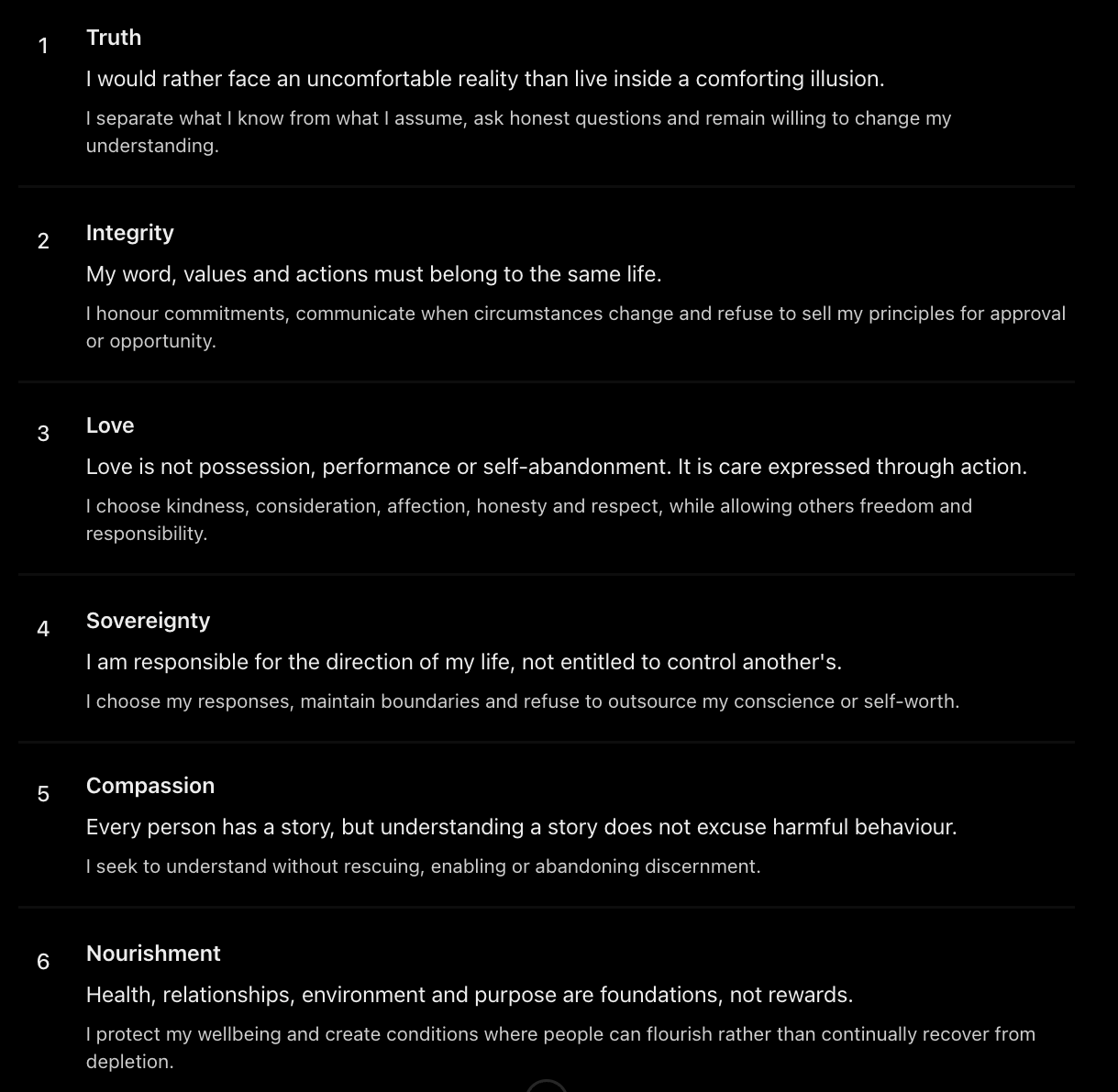
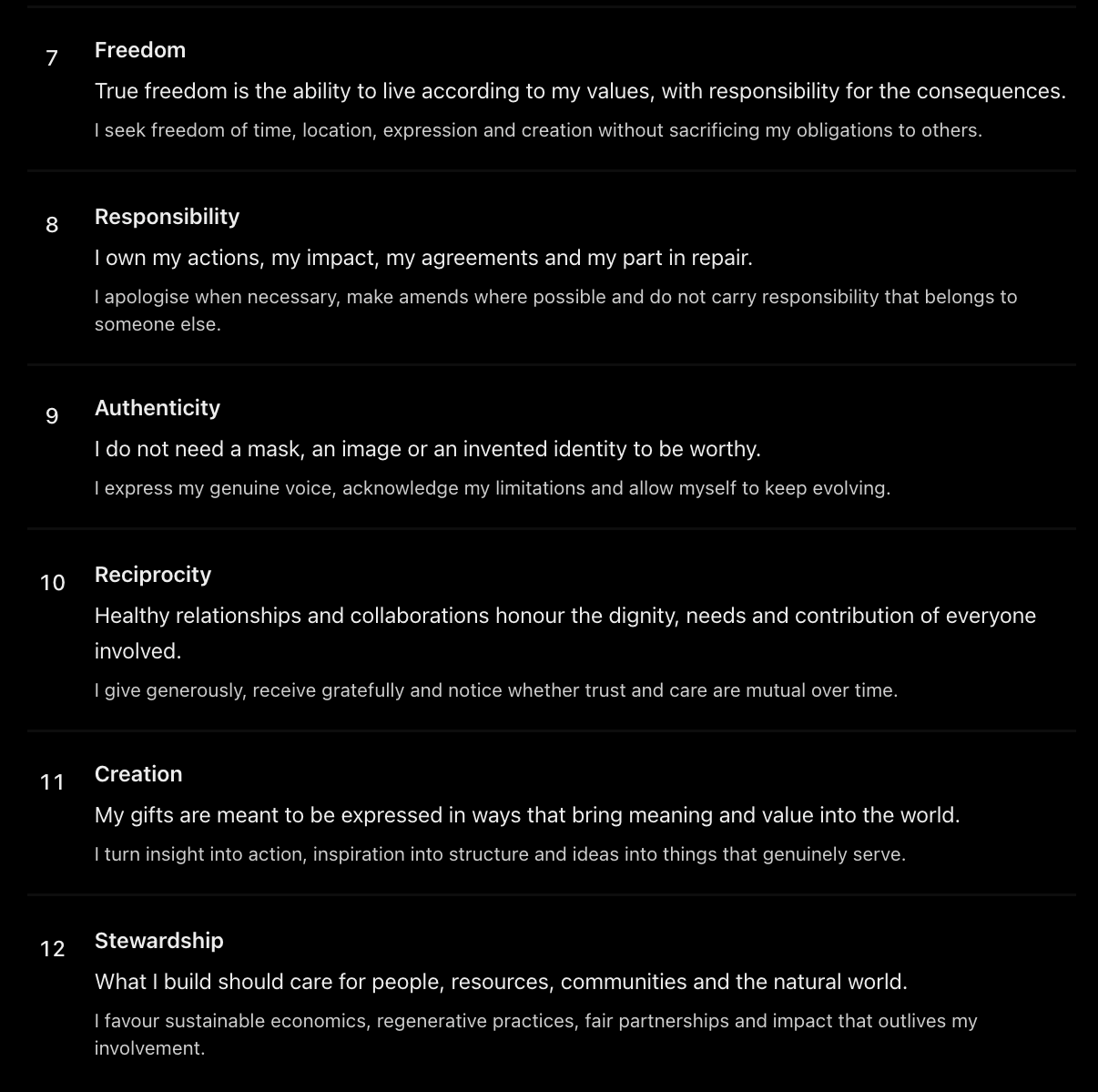
What I stand for, and against. These aren't opposing tribes of good and bad people. They're choices about behaviour and systems.
Standing against a behaviour doesn't mean hating the person doing it. I can oppose exploitation without becoming vindictive, recognise manipulation without becoming paranoid, and insist on accountability without needing revenge.
My moral lines.
- I don't knowingly deceive, exploit, coerce or manipulate people for my own advantage.
- I don't use someone's vulnerability, trust or affection as leverage.
- I don't promise what I can't reasonably deliver, and I own it when I fall short.
- I don't take credit for someone else's work.
- I don't treat my generosity as entitling me to anyone's loyalty, affection or time.
- I don't stay in arrangements that keep requiring me to betray my values.
- I don't use spiritual or personal-development language to avoid accountability.
- I don't make my own suffering a justification for harming others.
I don't require perfection from myself or anyone. I do require the willingness to recognise harm, take responsibility and repair where possible.
The wisdom I'd pass on
Practise the virtues, not just the values. Values describe what matters. Virtues describe how I want to be experienced.
Courage. Wisdom. Temperance. Justice. Compassion. Humility. Faithfulness. Generosity. Discernment. Playfulness.
Beneath them all runs devotion. To health, to people, to love, to meaningful creation. But devotion needs discernment. Without boundaries, it becomes overextension. Without reciprocity, loyalty becomes self-abandonment. Without humility, conviction becomes rigidity. Without rest, service becomes depletion. The next step isn't to love or give less. It's to love and give with more wisdom and freedom.
Know what you refuse to become.
I refuse to knowingly exploit people for profit.
I refuse to manipulate someone into choosing me.
I refuse to make success more important than integrity.
I refuse to use my wounds as permission to wound others.
I refuse to let betrayal turn me into someone who no longer believes in goodness.
I refuse to build a life that looks extraordinary from the outside and leaves me empty within.
I refuse to sacrifice the people I love for the image of a mission supposedly built on love.
I can see clearly without becoming cynical. Protect myself without closing my heart. Be ambitious without being extractive. Lead without demanding followers.
Ask the real test. A code only becomes character when values compete. When telling the truth risks an opportunity. When a boundary risks disappointing someone. When refusing a profitable partnership risks financial security. When my body needs rest and my ambition wants more. When I could retaliate and choose not to. And when I'm the one who fell short and has to say so.
The most convincing evidence of what I believe isn't the philosophy I publish. It's the life people experience when they're with me.
Where this does not reach
A code isn't a claim of perfection. I haven't always lived it perfectly, and I'll fall short again. The code is what I return to.
My code isn't a rulebook for others. It's mine. People can live with integrity under very different codes.
Standing against something isn't the same as fighting everyone. Some battles are worth taking on. Many are better met with a boundary and a quieter life.
The evidence, named and dated
- Peterson and Seligman (2004), Character Strengths and Virtues: A Handbook and Classification. They identified six broad virtues (wisdom, courage, humanity, justice, temperance and transcendence) that appear across cultures and traditions, with 24 character strengths beneath them. Several of my virtues map onto theirs. It supports the idea that a personal code can draw on shared human virtues while being shaped by one person's life.
- Personal, and labelled: the twelve values, the stand-for table, the moral lines and the refusals are my own.
The shift
I used to think good character was what I said about myself.
Now I know it's what I do, especially when it costs me.
One thing, for the next day
Write down one line you won't cross, in your own words.
Then notice, tomorrow, the moment it would be easiest to cross it.
The spine of it
Beliefs, values, morals, virtues, character. Life tested the code first. Twelve values. Stand for, and against, without hating people. Moral lines I hold, with room for repair. Ten virtues and the devotion beneath them. Devotion needs discernment. Refusals that protect who I am. The real test is when it costs something. The evidence is the life people experience with me.
Questions people ask
What's the difference between values, morals and virtues? Values are what you prioritise. Morals are the lines you won't cross. Virtues are the qualities you practise to live them.
How do I write a personal code? Start from experience. List what life has tested and taught you, name your values, draw your moral lines, and keep them honest by revisiting them.
What does "integrity over image" mean? Choosing to keep your word and live your values even when it doesn't look good or costs you something.
Can you stand against something without becoming hateful? Yes. You can oppose a behaviour, set boundaries and seek accountability without needing revenge.
What is character? What remains when your values are tested, shown through what you do rather than what you say.
This is my code. Not because I've always lived it perfectly. Because I've lived enough to know what matters, and every day gives me another chance to embody it.
What would your code say about who you are when it costs you?