
The Man Beneath the Mission
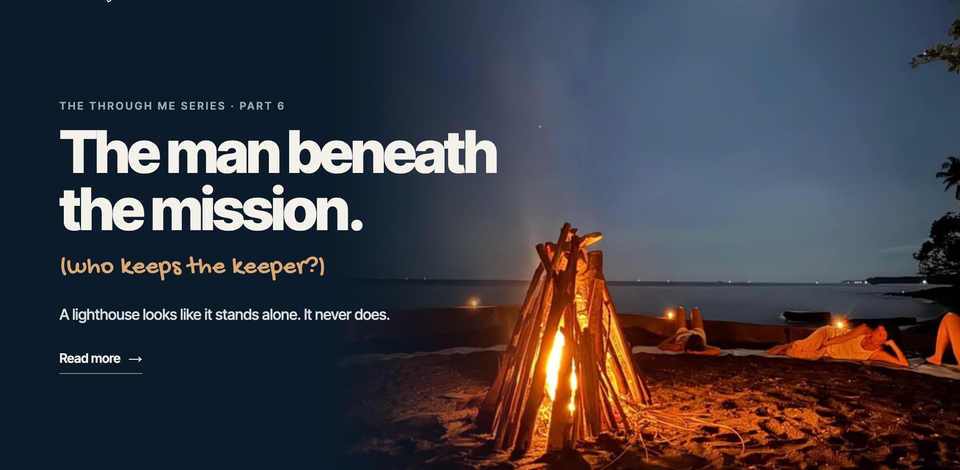
A lighthouse looks like it stands alone. It never does.
Rory Callaghan · The Through Me Series · November 2026
The lighthouse
From the water, a lighthouse looks like the strongest thing on the coast.
It stands through every storm. It never moves. Ships find their way home by its light, and most of them never think about it again.
What the ships don't see is the keeper. The one climbing the stairs at 3am to trim the wick. The one cleaning salt off the glass. The one who sits alone in the tower some nights, listening to the wind, wondering who keeps the keeper.
For five years, people saw the light. This is about the keeper.
The question
What does it really take to stay a pillar for others while life is breaking you open, and what does the person beneath the mission need?
The short answer
Being a pillar doesn't mean standing alone. The strongest people I know are held by something: practices, mentors, brotherhoods, the people who stay. Strength isn't the absence of need. It's the honesty to name it and the humility to let others in. Truth shared openly loses its power to shame us and becomes medicine for others.
What you saw
On the surface, you saw the mission.
The work. The stage. The retreats and summits. The community growing. Someone steady, calm, always there with the right word. The one people called when their own life was coming apart.
All of that was real. I meant every bit of it.
What was happening beneath
Underneath, life was happening through me and for me at the same time.
It came as loss. A father gone. A family to hold through grief while I was grieving myself. Someone I love walking through months of dark while I sat beside them and held the rope.
It came as collapse. A dream I'd built with my own hands, gone. My savings gone with it. A partnership turned against me.
It came as betrayal and noise. Stories told about me in rooms I wasn't in. People stepping away right when the storm hit.
It came as heartbreak. A love that came close and pulled away, again and again, until it finally didn't come back.
And it came all at once, in a week where the whole sky fell.
What I felt
I felt grief like a tide, coming in when I least expected it.
I felt the weight of being needed by everyone at the same time.
I felt betrayed, and then foolish for having trusted, and then sad that I'd ever felt foolish for trusting.
I felt fiercely devoted to the people and the work I loved. Even on the worst days, that never left.
And I felt tired. The kind of tired that lives in your bones and doesn't leave when you sleep.
What I sensed
There's something I've never said out loud before.
I sensed that the silence suited some things. That shame grows best in the dark. That the stories told about me only had power while I stayed quiet about what was really happening.
I sensed, too, that the parts of us that want to stay hidden are the ones most afraid of the light. The fear inside me. The fear in the situations around me. All of it wanted me to keep my head down and my truth to myself.
So I'm not keeping it to myself anymore.
Not to accuse anyone. Not to settle a score. Just to tell the truth of what I lived, from my side, and let it stand.
What I did with the energy
I made a choice early on that I've kept to ever since. Whatever came through me would go somewhere useful. It wouldn't rot inside me.
Grief became tools for self-care. My own fear of asking for help became a home for others who struggle to ask. A broken partnership became a fairer way of building. An empty account became an ecosystem. Every hard thing I felt, I tried to turn into service.
I think of it as dharma. Not a job. The work that's yours to do because of what you've lived.
The inner work
But I couldn't give what I didn't have. So I went inward, again and again.
I sat with a therapist who didn't know me and asked one question: what part did I play? I sat in a circle of men every week and said the things I couldn't say anywhere else. I called on mentors and guides who asked me the questions I'd been avoiding. I kept my practices: breath, ocean, journaling, long walks, stillness.
I stopped pretending I could do it alone. I called in every resource I had. Brotherhood. Teachers. Friends. Nature. Faith in something bigger.
That's the secret of the lighthouse no one tells you. It looks like it stands alone, but it's anchored deep in rock. Without the rock, the first storm would take it.
My rock was the people and practices I let in.
Being the pillar
Because I was held, I could hold.
I could stay steady for the people I loved while they were falling. I could sit with clients in their darkest seasons without being pulled under. I could be a pillar for people who were also learning that life was happening through them and for them.
I didn't do that because I was unbreakable. I did it because I'd stopped trying to be.
What I own
- For a long time, I tried to be the light and the rock at once. I wanted to hold everyone without being held. That's how lighthouses fall.
- I hid my need behind my strength. People couldn't help a man who never let them see he needed it.
- Sometimes I gave from empty. Service is beautiful. Service from an empty well isn't sustainable.
- I waited too long to tell the truth. Silence protected nothing. It just kept me alone with it.
What I learned
- Strength isn't the absence of need. It's the honesty to name it.
- Truth told openly loses its power to shame us.
- You can't be a pillar without a foundation. Build yours on people and practices, not willpower.
- Life happens through us and for us. Both at once. The pain is real, and so is the gift.
- The work we're here to do often comes straight out of the wound we didn't choose.
What the wise ones already knew
- The Bhagavad Gita teaches that it's better to live your own dharma imperfectly than someone else's perfectly. The path that's yours is the one that came through your own life.
- Brené Brown, in Daring Greatly (2012), writes that shame needs secrecy, silence and judgment to grow. Speak it, and it starts to lose its grip. That matches everything I sensed.
- Men often wait too long to ask. Addis and Mahalik, writing in American Psychologist (2003), reviewed why men seek help less often than women, and how ideas about masculinity shape that. I was a textbook case.
- Connection keeps us alive. A meta-analysis by Holt-Lunstad and colleagues (PLOS Medicine, 2010), covering 148 studies, found people with stronger social relationships had a 50% greater likelihood of survival over the study periods. Being held isn't a luxury. It's health.
The Keeper's Practice
For anyone who's the lighthouse in their family, team or community, here's what I'd offer. I call it the Keeper's Practice.
- Name what you're holding. Write it down. All of it. The keeper has to see the tower clearly.
- Name what you need. Not what you think you should need. What you actually need.
- Find your rock. List the people, practices and places that hold you. If the list is short, that's your first task.
- Tell one truth out loud. To one person you trust. Shame shrinks in the light.
- Shine from overflow. Serve, but from a full well. Rest is part of keeping the light on.
Where this gets tricky
- Sharing your truth isn't attacking someone else's. I've left out names on purpose. This is my experience, told from my side, not a verdict on anyone.
- Not every truth needs a public audience. A circle, a therapist or one friend can be enough.
- Being a pillar isn't a life sentence. You're allowed to step down from the tower for a while.
- Dharma can become pressure. If purpose starts to feel like a debt, it's time to rest.
- If the storm feels too big to hold, please reach out today. A doctor, a counsellor, a brother, a friend.
The shift: the man beneath
Here's what I know now.
The man beneath the mission is not the strongest man in the room. He's the most honest one. He knows what he's carried. He knows what he needed. He knows what he owns.
He doesn't need anyone to be the villain for his story to be true. He doesn't need to hide it either.
He's tired, and he needed a hug. Not another test. Not another initiation. Just someone to hold the rope for a while.
And when the storms cleared the field, he finally gave that to himself, and let others give it too.
The light was never the point. The keeper was.
One action for today
Ask yourself: who keeps the keeper in my life? Write down one name. Then let them know, today, what they mean to you, or what you need.
Recap
- From the outside, people see the light. Few see the keeper.
- Life happens through us and for us at the same time.
- Shame grows in silence. Truth told openly loses its grip.
- You can't be a pillar without a foundation of people and practices.
- The strongest thing we can do is let ourselves be held.
Questions people ask
What does "life happens through me, not to me" mean? It's a shift from seeing hard events as random attacks to seeing them as experiences that shape who we become and what we offer. The pain is still real. The shift gives us agency inside it.
Why do men struggle to ask for help? Research by Addis and Mahalik (2003) links it to cultural ideas about masculinity, like self-reliance and hiding vulnerability. Many men wait until they're in crisis. Brotherhood and men's circles can make asking feel safer.
What is dharma? In Hindu and Buddhist traditions, dharma refers to one's right path or purpose. In everyday use, it often means the work that's truly yours to do, often shaped by what you've lived through.
How can I support others when I'm struggling myself? Build your own foundation first: practices, mentors, friends and rest. Being held makes it possible to hold others without being pulled under. Serving from empty leads to burnout.
Is it healthy to share painful experiences publicly? It can be, if you're ready and it's your story to tell. Speaking truth can loosen shame and help others feel less alone. It's wise to leave out other people's identities and keep some things for private spaces.
A closing reflection
For five years, people saw the light.
This was always about the keeper.
Who's keeping you, and do they know?