
The Ripple Effect: The biggest flex is how many lives we positively impact
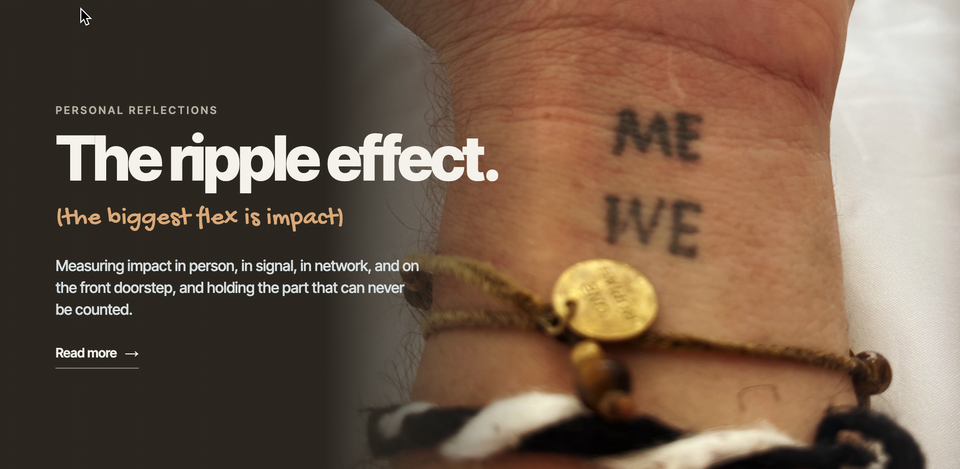
How one person going first becomes ten, a hundred, a thousand and more. Direct and indirect, in person and through networks, and the part no number can hold.
"The meaning of life is to have fun and plant seeds for trees, whose shade we may never sit under."
Rory Callaghan · Personal Reflections · November 2026
The night I tried to count
Late one night in Bali, I sat with a notebook and asked a question I had avoided for years.
How many lives have we actually touched?
Not followers. Not revenue. Lives.
For a long time I measured myself the way most founders do. Money in. Launches out. Rooms filled. And underneath it, something felt missing.
What I believe now is simple. The biggest flex we can have is how many lives we have positively impacted. Starting with ourselves. Then our front doorstep. Then our local community. Then the world.
So I counted. Honestly. Then I kept going, because the counting showed me something the numbers alone could not. The real impact was never mine. It was what the people I served went on to do.
The guiding question
How far does one life lit up in its purpose actually travel, and how do we measure it without inflating it or shrinking it?
The quick answer
Impact travels from one to many in five steps: you, family, local, national and global. Count what you reached directly at each step, then model what travelled indirectly through others. For my work, about 130,000 to 180,000 lives meaningfully touched, over a million reached by signal, and tens of millions more through the networks of the people we lit up.
Why this matters now
We live in an attention economy that counts eyeballs and calls it impact. A million views feels like a million lives. It is not.
And yet the opposite mistake is just as real. Many of us who serve quietly never pause to see what we have helped bring into being. We forget that one session, one summit, one honest conversation can travel through a family for generations.
I wanted a way of seeing that held both truths. Rigorous enough that a doctor would respect it. Soft enough to honour what can never be measured.
The core insight
The real multiplier is not reach. It is ignition.
When I serve one person, I touch one life. When I help one person remember their own purpose and gifts, I touch everyone they will ever serve. That is the difference between a ripple and a wave.
Three stories of one becoming many
The forest man
In 1979, after a flood, a sixteen-year-old named Jadav Payeng found hundreds of snakes dead from the heat on a bare sandbar in the Brahmaputra River. He began planting bamboo there. Then trees. Then more, every day, for around forty years.
That sandbar is now the Molai forest, about 1,360 acres planted largely by one pair of hands. It shelters Bengal tigers, Indian rhinoceros and deer, and a herd of around a hundred elephants returns to it each year (Wikipedia, Blue Dot Living). I tell his story in One Person Can Make a Difference Today.
He did not plant a forest. He planted a tree, and kept planting. The forest did the rest.
The teacher from Uganda
Charles came to one of our summits from Uganda because a community crowdfunded his journey. He went home and built a school. Today it serves 800 children directly.
Think about what that crowdfund actually bought. Not a flight. A school. And every one of those 800 children will carry what they learn into their homes, their villages and the next generation.
From I Am Creation to We Are Creation
One woman I have walked beside for three years started with a single retreat in Bali, I Am Creation. It grew into online summits where more than 50,000 people registered and stayed for hours with teachers who had walked their path for decades. Then into We Are Creation, with more than 500 people in one room for three days (2026 announcement).
I AM became WE ARE. One person, then a room, then a movement.
And my own
My part began in clinics and businesses: more than 10,000 patients, a nutrition business that reached 52,000 people and their families, and enterprises that have turned over more than $50 million. Then the incubator, the summits and the stages.
But the real multiplier was never what I built alone. It is the leaders. Each one carries their own followers, their own email list, their own community. When we come together on one stage, our signal goes out to every continent at the same moment.
When we come together, our impact multiplies and magnifies. That is the key.
The framework: the One-to-Many Ripple
In SelfCare we call it the Impact Scale. One to many. Each step is roughly ten times the one before. At every step there are two kinds of impact. Direct, the people the work reached itself. Indirect, the people it reached through someone else.
1 · You, go first
Every ripple begins with one coherent nervous system. If I am not regulated, I am not a stone dropped in still water. I am a splash. This step is not counted. It is the source of everything that is.
10 · Family community
The people I sit closest to. Fourteen mentoring and consulting stories, sixteen people, and the twenty-four founders of CoCreator Cohort 1. Together they have built 95 named creations with me: retreats, summits, programmes, books, communities and a school term of young people learning what a dollar costs.
Each of them goes home to someone. That is the first indirect ring.
100 · Local community
The rooms. A hundred founders through the CoCreator incubator. Retreats in Bali. Thousands of class visits at a retreat centre. A day of practitioners teaching side by side.
This is where indirect impact starts to outgrow direct. If each incubator founder deeply supports ten people, that is 1,000. If each of those supports ten more, that is 10,000.
1,000 · National community
The clinical years and the nutrition business. More than 10,000 patients treated and 52,000 people through the nutrition work, plus the summit rooms of 700 and 500.
When one person changes how they eat, sleep or speak to themselves, the household feels it first. In Australia, the 2021 Census found the average household holds 2.5 people. So each person served likely went home to one or two others.
Then there is Charles in Uganda, who built a school that serves 800 children. Uganda's 2024 census puts the average household at 4.4 people. Those children go home each evening to roughly 2,700 more.
10,000+ · Global community
The signal. Online summits that reached people from Ukraine to Zimbabwe, Canada to New Zealand. Around a million views on content. Podcasts.
Signal is exposure, not proof of change. A view is a seed landing, not a tree growing. I hold it with humility.
And then the networks. This is where the numbers get large, so this is where I am most careful.
The multipliers: partners, networks and compounding
Cross-pollination
We do not do it alone. When twenty speakers share one stage, each with 20,000 to 100,000 engaged followers, one summit opens 400,000 to 2 million people to every voice on it. Across our summits and partners, our email lists hold an estimated 200,000 to 500,000 people.
SelfCare is also a Business for Good with B1G1, a giving movement whose members have collectively created more than 395 million giving impacts. That number belongs to the whole movement, not to us. I am proud to be one small part of it.
These layers overlap heavily. The same person can follow three speakers and sit on two lists. So I never add them together.
Metcalfe's law
Robert Metcalfe's idea is that a network's value grows with the number of possible connections inside it, not the number of people. For n people, that is n × (n − 1) ÷ 2.
Our 100 incubator founders hold 4,950 possible peer connections. Twenty speakers on one stage make 190 speaker-to-speaker bridges, each one opening an audience to another. And every new founder adds a link to everyone already there.
The bigger idea is what happens when networks combine. Kept apart, 100 founders with 1,000 people each hold about 50 million possible connections. Woven into one network, they hold about 5 billion. Roughly a hundred times more, because every network can now reach every other.
The honest caveat matters. Researchers Briscoe, Odlyzko and Tilly argued in IEEE Spectrum that Metcalfe overstates large, loose networks, because not every connection is worth the same. Their more cautious reading, n × ln n, gives our 100 founders about 461 meaningful links instead of 4,950. That is why the small rooms matter most. Value lives where people actually know each other.
The compound effect
Now imagine every person we light up in their own purpose and gifts directly impacts 100 people, with a wider network of 1,000.
That table assumes only 2 in every 100 people they touch go on to do the same. Two is the tipping point worth remembering. When each person lights up just one other, the ripple holds steady forever. When each lights up two, it doubles every wave.
That is the whole game. Not more reach. More ignition.
The totals
The measurable part is around 180,000 lives. The part that matters most can't be measured, and I've stopped needing it to be.
How to build your own ripple map
- Start with 1. Before counting anyone else, ask how regulated you are. The quality of the ripple depends on the stillness of the stone.
- Count direct at each step. Clients, students, guests, patients. Use real records and label estimates as estimates.
- Model indirect with real data. Census household sizes for families. A modest multiplier, five or ten, only for people you supported deeply.
- Keep signal separate. Views and registrations are reach, never lives.
- Never add overlapping networks. Show them side by side.
- Track ignition, not just reach. Ask how many people you served went on to serve others. That is the number that compounds.
The proof
The science of social networks supports the shape of the ripple.
Happiness travels through networks. Fowler and Christakis followed 4,739 people in the Framingham Heart Study for twenty years. They found that happiness clusters in social networks and that the link between people's happiness extends up to three degrees of separation, to the friends of one's friends' friends (BMJ, December 2008).
The ripple fades with distance. The same study found the effect decays with time and geographical separation. This is why the inner steps of the scale carry more weight than the outer ones. Proximity matters.
Networks are worth more than the sum of their people, but not infinitely more. Metcalfe's law describes why combined networks grow so fast. The IEEE Spectrum critique reminds us that most of that value sits in the connections people actually use.
One person going first is enough to begin. One boy with bamboo on a sandbar became a 1,360-acre forest that brought back tigers and rhinoceros (Molai forest). One person. One daily act. Forty years.
And the wisdom keepers saw this long before the data did.
Thich Nhat Hanh taught interbeing: that nothing exists on its own, that every life is woven through every other.
Robert F. Kennedy, speaking in Cape Town in 1966, described each act of courage as sending forth "a tiny ripple of hope."
Jane Goodall reminds us that we cannot get through a single day without having an impact on the world around us. The only question is what kind.
Where this does not hold
I want to be honest about the edges.
The direct figures are my own records and estimates, not audited data. Some people appear at more than one step. The network and compound figures are scenarios, not counts. The Framingham findings are associations in one American community, and researchers still debate how much is true contagion. The partner figures overlap and are self-reported. And not every touch is a positive one. Some people came, took nothing, and left.
None of this makes the ripple less real. It makes the claim more trustworthy.
The shift
I used to think impact was something I had to prove.
Now I see it is something I get to witness.
The flex is not the number. The flex is the life that keeps moving after we have left the room. The founder who lights up a hundred others. The mother who sleeps again. The child in Uganda who becomes a teacher. That is the true return on a life.
One action for the next 24 hours
Write down the name of one person whose life is different because of you.
Then send them a message. Not to be thanked. Just to tell them you see what they have built since.
That is the ripple, felt from the other side. And it might be the moment they decide to go first for someone else.
Recap
- Impact travels from one to many: you, family, local, national, global.
- At every step there is direct impact and indirect impact. Count the first, model the second, label both.
- My own map comes to about 130,000 to 180,000 lives touched, over a million by signal, and tens of millions through networks.
- Networks combine in ways that multiply, but the real value lives in connections people use.
- The number that compounds is ignition: how many people we light up who go on to light up others.
Frequently asked questions
What is the ripple effect of impact?
It is the way one person's change travels outward: to family, then local community, then nation, then the world. Each step is roughly ten times wider. Direct impact is who you reach yourself. Indirect impact is who you reach through the people you served.
How do you measure direct and indirect impact?
Count direct impact from records: clients, students, guests, patients. Model indirect impact with real data, such as census household sizes, and a modest multiplier only for people you supported deeply. Label every figure as counted, reached or modelled.
Is a social media view the same as a life changed?
No. A view is exposure, often from the same person more than once. It belongs in the signal layer. Change shows up in behaviour, relationships and testimonials, which is why direct work carries more weight in an honest count.
What does Metcalfe's law say about impact networks?
It says a network's value grows with its possible connections, n × (n − 1) ÷ 2, not with its headcount. So combining networks multiplies value. Critics in IEEE Spectrum argue the law overstates large networks and suggest a more cautious n × ln n.
How does impact compound?
When people you serve go on to serve others. If each person lights up one other, the ripple sustains. If each lights up two, it doubles every wave. Tracking how many people you ignite matters more than tracking reach.
Does happiness really spread from person to person?
The Framingham analysis by Fowler and Christakis, published in the BMJ in 2008, found happiness clustered up to three degrees of separation. The effect weakened with time and distance, and researchers still debate how much is true contagion.
A final reflection: one day, one signal
So here is the question I keep coming back to.
What if we all came together on one day? One shared vision. One mission. One signal. Every speaker, every founder, every partner, every list. Sent out to all of our networks at the same moment.
How many people could we reach, and where?
Here is my honest attempt at the number.
These layers overlap, so the outer number already holds the inner ones. Up to 100 million people could be within reach of one shared signal. That is about one person in every eighty on Earth.
Not all of them would see it on the day. If roughly one in twenty followers sees a given post and around a third of email subscribers open a message, which are my working assumptions, not measured figures, then somewhere between one and five million people would actually receive the signal in a single day. If just one in a hundred of them took one small action, that is 10,000 to 50,000 people moving at once.
And where? Our summits have already reached people from Ukraine to Zimbabwe, from Canada to New Zealand. Every continent. Through email, podcasts, video, social feeds, stages and living rooms. Every medium we already use, all at the same time.
That is the real meaning of the ripple. Not one stone thrown harder. Many stones dropped into the same water at the same moment, their circles crossing and lifting each other.
One person can plant a forest. Imagine what happens when we all plant on the same day.
A closing question
If we all sent one signal on the same day, what would you want it to say?