
What Do the Sumerian Tablets Actually Say?
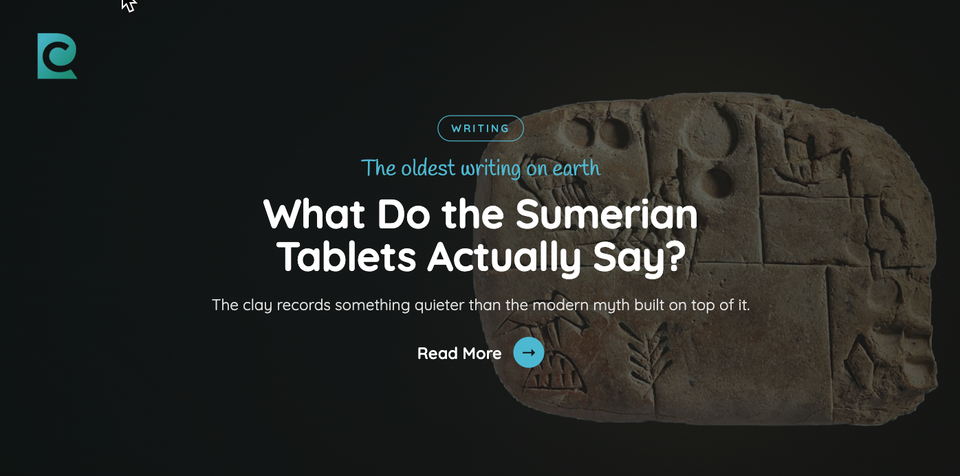
The oldest writing on earth has become the centre of a modern myth. Here is what the clay really records, and where the popular story departs from it.
Before the Bible, before the Gita, before almost any story we still tell, people in southern Mesopotamia pressed reed styluses into wet clay and left us the first written words humanity ever kept. Those tablets are real, and they are astonishing. They are also, in our time, the subject of a story that the clay itself does not tell.
So it is worth separating the two. What the Sumerians actually wrote is remarkable enough. What a modern author added in the 1970s is a different thing, and honesty asks us to hold them apart.
The question this piece answers
What do the Sumerian tablets genuinely contain, and how much of the popular "ancient astronaut" version comes from the tablets themselves?
The quick answer. The Sumerian tablets are humanity's oldest written records, from around 3200 BCE onward, containing law, trade, hymns, and the world's first great myths, including the Epic of Gilgamesh and creation stories featuring gods called the Anunnaki. The claim that the Anunnaki were extraterrestrials who engineered humans comes from the modern writer Zecharia Sitchin, not from the tablets, and Assyriologists reject it as mistranslation.
Why this matters now
The Sumerian material has become the anchor of a whole modern mythology, retold across countless videos and books as secret history: aliens, genetic engineering, a hidden planet. It is a powerful story, and it borrows its authority from the genuine awe these tablets deserve.
That is exactly why the distinction matters. When we treat a modern interpretation as ancient fact, we lose two things at once: the real wonder of what Sumer actually achieved, and our own footing in what is true. Reading the tablets honestly is a small act of the discernment this whole series is about, holding wonder and accuracy in the same hand.
The one idea worth keeping
The Sumerian tablets are the seed of a pattern that runs through every tradition that followed: unity dividing into experience, and the long human effort to return to it consciously.
Strip away the later embellishments and the core is genuinely foundational. Here, in the oldest writing we have, are the first recorded attempts to ask where we came from, why we suffer, and how to live well. Every wisdom tradition in this series is, in some sense, a later verse of a song these scribes began.
What the tablets actually contain
Named plainly, here is what the clay records.
The first writing itself. Cuneiform, developed in Sumer from around 3200 BCE, is among the earliest writing systems on earth. Much of it is startlingly ordinary: receipts, inventories, contracts, the accounting of a working civilisation. The everyday origin of writing is its own quiet marvel.
The world's first literature. The Epic of Gilgamesh, a king's search for meaning in the face of death, is among the oldest stories ever written and still moves readers today. It contains a flood narrative that predates and parallels the one in Genesis, which tells us these traditions were in deep conversation.
Creation myths and the gods. Sumerian and later Babylonian texts, including the Enûma Eliš, describe gods bringing order out of chaos and shaping humanity. Among these gods are the Anunnaki, and deities including Anu (the sky father), Enki (associated with water, wisdom, and craft), and Enlil (associated with air, storm, and authority). In the actual texts, these are gods of a divine assembly, not spacecraft crews.
Where the popular story departs from the clay
Here is the honest fork, and it deserves to be named clearly.
The modern idea that the Anunnaki were extraterrestrials from a planet called Nibiru, who genetically engineered humans as a labour force, comes almost entirely from Zecharia Sitchin and his Earth Chronicles series, beginning with The 12th Planet in 1976. It is a twentieth-century interpretation, not an ancient teaching.
Assyriologists, the scholars who actually read cuneiform, reject it firmly. The word Anunnaki means roughly "offspring of Anu," gods of princely descent, with no extraterrestrial sense in the original language. Specialists have shown that the terms Sitchin translated as spacecraft and distant planets carry no such meaning in the Mesopotamian dictionaries the scribes themselves left us. This is not a subtle scholarly quibble. The alien narrative is simply not in the tablets.
None of this diminishes the tablets. It relocates the wonder to where it actually belongs: in a real civilisation that invented writing and asked the first great questions.
How to actually use this
Read the Sumerian material as origin, not as secret history.
When you meet the tablets, hold two things. First, genuine reverence: this is where the written human story begins, and its questions are still ours. Second, clear discernment: notice where a source is reporting the ancient text and where it is adding a modern layer. A useful habit is simply to ask, of any striking claim, is this in the tablet, or is this someone's reading of the tablet? That single question protects both your wonder and your accuracy.
Then let the deeper pattern speak. Beneath the specifics, the Sumerian creation stories describe the same movement this series traces: an original wholeness, a division into the world of experience, and the human task of finding the way back.
The evidence, named and dated
This is history and mythology, so the sourcing is the texts and the scholarship, named and dated.
- The cuneiform tablets themselves (from c. 3200 BCE). The primary record, including the Epic of Gilgamesh and the Babylonian Enûma Eliš. Held and translated in major collections such as the British Museum, and rendered in standard scholarly editions.
- Mainstream Assyriology. The academic consensus, represented by specialists such as the biblical-scholar and Semitic-languages researcher Michael S. Heiser and many university Sumerologists, holds that Sitchin's translations are unsupported by the Mesopotamian lexicons and that his Anunnaki-as-aliens narrative appears nowhere in the actual literature.
- Zecharia Sitchin, The 12th Planet (1976) and the Earth Chronicles. Named here as the actual source of the popular ancient-astronaut reading, so that it can be recognised as a modern work of interpretation rather than an ancient teaching.
- Wisdom-keeper lens: the tablets as first verse. Across traditions, the Sumerian questions recur, where we came from, why we divide, how we return. Offered as thematic continuity, not as a claim that later traditions descend directly from Sumer.
Where a claim is genuinely ancient, it is named as such. Where it is modern interpretation, that is said plainly.
Where this does not apply
Three honest caveats.
Rejecting Sitchin's aliens is not the same as dismissing the myths. The Sumerian gods and their stories are a serious, meaningful body of literature. Reading them symbolically, as this series does, is legitimate. Reading them as documented alien history is not.
Symbolic reading has its own limits. To say the Anunnaki myth can mean something for us is not to say it happened. Meaning and historical fact are different claims, and honesty keeps them separate.
And this piece is an overview, not a translation. Sumerology is a deep field. If a specific tablet or line matters to you, go to a scholarly translation rather than a summary, this one included.
Who you become when you hold this
You become someone who can feel wonder without surrendering discernment.
You can stand before the oldest writing on earth genuinely moved, and still ask, calmly, which part of what you are being told is in the clay and which part was added later. You stop needing a story to be secret or extraterrestrial to find it astonishing. The truth, that ordinary humans four thousand years before us invented writing and asked the deepest questions, turns out to be wonder enough.
The spine, in five lines
- The Sumerian tablets are humanity's oldest writing, from around 3200 BCE, and hold the first law, literature, and myth.
- They include the Epic of Gilgamesh and creation stories with gods called the Anunnaki, Anu, Enki, and Enlil.
- In the actual texts these are gods of a divine assembly, not extraterrestrials.
- The alien and genetic-engineering reading comes from Zecharia Sitchin in the 1970s and is rejected by Assyriologists.
- Read the tablets with wonder and discernment together: real awe, honest sourcing.
One step for the next 24 hours
Read a few genuine lines from the Epic of Gilgamesh, from a reputable translation, not a summary of what someone says it "really" means. Notice that a story written over four thousand years ago, about loss and the fear of death, still reaches you. That direct contact with the oldest human writing is worth more than any secret-history video.
Questions people ask
What are the Sumerian tablets?
They are clay tablets inscribed in cuneiform, the writing system developed in Sumer from around 3200 BCE, making them among the oldest written records on earth. They contain everyday accounts, laws, hymns, and the first great works of literature and myth, including the Epic of Gilgamesh and Mesopotamian creation stories.
Who were the Anunnaki?
In the actual Sumerian and Babylonian texts, the Anunnaki are a group of gods, a divine assembly, with the name meaning roughly "offspring of Anu," the sky god. They are deities of Mesopotamian religion. The popular idea that they were extraterrestrials is a modern interpretation, not part of the ancient texts.
Did the Sumerian tablets say aliens created humans?
No. That claim comes from the modern writer Zecharia Sitchin, beginning in 1976, not from the tablets. Assyriologists, the scholars who read cuneiform, have shown his translations are unsupported and that no such alien or genetic-engineering narrative appears in the actual Sumerian literature.
Do the Sumerian tablets predate the Bible?
Yes. Sumerian writing began around 3200 BCE, well before the Hebrew Bible was composed. Some Sumerian and Babylonian stories, such as a great flood narrative, parallel later biblical accounts, which shows these traditions shared and reworked common material over long spans of time.
Is the Epic of Gilgamesh real?
Yes. The Epic of Gilgamesh is a genuine ancient poem, among the oldest surviving works of literature, preserved on cuneiform tablets. It follows a king confronting friendship, loss, and mortality, and includes a flood story. It is historically real as a text, though it is a work of myth and literature, not a documentary record.
The question the tablets hand back
We reach for secret histories because the true one can feel too plain. Yet the plain truth here is extraordinary: four thousand years ago, ordinary people learned to write, and the first things they reached for were accounts, and then the oldest questions of all.
So the tablets hand the question back to us. Can we let the truth be wonderful enough?
A closing thought. We do not need the story to be secret for it to be sacred. The oldest writing on earth asks what we still ask, where we came from and how to live well. Meet it with awe and with honesty, both at once. That is the whole practice. No rush.
Last updated: July 2026.