
Becoming Dangerous, and Less Interested in Harm
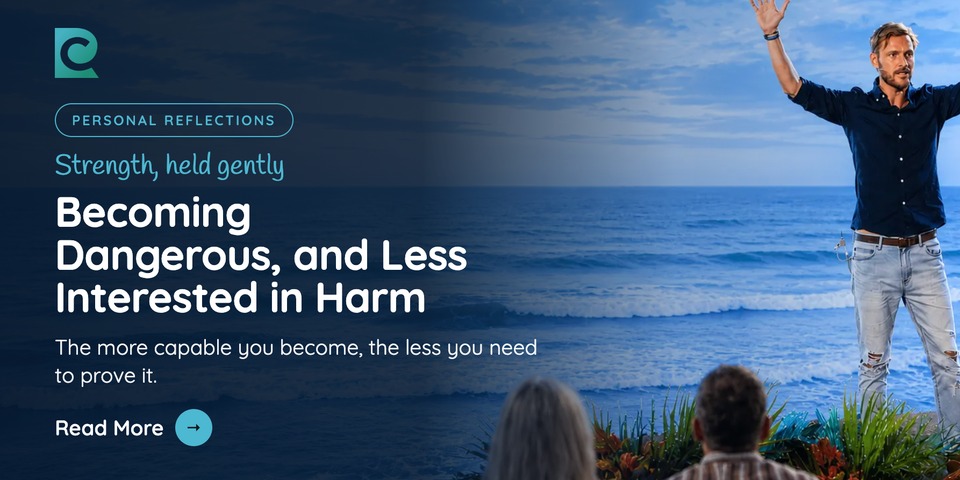
What the mat, the ocean and nine months of stillness taught me about strength.
"You have to stay calm when you are in bad situations."
Rickson Gracie, Breathe: A Life in Flow, 2021
Martial arts has taught me more about strength than almost anything else in my life.
Not physical strength.
Inner strength.
The strength to remain calm when someone else becomes reactive.
The strength to breathe when pressure increases.
The strength to listen when my ego wants to defend.
The strength to walk away when I know I have the ability to fight.
The strength to hold my ground without needing to prove I am standing.
The ultimate aim of karate lies not in victory or defeat, but in "the perfection of the character of its participants."
Gichin Funakoshi, second of the Twenty Precepts, set out in Karate-Dō Kyōhan, 1935
What the mat exposes
Jiu Jitsu has a funny way of exposing a man.
I get tired.
I get uncomfortable.
I get trapped.
My ego gets tested.
And if I panic, I waste energy.
If I become emotional, I stop seeing clearly.
If I try to overpower everything, eventually I meet someone stronger.
So I learned another way.
Breathe.
Create space.
Stay patient.
Feel what is happening.
Stop fighting force with force.
Wait.
Move when the opening appears.
The breath is not a metaphor here. It is the mechanism. Heart rate rises on the inhale and falls on the exhale, and the slowing happens through the vagus nerve on the way out. Slow the exhale and the brake comes on. Patanjali linked the out-breath to steadiness of mind roughly two thousand years before anyone described why it worked. The principle is what holds. Not a number, and not a perfect rhythm, because the rate that suits me today may not be the rate that suits me next week.
There is something deeply philosophical about learning how to become dangerous, while simultaneously becoming less interested in causing harm.
The deeper lesson is restraint.
Funakoshi wrote that the man who genuinely understands the art is never easily drawn into a fight, and that an ordinary person may have occasion to use it once in a lifetime, or never.
I developed the ability to fight so I no longer needed to prove I was a fighter.
I developed strength so I no longer needed to perform strength.
I developed confidence so I no longer needed everyone else to recognise it.
The strongest person in the room is rarely the loudest.
Sometimes he is the calmest.
He knows what he is capable of.
He also knows every action carries consequences.
So he chooses his actions carefully.
Off the mats
That lesson has followed me far beyond the mats.
Over the last year, life gave me plenty of opportunities to react.
To defend.
To explain.
To prove.
To fight.
To set a record straight that only I was keeping.
I learned something far more valuable.
Not every invitation deserves a response.
Not every misunderstanding requires correction.
Not every attack requires retaliation.
Not every battle deserves my energy.
Sometimes the greatest expression of power is remaining centred enough to choose my response.
Wu wei.
Action without unnecessary force.
Not passivity.
Not weakness.
Not avoidance.
Alignment.
Laozi puts it as knowing the strong and keeping to the yielding. Returning to the uncarved block, whose original qualities are destroyed the moment it is carved into something useful.
Knowing when to move and when to remain still.
Knowing when to speak and when my actions will eventually speak louder.
Knowing when to fight for something and when fighting only keeps me connected to something I have already outgrown.
My actions represent my character.
Someone else's actions represent theirs.
Karma, as I have come to understand it, is not punishment arriving later. It is repetition. The thing I keep doing without noticing I am doing it.
I do not need to absorb another person's chaos to prove my strength.
I do not need to enter their emotional state.
I do not need to inherit their drama.
I bring my 100%.
I take responsibility for my choices, my impact, my mistakes, my repair and my growth.
Then I release what belongs to others.
The Gita holds the same shape and adds a warning I need. Full commitment to the action, released claim on the fruit.
And Arjuna's temptation, the one the whole teaching exists to refuse, is withdrawal. Stepping back from the field because the field is painful. Releasing the outcome is not the same as leaving.
What the ocean taught
Surfing taught me another side of the same lesson.
I cannot dominate the ocean.
I cannot negotiate with a wave.
I cannot tell her when to arrive, how large to become or where to break.
I learned to watch.
To listen.
To wait.
To respect forces larger than myself.
Some waves are mine.
Some are not.
Some waves give me the ride of my life.
Others humble me within seconds.
I paddle back out either way.
That is resilience.
The ocean taught me patience without stagnation.
Surrender without weakness.
Flow without losing direction.
Power without control.
Surfing became meditation in motion.
There is nowhere else to be when I am dropping into a wave.
No past.
No future.
No phone.
No audience.
No performance.
Body.
Breath.
Board.
Ocean.
Presence.
I started seeing the ocean as another teacher of the feminine essence of life.
Wild.
Creative.
Beautiful.
Unpredictable.
Sometimes peaceful.
Sometimes chaotic.
The lesson was never to master her by controlling her.
The lesson was to become skilled enough, centred enough and present enough to dance with her.
Ride with life rather than against life.
What the stillness returned
Nine months + of celibacy deepened the same remembrance.
Celibacy, for me, became far more than removing sex or romantic intimacy.
I removed noise.
I removed unnecessary entanglements.
I reduced distractions.
I spent more time in nature.
I surfed.
I trained.
I breathed.
I sat with myself.
I allowed the muddy pond to settle.
And when the water became still, I started seeing more clearly what belonged to me and what I had been carrying from other people, environments and old decisions.
I remembered the qualities I want my life to represent.
Grounded confidence.
Vision without superiority.
Individuality without separation.
Authentic expression without needing applause.
Responsibility without self-punishment.
Relationships built around mutual empowerment.
Compassion with boundaries.
Celebrating other people's victories.
Humble strength.
I also remembered something about my own nature.
When I love, or when I commit, I follow it through to the end.
A win teaches.
A lesson transforms.
Both hold value.
I am grateful for both.
Some of the greatest lessons of my life arrived disguised as experiences I would never have consciously chosen.
Loss taught me presence.
Grief taught me feeling.
Betrayal taught me discernment.
Conflict taught me restraint.
Love taught me surrender.
Martial arts taught me calm.
Surfing taught me flow.
Stillness taught me what was mine.
Celibacy taught me how to romanticise life again.
And all of them taught me gratitude.
Not gratitude because every experience felt good.
Gratitude because every experience showed me something.
What I want now
The last year has been less about becoming someone new and more about remembering who I am when the noise disappears.
I no longer want strength built around armour.
I want strength with an open heart.
I no longer want confidence built around being right.
I want confidence grounded in character.
I no longer want peace dependent on everyone around me behaving peacefully.
I want the kind of peace I carry into the storm.
Perhaps that is one of the deeper teachings of martial arts.
The goal is not becoming someone nobody dares challenge.
The goal is becoming someone who does not lose himself when challenged.
To hold power without abusing it.
To hold boundaries without hatred.
To see darkness without becoming consumed by it.
To meet chaos without becoming chaos.
To remain compassionate without abandoning discernment.
To know when the highest expression of strength is action.
And when the highest expression of strength is simply walking away.
Be the lighthouse
A lighthouse does not chase ships.
It does not enter every storm trying to calm the ocean.
It does not argue with darkness.
It stands.
Grounded.
Consistent.
Visible.
And when storms damage the lighthouse, it gets repaired.
Because repair is part of strength too.
Growth has seasons.
Expansion has seasons.
Rest has seasons.
Grief has seasons.
Love has seasons.
Life has waves.
The work is not controlling every season or wave.
The work is learning who I choose to be inside them.
That is what martial arts keeps teaching me.
That is what surfing keeps teaching me.
That is what this season of stillness has helped me remember.
True strength does not need to announce itself.
True power does not need to dominate.
True confidence does not need an audience.
And true peace is not the absence of storms.
It is knowing how to stand within one without abandoning myself.
Calm.
Grounded.
Humble.
Strong.
Then, when the next wave arrives.
Ride.
One question I am still sitting with, and the one I would leave you with.
Where am I still proving a strength I already have?
Notes on sources
Rickson Gracie, Breathe: A Life in Flow, with Peter Maguire, Dey Street Books, 2021. The line sits inside a longer passage on applying Jiu Jitsu principles to every endeavour, which also includes moving at the right time, defending critical areas, and not attacking an opponent's strongpoints.
Gichin Funakoshi, second of the Niju Kun, given in Karate-Dō Kyōhan, 1935. The surrounding passage in Kyōhan makes the point about the trained man rarely being drawn into a fight.
Miyamoto Musashi is deliberately not cited here. "The ultimate aim of martial arts is not having to use them" is widely attributed to him and does not appear in Go Rin No Sho. It traces to Stephen F. Kaufman's 1975 interpretation, published as an interpretation rather than a translation, and has been flagged as a misattribution in the Musashi listings it circulates through. The primary Musashi runs the other way. Funakoshi holds the sentiment and can be sourced.
Laozi, Tao Te Ching, verse 28, on knowing the strong and keeping to the yielding, and the uncarved block. Wu wei used in its accurate sense of aligned action, not inaction.
Bhagavad Gita, karma yoga. Full commitment to the action with the claim on the fruit released. Arjuna's temptation is withdrawal and the teaching refuses it.
Breath and the vagal brake. Respiratory sinus arrhythmia, with the parasympathetic brake applied on the exhale. Slow-paced breathing near 0.1 Hz brings cardiac oscillations into phase with respiration. Systematic review, Neuroscience and Biobehavioral Reviews, 2022, building on Vaschillo and Lehrer. Resonance frequency is not stable between test and retest, which is why the principle is taught and not a fixed number.