
Coherence Is the New Power
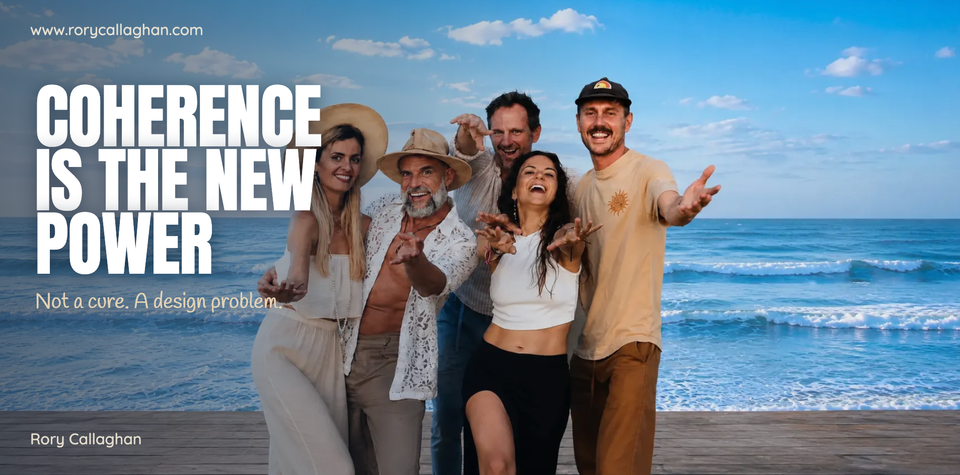
I treated ten thousand patients before his own body stopped. What he found on the other side was not a cure. It was a design problem.
I was thirteen when I learned that hope speaks in squeezes, not speeches.
My father was in a coma. He was an artist, gifted and haunted, and by then he had been living on the streets of the same city I grew up in. I sat beside the bed and held his hand and asked for a sign. Any sign. And his fingers closed around mine.
That was it. No words. Just pressure, and warmth, and the knowledge that something was still in there.
I have built my whole working life on that moment, though it took me twenty years to understand why.
The contradiction I could see from the inside
I did what the odds said I would not do. Two degrees. A Master of Physiotherapy. A scholarship, elite athletes on my table, a clinic, a career. Three of the four siblings in my father's generation became alcoholics. Arriving both successful and whole was never the likely outcome.
And then, at twenty-six, I stopped.
Not dramatically. There was no collapse in a corridor, no ambulance. Just a slow greying out of everything that used to have colour. I was the one holding everyone, and there was no one holding me.
Here is what I could not unsee once I saw it. The people trained to restore health were themselves the most depleted people in the building. We treated disease brilliantly. We almost never built health. Patients came back with the same conditions, and we called it management. I was good at my job, and my job was downstream of the problem.
The uncomfortable part was not that the system was broken. It was that by standing inside it, I was helping it stay that way.
The question that changed the terrain
A friend asked me something simple. What is your ideal day?
I could not answer. I had a career plan, a savings plan, a five-year plan. I had no idea what a good Tuesday looked like.
That question broke something open. Within a year I had left the stable path and started travelling, forty countries eventually, sitting with indigenous elders, studying the places where people reliably live long and live well. I was not looking for a protocol. I was looking for the conditions.
What I found was consistent enough to be boring. In the communities where health was the norm rather than the achievement, nobody was optimising anything. They were simply living inside environments that made wellbeing the path of least resistance. Movement was built into the day. Food was shared. Purpose was assumed. Belonging was not a benefit, it was the water.
Health was not a discipline there. It was a design.
Burnout is not a badge, it is a design flaw
This is the part I now say in every room I stand in, and it is the reason I write it here.
Burnout is treated almost everywhere as a personal failure. Not enough resilience. Not enough boundaries. Not enough grit. So we hand people breathing exercises and send them back into the same architecture that emptied them.
I do not believe most people need fixing. I believe most people are running coherent operating systems inside incoherent environments, and the environment wins. A broken system will always beat a good person, unless we build a better one.
The evidence supports the reframe more strongly than most leaders realise.
The lifestyle-medicine literature is now unambiguous about how much of chronic disease is conditional rather than fated. Katz and colleagues, writing in the American Journal of Health Promotion in 2018, made the case that the daily patterns of eating, moving, sleeping and connecting account for the majority of the chronic disease burden we currently treat pharmacologically (Katz, D.L., et al., 2018, 32(6), 1452 to 1458). The EPIC-Potsdam cohort found something similar from the other direction, tracking how a small cluster of ordinary habits sharply reduced the incidence of major chronic disease across thousands of adults (Ford, E.S., et al., 2009, Archives of Internal Medicine, 169(15), 1355 to 1362).
And then there is the finding that should reorganise every workplace on earth. Holt-Lunstad and colleagues, reviewing the research on loneliness and social isolation, found them to be mortality risk factors on a scale comparable with the ones we legislate against (Perspectives on Psychological Science, 2015, 10(2), 227 to 237). Isolation is not a mood. It is a clinical variable.
We have built enormous economies on top of environments that reliably produce depletion and disconnection, and then we have sold people supplements to survive them.
What coherence actually means
Coherence is a physiological word before it is a philosophical one. It describes a system whose parts are working with each other rather than against each other. A nervous system at rest is coherent. A person operating from safety rather than threat makes different decisions than one operating from urgency, and they make them for years rather than months.
Most leaders I work with have never had the problem of insufficient drive. They have the opposite problem. They have been rewarded for so long for pushing that they have lost the ability to sense when the pushing has stopped serving anything.
So when I am invited to open an event, I do not add energy to the room. I settle it first. Most speakers arrive to lift a crowd. I have come to believe a settled room is the only one that can actually build from what it hears. Coherence is felt before it is understood.
Viktor Frankl, writing out of the worst environment a human being has ever been asked to survive, held that meaning comes before motivation, not after it (Man's Search for Meaning, Beacon Press, 1959). Get the meaning right and the discipline stops needing to be manufactured. I have watched that hold true in boardrooms and in clinics and in my own house.
Thich Nhat Hanh put the other half of it plainly. We are here, he wrote, to wake up from the illusion of our separateness. Every serious finding about isolation and mortality is a scientific restatement of a thing the contemplative traditions have said for two thousand years.
The ripple, and why it is not sentimental
I work with a simple sequence. Self, then household, then team, then community, then enterprise, then nation.
It is not a metaphor. It is the actual order in which change propagates and the actual order in which it fails. I have never once seen a regulated organisation built by a dysregulated founder. I have never seen a culture of care emerge from a leadership team that quietly punishes rest.
We do not pour from an empty cup. I would go further. I do not think we are meant to be cups at all. My mother raised us on very little and gave from what looked from the outside like emptiness, and turned out to be a well. A cup is a fixed quantity that runs out. A well is connected to a source. The work is not to ration what we have. It is to reconnect to what replenishes.
That is what I mean by ME, then WE, then ONE. Fill your own well, serve from the overflow into your household and your team, and let the ripple find the edges you will never personally reach.
Jane Goodall has spent decades saying that the real threat to our future is not any single crisis but apathy, the quiet belief that what one person does could not possibly matter. I have found the opposite to be true at close range. The most contagious thing in any organisation is a regulated person.
Where I would begin
If I were sitting across from you with a coffee, I would not give you a protocol. I would ask what your ideal day looks like, and I would wait, because most capable people cannot answer that question either.
Then I would suggest one percent. Not a transformation. One small return, repeated. Sunlight before screens. A meal eaten with someone. A walk without a phone. Whatever is closest to hand and hardest to argue with.
Health has never been about fixing what is broken in us. It is about nourishing what was already whole and has simply gone unwatered for a while.
The tree does not apologise for the storms that shaped it. It grows anyway, gives shelter anyway, and drops seeds for forests it will never stand in.
My father died without ever knowing what his life would go on to build in mine. He gave me the wound and, without meaning to, the work. The addiction ends with me. That is not a triumph. It is just a decision, made once, and then made again the next morning.
Somewhere in this there is a hand you could hold. A team, a household, a person waiting to feel that something is still in there.
You do not have to change your life this week.
The door is open. There is no rush.
Rory Callaghan is a Wellness Architect and the author of the Amazon bestseller SelfCare: Lifestyle Medicine for the People. A Master of Physiotherapy who treated more than ten thousand patients before turning to prevention, he has mentored over five hundred entrepreneurs across forty countries and is a producer and cast curator on The New Woo, a documentary on the future of wellbeing.
Join the community here https://www.skool.com/cocreator/about