
Character Before Capacity
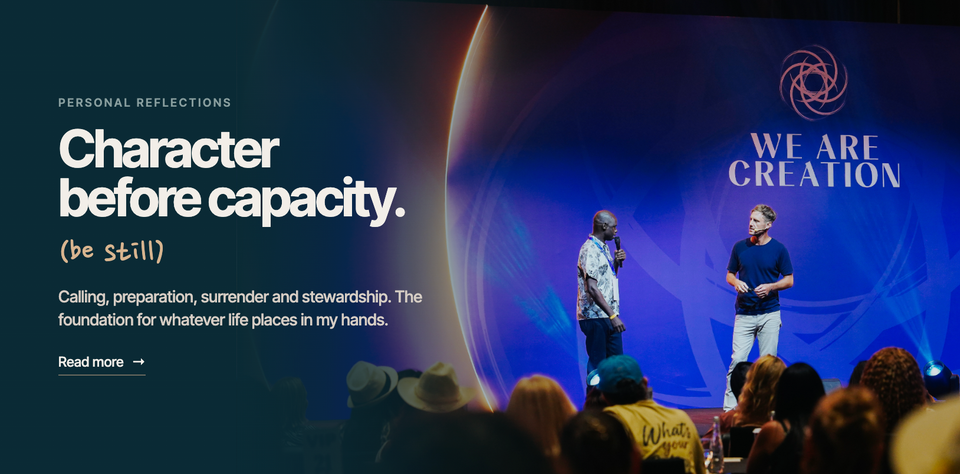
The biblical pattern of calling, preparation, surrender and stewardship. Be still, the battle isn't yours to carry alone. Not proof of future greatness, but the foundation for carrying whatever life places in my hands.
A personal reflection.
There comes a moment when life asks us to live what we say we believe.
Not when everything is easy. When the familiar structures disappear, the things we relied on stop providing security, and we're invited to discover what remains.
I see that pattern again and again in the great spiritual stories. Joseph carried a dream long before he carried authority. David was anointed long before he became king. Different lives, different circumstances, and a recurring invitation:
Let your inner character become capable of carrying your outer responsibility.
The question this piece answers
Why does character matter more than capacity, and what does the Bible's pattern of preparation actually teach?
The quick answer. Many biblical stories show a person glimpsing a calling, being stripped of what defined them, being refined through hardship, learning to surrender control without abandoning responsibility, and finally stewarding influence in service of others. It isn't a guaranteed formula, and it isn't proof that every loss is a test or a promise. It's a pattern that points to one thing: develop the character to carry responsibility without being consumed or corrupted by it.
What I experienced
The pattern I keep seeing.
What each story illuminates.
- Joseph: betrayed, enslaved, imprisoned, then entrusted with authority. Integrity and stewardship through changing circumstances.
- Moses: exile, calling, and leadership through the wilderness. Humility and responsibility.
- David: anointed before he was king, then endured danger, made grave mistakes and faced consequences. Character needs courage, restraint, repentance and accountability.
- Ruth: widowhood, displacement and loyalty to Naomi. Faithfulness shown through action.
- Esther: a consequential choice with personal risk. Courage in service of others.
- Paul: a radical change of conviction, then hardship and service. Transformation and perseverance.
- Nebuchadnezzar: pride, humiliation and restoration in Daniel 4. Authority without humility becomes destructive.
- Jehoshaphat: facing overwhelming danger and turning to prayer. Trust in the face of uncertainty.
The contrast isn't between perfect and unprepared people. David wasn't exempt from serious moral failure because he'd been prepared. Saul's story is about disobedience and the misuse of authority, not simply being promoted too early. The real difference is how people respond to power, correction, responsibility and their own limits.
What I learned
Surrender isn't passivity. Jehoshaphat's story moves me most. Facing a coalition he couldn't defeat, he admits he doesn't know what to do and turns his eyes toward God. But he doesn't simply stop. He gathers the people, prays, listens, takes counsel, appoints singers, and leads them into the situation. He lets go of the illusion of total control without letting go of his responsibility to act.
- Surrender isn't abandoning agency.
- Faith isn't refusing to plan.
- Stillness isn't avoiding hard conversations.
- Trust isn't ignoring reality.
Be still, and the meaning of raphah. In Psalm 46:10, "be still, and know that I am God," the Hebrew verb is raphah. It can mean to let go, to relax, to go slack, to cease. The psalm around it is full of nations in turmoil and conflict, so it reads naturally as cease striving, stop fighting, and recognise who is sovereign. Some scholars read the command as spoken to the warring nations, not only to the faithful. And the verb doesn't literally say "drop what you're holding"; that's an application, not a translation. But the heart of it holds: stillness isn't only the absence of movement. It can be the end of unnecessary struggle. It isn't a universal instruction to stop acting.
Joshua: the promise came before the walls fell. In Joshua 6, the promise is given first ("I have given Jericho into your hand"). And the people still had to walk, day after day, without seeing the outcome. Promise and obedience sit together. Trust isn't passivity. It shapes how I move.
Three expressions of trust.
I can read my own life through this, honestly. My early calling was toward healing. Burnout challenged the idea that professional success meant living well. Entrepreneurship brought freedom, and new responsibility. Writing SelfCare turned experience into something others could use. Walking away from a vision that conflicted with my values tested my attachment to what I'd built. And now I'm learning to receive and enjoy the life I've created, not keep proving my worth through what I give.
None of that proves God arranged a particular test. The honest difference is between saying "this happened because I'm destined for something greater" and "whatever the cause, I can choose to become wiser, more loving and more responsible through how I respond." The second keeps both faith and humility.
The wisdom I'd pass on
Be still. The battle isn't mine to carry alone. There comes a moment when I realise I've been fighting battles I was never meant to carry the way I've been carrying them. Fighting to be understood. To be chosen. To preserve a vision. To prove my worth. To make someone see what I see. To hold together something that needs more than one person's participation. And somewhere in the striving, I lose my centre. I forget to breathe, to nourish myself, to see the life already in front of me.
Then a quieter invitation arrives. Be still. Not because nothing matters. Because not everything requires a fight. Not because I'm powerless. Because there's a difference between using my power wisely and exhausting myself trying to control what belongs to someone else.
I'm responsible for my alignment, my character, my choices and my actions. I'm not responsible for controlling every outcome.
- I can tell the truth. I can't force someone to receive it.
- I can love. I can't force someone to reciprocate.
- I can invite. I can't force someone to choose.
- I can build something beautiful. I can't guarantee it unfolds as I imagined.
- I can act with integrity. I can't control the stories other people tell.
- I can plant seeds. I can't command every tree to grow.
That's where surrender begins. Not in giving up. In releasing the illusion that my effort has to hold the whole world together. Surrender isn't a failure of strength. Sometimes it's strength finally becoming wise.
Be still. Not forever. Not in avoidance. Not in helplessness. But long enough to remember who I am, what matters, and what's actually mine to do. Then rise, and live, and love, and create, and trust.
Measure yourself by what you can carry without losing yourself. Influence without integrity becomes exploitation. Freedom without responsibility becomes carelessness. Prosperity without stewardship becomes greed. Leadership without humility becomes domination. And purpose without nourishment becomes another form of self-abandonment. The real measure is how I treat people when I have power, how I behave when I lose it, and how I use my gifts when nobody is applauding.
Ask the "before" questions.
- Before asking what I want to build, I ask who I'm becoming through the way I build it.
- Before asking for more influence, I ask whether I'm stewarding the influence I already have.
- Before asking for more abundance, I ask how I'm caring for what's already entrusted to me.
- Before asking for more love, I ask whether I'm living the honesty and reciprocity I value.
- Before asking for a greater mission, I ask whether I'm nourishing the life already in front of me.
Do yours. Release the rest. Do what is mine to do. Release what is not mine to control. Remain faithful to my character, whatever the outcome.
Hold a prayer for every season. If greater influence comes, may I carry it wisely. If a quieter life comes, may I see its beauty. If abundance comes, may I share it responsibly. If uncertainty comes, may I stay grounded. If love comes, may I receive it fully. And if another threshold appears, may I remember I don't need to lose myself to move through it.
God doesn't need me to perform greatness. My responsibility is to practise goodness, integrity and love with what I've been given.
Where this does not reach
Preparation isn't proof of future status. Some faithful people become leaders. Some serve quietly. Some never receive recognition. Their lives aren't less meaningful.
Not every loss is a lesson. Sometimes life is simply hard, people make hurtful choices, or systems fail. I don't need to read every loss as punishment or every delay as a promise.
Faith doesn't guarantee outcomes. Joshua 6 also describes the violent conquest of a city. It shouldn't be turned into a promise that faith makes every desired result inevitable.
Traditions don't always mean the same thing. Biblical surrender and the Daoist idea of wu wei, acting without unnecessary force, both speak to me. They come from different worldviews, and I hold them side by side rather than treating them as one teaching.
The evidence, named and dated
- Scripture, by reference: Joseph (Genesis 37 to 50); Moses (Exodus); David's anointing (1 Samuel 16) and his failure and repentance (2 Samuel 11 to 12); the Book of Ruth; Esther (Esther 4); Paul's conversion (Acts 9); Nebuchadnezzar (Daniel 4); Jehoshaphat (2 Chronicles 20); Joshua and Jericho (Joshua 6, and Hebrews 11:30); Psalm 46, including verse 10 and the Hebrew verb raphah (to let go, relax, cease).
- Interpretation, and labelled: the five-stage pattern is my reading of recurring themes in these stories, held as a spiritual framework, not a universal formula or a claim about how God works in every life.
The shift
I used to wonder what I was being prepared for.
Now I ask whether I have the character to carry what's already in my hands, and the wisdom to know when to put it down.
One thing, for the next day
Pick one "before" question from the list. Answer it honestly about one area of your life.
Then do the one thing that's yours to do there.
The spine of it
Let inner character carry outer responsibility. The glimpse, the stripping, the refinement, the surrender, the stewardship. Joseph, Moses, David, Ruth, Esther, Paul, Nebuchadnezzar, Jehoshaphat. The difference is how people respond to power and limits. Surrender isn't passivity. Be still: cease striving. The promise comes before the walls fall, and we still walk. I'm responsible for my actions, not every outcome. Read your life honestly, not as destiny. Measure yourself by what you can carry without losing yourself. Ask the "before" questions. Do yours, release the rest. Preparation isn't proof of status.
Questions people ask
What does "character before capacity" mean? Developing the integrity, humility and resilience to handle responsibility before seeking more of it.
What does Jehoshaphat's story teach? That you can admit you don't know what to do, turn to faith, and still act responsibly. Surrender and action go together.
Does God test us through suffering? Many people understand hardship that way, but not every loss is a test or a promise of reward. What we can choose is how we respond.
What does "be still" in Psalm 46 mean? The Hebrew verb, raphah, can mean let go, relax or cease. In context, it's a call to cease striving and recognise God's sovereignty in turbulent times, not a command to stop acting.
What does "the battle is not yours" mean? In 2 Chronicles 20, it's the assurance given to Jehoshaphat. Applied to life, it means doing what's yours to do and releasing what you can't control.
Is preparation a guarantee of success? No. Faithful people end up in very different places, many of them quiet and unrecognised.
The highest expression of purpose isn't elevation above others. It's the capacity to stand alongside them, nourish life, and contribute what I can.
Character before capacity. Coherence before creation. Stewardship before scale.