
The Seven Thresholds of Elevation
From the glimpse of possibility to the embodiment of who we truly are. When elevation means becoming more whole, not more important.
A personal reflection.
There are seasons when we're shown what's possible.
The love. The freedom. The abundance. The connection. The purpose. The life we once dreamed of.
And then something changes. What felt certain becomes uncertain. What we thought would stay begins to fall away. The future we imagined stops unfolding to plan.
And life asks a deeper question.
Are we who we say we are, even when life no longer looks the way we hoped?
That's the threshold. Not punishment. Not proof that the universe is testing us. Not a guarantee that what we lost will return. An opportunity to find out whether our values are beliefs we hold when life is beautiful, or principles we live through every season.
The question this piece answers
What are the stages of growing through a major life change?
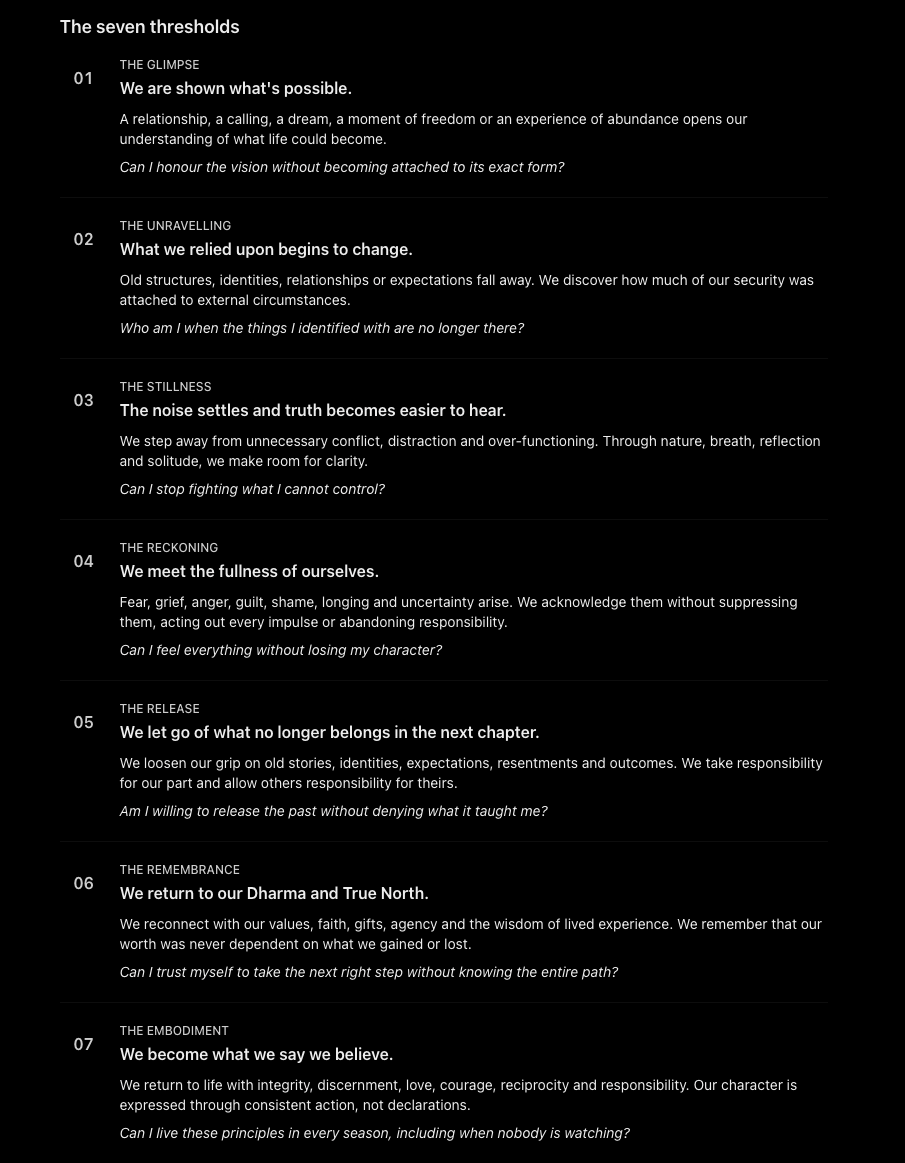
The quick answer. I see seven thresholds. The glimpse of what's possible. The unravelling of what we relied on. The stillness where truth gets easier to hear. The reckoning with everything we feel. The release of what's no longer ours to carry. The remembrance of our values and true north. And the embodiment, living what we know to be true. They don't always come in order, and we revisit them. Elevation, in the end, isn't a higher position. It's becoming more grounded, whole and free.
What I experienced
Sometimes life gives us a glimpse of everything we've wanted, and then circumstances change. I've lived that. And I've learned that the question isn't how to get it all back. It's whether I can remain loving when I'm hurting. Truthful when honesty is uncomfortable. Generous with less. Courageous when afraid. Peaceful in uncertainty. Discerning without becoming cynical. Open-hearted without abandoning myself. And willing to surrender an outcome without surrendering my values.
What I learned
The seven thresholds.
They aren't a ladder. People move through them in different orders, revisit them, or live several at once. They're a map, not a law.
The point isn't to avoid hard feelings. It's to develop the capacity to experience the fullness of being human without letting every emotion dictate my actions. To feel deeply. Respond consciously. Repair what's mine to repair. Release what's not mine to control. And stay open to love, joy, play and creation.
The wisdom I'd pass on
Redefine elevation. It doesn't have to mean more wealth, status or influence. Sometimes elevation is peace where there used to be chaos. Reciprocity where there used to be pursuit. Freedom where there used to be obligation. Sometimes the ultimate evidence of growth is that, when life offers something beautiful again, I no longer need to abandon myself to receive it.
Character is practised, not claimed. It isn't what we say in our highest moments. It's what we practise through every season.
Ask the greatest threshold question. Can I let go of who I thought I needed to be, so I can fully embody who I already know myself to be?
Carry the principles.
Coherence before creation. Character before capacity. Surrender without self-abandonment. Faith without denial. Love without possession. Purpose without performance.
Where this does not reach
Not every loss leads to growth. Some losses simply hurt, and that's allowed. Growth after hardship is common, but it isn't guaranteed or required.
This isn't a timeline. No one should feel behind for still being in the unravelling or the reckoning.
Some thresholds need professional support. If grief, fear or loss becomes overwhelming or persistent, a counsellor or doctor can help in ways a framework can't.
The evidence, named and dated
- William Bridges, Transitions: Making Sense of Life's Changes (1980). Bridges described change as moving through an ending, a "neutral zone" of uncertainty, and a new beginning. The unravelling, stillness and reckoning map closely onto his neutral zone.
- Tedeschi and Calhoun (1996), Journal of Traumatic Stress, introduced the Posttraumatic Growth Inventory. Their research found many people report positive change after hardship, such as deeper relationships, new possibilities and a changed sense of what matters. Limit: growth isn't universal, and self-reported growth doesn't always match measured change.
- Personal, and labelled: the seven thresholds are my own synthesis of spiritual and life principles, not a fixed biblical sequence or a universal law.
The shift
I used to think elevation meant rising higher.
Now I think it means becoming more grounded, more whole, and more able to receive.
One thing, for the next day
Read the seven thresholds. Notice which one you're standing in right now.
Answer its question honestly. Nothing else needed.
The spine of it
Life shows us what's possible, then changes. Are we who we say we are? The glimpse, the unravelling, the stillness, the reckoning, the release, the remembrance, the embodiment. Not a ladder; a map. Feel fully without letting feelings rule. Elevation is peace, reciprocity and freedom, not status. Character is practised, not claimed. Let go of who you thought you needed to be. Nothing to prove. Everything to embody.
Questions people ask
What are the stages of a major life transition? One way to see it: a glimpse of possibility, an unravelling, stillness, a reckoning with feelings, release, remembrance of your values, and finally embodiment. They don't always happen in order.
What is the "neutral zone" in a transition? William Bridges' term for the uncertain in-between time after an ending and before a new beginning.
Can people grow from hard experiences? Many do. Research on posttraumatic growth found people often report deeper relationships and new priorities after hardship, though growth isn't guaranteed.
What does elevation mean if not success? Being more grounded and free: more peace, more reciprocity, less obligation, and the ability to receive good things without abandoning yourself.
Perhaps elevation isn't always rising to a greater position. Perhaps it's becoming more grounded, more whole, more free, and more able to receive the life we've spent so long learning to create.
Nothing to prove. Everything to embody.