
Connection Is the Medicine
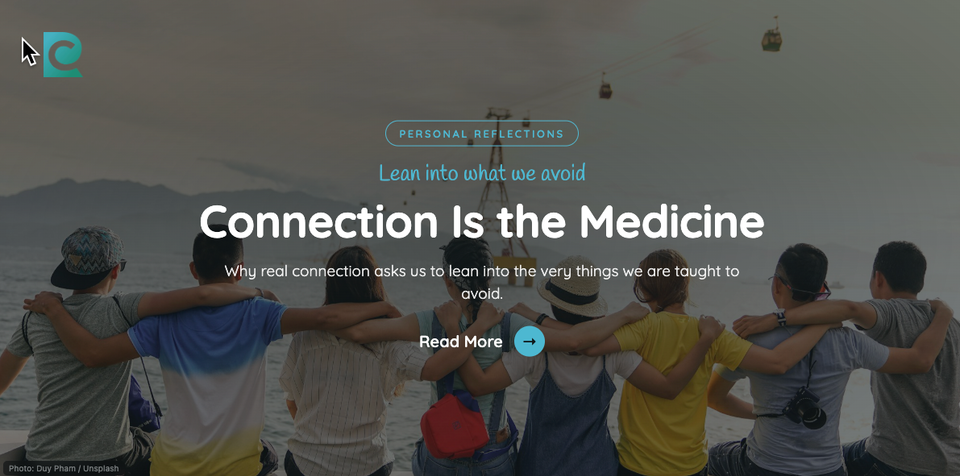
Why real connection asks us to lean into the very things we are taught to avoid
Last updated: 3 July 2026
Connection is one of the greatest medicines we have.
- It takes a village to raise a child.
- It takes community to help someone heal.
This is not sentiment. It is closer to a law of human biology, and we have somehow built a modern world that quietly works against it.
Because so much of modern life teaches isolation. Avoid the trigger. Avoid the conflict. Avoid the difficult conversation. Stay comfortable.
And a lot of it comes dressed as wellness. But growth rarely happens in isolation, and neither does healing.
Is connection really that important for our health?
It is one of the most underestimated forces in medicine, and the evidence is now overwhelming.
We treat it as a nice-to-have, a soft extra on top of diet and exercise. It is not. It is foundational.
The short answer
Connection is one of the strongest predictors of a long, healthy life, on par with major medical risk factors.
Strong social relationships significantly lower the risk of heart disease, stroke, dementia, depression, and early death, while loneliness measurably harms the body. But real connection is not just company.
It requires leaning into conflict, telling the truth, and repairing rupture, the very things we are taught to avoid.
Why this matters now
We are living through what the World Health Organization now calls a defining challenge of our time. Loneliness is not just an emotional weather system. It is a public health emergency, and the numbers are staggering.
And here is the painful irony. Much of the culture that promises to heal us teaches the exact opposite of what heals. Avoid your triggers. Cut off anyone difficult. Protect your peace by protecting yourself from other people. Stay comfortable. Some of that is wise boundary-setting. But a lot of it is avoidance wearing the costume of self-care, and it is quietly making the loneliness worse. We are more protected, and more alone, than ever.
The core insight: the people who love you tell you the truth
Here is what I have learned about who actually helps us grow.
The people who love us most are not the ones who tell us what we want to hear. They are the ones who love us enough to tell us the truth. They call us up, not call us out.
They hold space for our becoming. And they remind us of something we forget: we were never broken, and we never needed fixing.
That kind of love is not conflict-free. The strongest relationships are not the ones without rupture. They are the ones committed to repair. To honesty. To transparency. To choosing the connection over the ego, again and again. That commitment is the whole thing. Anyone can be close when it is easy. Connection is proven in the repair.
The real invitation: lean in or run
Every meaningful relationship eventually brings you to the same doorway. Something goes wrong. A truth needs saying. A rupture needs mending. And in that moment, you face a single question.
Will I lean in, or will I run? Will I choose fear, or will I choose truth?
Most of us were taught to read fear as a signal to lean out. To go silent. To treat conflict and hard truth as something to avoid. But it is actually an invitation, to have a voice, to express your needs, to be honest and transparent, with no half-truths and no deception. Leaning in is how connection deepens. Running is how it quietly dies.
And sometimes, even when you lean in fully, the path is no longer shared. Sometimes people grow together, and sometimes they grow apart.
Neither is wrong. The people who truly love you can step back and keep walking their own path without walking away in bitterness, and without judgment, because they have messed up too. The goal is not to cling. It is to stay honest all the way through, including the goodbye.
How to practise this today
The practice is to notice the moment you want to run, and lean in instead.
The next time fear tells you to go silent, avoid the conversation, or withdraw to stay comfortable, treat that fear as a signal pointing exactly where the growth is. Say the true thing, kindly. Express the need you would normally hide. Initiate the repair you have been avoiding. You do not have to do it perfectly. You just have to choose the connection over the comfort, once, and notice what it opens.
What the research says
This is lived truth, and here the science is exceptionally strong.
Connection is a longevity factor on par with the big ones. Research led by Julianne Holt-Lunstad found that strong social connection increases the odds of survival by roughly 50 percent, an effect size comparable to established risk factors like smoking. The Harvard Study of Adult Development, which has followed lives for over eighty years, reached a similar conclusion through its director Robert Waldinger: close relationships are the most consistent predictor of a long, healthy, happy life.
Loneliness is a measurable biological threat. In 2025 the World Health Organization reported that loneliness is linked to an estimated 871,000 deaths a year, roughly one hundred every hour, and that one in six people worldwide is affected. Loneliness is associated with a 29 percent higher risk of heart disease, a 32 percent higher risk of stroke, and a 50 percent higher risk of dementia, along with higher rates of depression and anxiety.
It works through the body, not just the mood. Researchers describe how chronic isolation dysregulates the stress system and immune function. As social genomics researcher Steve Cole puts it, loneliness acts almost like a fertilizer for other diseases, promoting the inflammation that drives conditions from heart disease to Alzheimer's. Connection, by contrast, lowers inflammation and supports immune resilience. The village is not a metaphor for health. It is a mechanism of it.
Where this does not apply
Two honest caveats.
First, "lean into conflict" does not mean tolerate harm. There is a real difference between the discomfort of a growthful hard conversation and the damage of an abusive or genuinely unsafe relationship. Leaning in assumes two people willing to be honest and repair. Where that willingness is absent, or where a relationship is harmful, the loving choice can be to walk away with compassion, not to keep leaning into something that only costs you. Boundaries are real, and some avoidance is wisdom.
Second, connection is not the same as never being alone. Solitude is nourishing and necessary, and this is not a call to fill every moment with people. The point is the quality and honesty of your bonds, not the quantity. Deep, truthful connection with a few is the medicine. Constant shallow company is not.
The shift
Here is who you become when this lands.
You stop treating fear as a stop sign and start reading it as a signpost. You stop avoiding the hard conversations that would actually free you. You become someone who can lean in, tell the truth, repair when needed, and walk away with compassion when the path is no longer shared.
And something shifts inside. When your values stay the same through every season, at the heights when you have everything you wanted, and in the depths when you are dysregulated and afraid, you stop repeating old patterns. You stop abandoning yourself. You become clearer, calmer, more honest, more free.
The goal was never to find perfect relationships. The goal was to become someone who can love with an open heart, communicate with honesty, repair when needed, and walk away with compassion when the path is no longer shared. That is real connection. And that is where freedom begins.
One thing to do in the next 24 hours
Find the one conversation you have been avoiding.
The repair you keep postponing, the truth you keep swallowing, the need you keep hiding to stay comfortable. Lean in. Say it, honestly and kindly. Choose the connection over the comfort, just once, and notice how much lighter and freer you feel on the other side of it.
Recap
- Connection is one of the strongest predictors of a long, healthy life, comparable to major medical risk factors.
- Modern life, and some of wellness culture, teaches avoidance dressed as self-care.
- The people who love us most tell us the truth. They call us up, not out.
- Real connection is not conflict-free; it is committed to repair. Lean in rather than run.
- Grow together or grow apart, both are okay. The goal is to stay honest all the way through.
FAQ
Is connection really linked to living longer? Yes, strongly. Research by Julianne Holt-Lunstad found that strong social connection increases odds of survival by about 50 percent, comparable to major risk factors like smoking. The Harvard Study of Adult Development found close relationships to be the most consistent predictor of a long, healthy life. Connection is a genuine longevity factor, not just an emotional comfort.
How does loneliness affect your health? Loneliness is a measurable biological threat. The World Health Organization links it to roughly 871,000 deaths a year. It is associated with a 29 percent higher risk of heart disease, 32 percent higher risk of stroke, and 50 percent higher risk of dementia, and it drives chronic inflammation and immune dysfunction that accelerate many diseases.
Why is avoiding conflict bad for relationships? Because growth and closeness happen through honest engagement, not avoidance. The strongest relationships are not conflict-free; they are committed to repair. Avoiding difficult conversations keeps things comfortable but shallow, and often lets small ruptures quietly erode the bond. Leaning in with honesty, and repairing afterward, is what deepens connection over time.
What does it mean that the people who love you "call you up, not call you out"? It means they tell you the truth out of love rather than shaming you. Calling out is public criticism that diminishes; calling up is honest feedback that invites you to rise. People who love you challenge your patterns and hold space for your growth, telling you what you need to hear rather than only what you want to hear.
Is it okay to walk away from a relationship? Yes. Sometimes people grow together and sometimes they grow apart, and neither is wrong. The healthy version is walking away with compassion and honesty rather than bitterness or avoidance. If a relationship is harmful, or if one person is unwilling to be honest and repair, walking away can be the loving and self-respecting choice.
How do I stop avoiding difficult conversations? Start by treating fear as a signpost rather than a stop sign. When you feel the urge to go silent or withdraw to stay comfortable, recognise that is often exactly where growth lives. Say the true thing kindly, express the need you would normally hide, and initiate the repair. You do not need to do it perfectly, only to choose connection over comfort.
A closing question
If the deepest connection was never about finding perfect people, but about becoming someone honest enough to lean in, repair, and love with an open heart, what conversation would you stop avoiding today?