
Invitations and Initiations
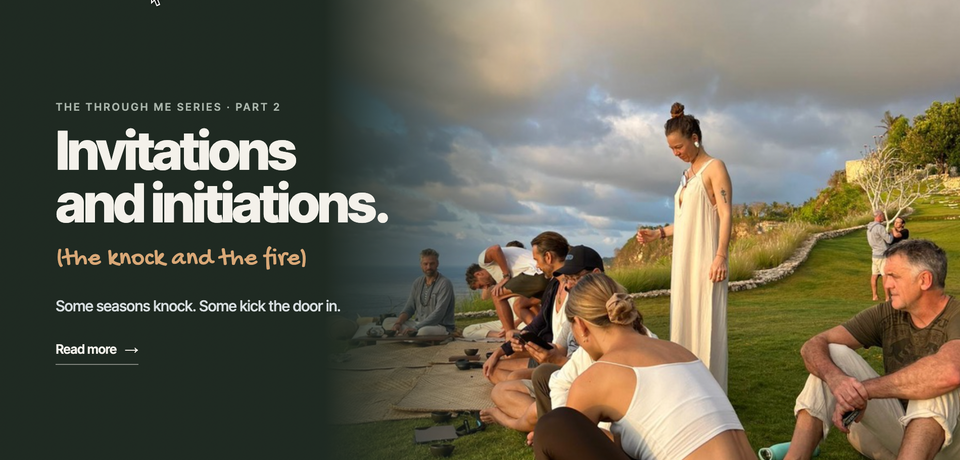
Some seasons knock. Some kick the door in. Learning the difference changed how I carry everything.
Rory Callaghan · The Through Me Series · November 2026
The knock and the fire
Some seasons knock.
They stand at the door and wait. A new project. A new love. A chance to build something bigger than you thought you could. You can open the door, or you can leave it closed. Either way, the choice is yours.
Other seasons don't knock. They come through the roof. A phone call at 3am. A diagnosis. A partnership that breaks overnight. A grief that arrives before you've finished the last one.
The first kind is an invitation. The second is an initiation.
For years I treated them as the same thing. That was the mistake that nearly broke me.
The question
How do we tell the difference between what we chose and what we were asked to carry, and why does it matter?
The short answer
An invitation is something we say yes to. An initiation is something that happens to us and asks us to become someone new. When we confuse the two, we blame ourselves for storms we never chose, or we keep saying yes long after our hands are full. Knowing the difference lets us own our part, put down what was never ours, and grow through what arrives.
What I said yes to
Looking back, I can see the doors I opened.
I said yes to building something with my own hands, stone by stone, for two years. I said yes to love, fully, across oceans. I said yes to writing a book with everything I had. I said yes to holding people: clients, friends, family, whoever was falling at the time.
Those were invitations. I walked through every one with my eyes open. I'm proud of most of them. Some I'd open again tomorrow.
But I also said yes when I had nothing left to say it with. I kept opening doors while the house was already on fire. That part is mine to own.
What arrived without asking
Then there were the things I never chose.
My father's death, in the same week a relationship ended, a legal fight began and a pothole put me in surgery. Months sitting beside someone I love while they lived in the dark, and all I could do was keep holding the rope. A partnership collapsing and taking my savings with it. Saying goodbye to another family member who chose her own way out of this life.
None of that knocked. It just came in.
And here's what I didn't understand at the time. I was treating every one of those storms like a door I'd opened. As if I'd invited it. As if, somehow, I should have seen it coming or been strong enough to stop it.
That's a heavy way to live. You end up carrying guilt for weather.
What I felt
Honestly? A lot of things at once.
Devotion, fierce and real, toward the people and the work I loved.
Exhaustion that went past my body into something older. Like a battery that charges to 20% and calls it full.
Betrayal, when things I'd built with trust were turned against me.
Loneliness, the strange kind you feel in a full room when everyone thinks you're the one holding it together.
And underneath all of it, a quiet question I didn't want to ask out loud. When does someone hold me?
What I needed
I didn't need another lesson. I'd had plenty.
I needed someone to ask how I was and wait for the real answer. I needed someone to take one end of the rope for a minute. I needed permission to stop being the strong one, just for an afternoon.
I didn't ask for most of it. That's the other thing I own. I made being needed my identity, and then I wondered why no one noticed I needed something too.
What I own
This is the part I find most useful to share, so I'll be plain about it.
- I confused showing up with choosing. I showed up for everything, and I counted all of it as a choice I had to justify. Some of it was never mine to choose.
- I turned devotion into duty. Love that should have flowed freely became something I had to keep proving.
- I said yes past capacity. Not every invitation deserves a yes, even a beautiful one. I opened doors I didn't have the energy to walk through.
- I didn't ask for help. I built an incubator for people too stubborn to ask for help, and it took me years to see I was its first member.
Owning these didn't make me feel worse. It made me feel free. You can only change what you're willing to call yours.
What the wise ones already knew
None of this is new. I just had to live it to understand it.
Nearly two thousand years ago, the Stoic teacher Epictetus opened his Enchiridion with one idea. Some things are up to us and some are not. Our job is to know which is which. That one line would have saved me years.
In 1909, the anthropologist Arnold van Gennep described rites of passage in three stages: separation from the old life, a threshold in between, and a return as someone new. Later, Victor Turner called that middle stage "betwixt and between." That's exactly where an initiation leaves us. No longer who we were. Not yet who we're becoming.
Psychology echoes it. Ronnie Janoff-Bulman's work on "shattered assumptions" (1992) describes how hard events break our core beliefs about the world: that it's fair, that it makes sense, that we're safe. Tedeschi and Calhoun, who coined the term post-traumatic growth, describe these events as seismic. They shake the ground, and growth comes from rebuilding on what's left.
An initiation isn't a punishment. It's a threshold. And thresholds are meant to be crossed, not lived on.
The Threshold Questions
When something arrives in my life now, I sit with five questions. I call them the Threshold Questions.
- Did I knock, or did it arrive? Be honest. Was this a door I opened, or weather that came in?
- What part of this is mine? Own that part fully. Put the rest down.
- What am I feeling right now? Name it plainly. Not the story. The feeling.
- What do I need? Not what would be impressive. What would actually help.
- What is this asking me to become? Every initiation has a question inside it. Find it.
If it was an invitation, I get to choose again. Yes, no, or not yet.
If it was an initiation, I stop asking why and start asking who.
Where this gets tricky
- Sometimes it's both. We open a door and a storm comes through it. A love we chose can still bring a grief we didn't. Own the door, not the storm.
- Not every hard thing is an initiation. Sometimes pain is just pain. We don't have to turn every loss into a lesson to deserve to heal from it.
- "Not mine" isn't "not my problem." Putting down what isn't yours doesn't mean walking away from people. It means helping without carrying their whole weight.
- If you're in the threshold right now and it feels too dark, please reach out to someone today. A doctor, a counsellor, a friend.
The shift
The day I stopped treating storms as doors, something in my chest unclenched.
I could finally say: I chose this, and I'll own it. I didn't choose that, and I'll stop carrying it like a crime.
The invitations showed me what I love. The initiations showed me who I am.
One action for today
Take one thing you've been carrying this year. Ask the first Threshold Question: did I knock, or did it arrive? Write down the answer and notice what your body does when you read it back.
Recap
- Invitations knock. Initiations come through the roof.
- Confusing them leads to guilt for weather and yes past capacity.
- Own what you chose. Put down what you didn't.
- Initiations are thresholds, not punishments.
- The Threshold Questions help you tell the difference in the moment.
Questions people ask
What is the difference between an invitation and an initiation? An invitation is an opportunity we can accept or decline: a project, a relationship, a move. An initiation is a hard event we didn't choose that changes who we are. One asks for our yes. The other asks for our growth.
Why do we blame ourselves for things we didn't choose? Hard events break our basic belief that the world is fair and predictable. Blaming ourselves can feel safer than accepting that some things are out of our control. Janoff-Bulman's research on shattered assumptions explores this.
What is the liminal stage of a rite of passage? In van Gennep's model, it's the in-between stage after leaving an old identity and before taking on a new one. Victor Turner described it as "betwixt and between." It often feels disorienting because it is.
How do I know what part of a situation is mine to own? Ask what you directly chose, said, or did. That's yours. Other people's choices, timing, and events outside your control are not. The Stoic idea of what is and isn't up to us is a good starting point.
Do I have to find meaning in every painful experience? No. Some pain is simply pain. Meaning can come later, or not at all, and healing doesn't depend on it.
A closing reflection
I used to think strength meant carrying everything that came through the door.
Now I think it means knowing which doors I opened.
What in your life knocked, and what came through the roof?