
Self-Union Before Divine Union
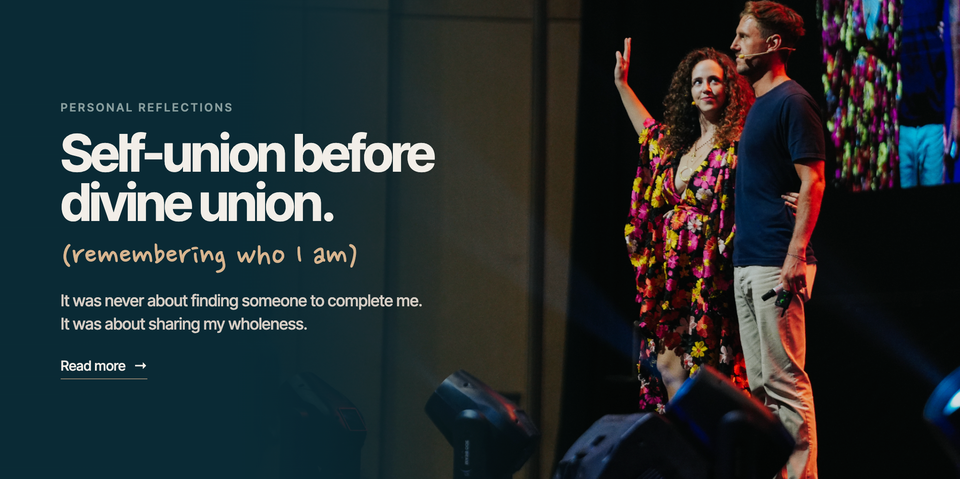
The journey was never about finding someone to complete me. It was about remembering who I am, and learning to share that wholeness with another.
A personal reflection.
We all want that divine partnership.
The kind of love that feels like home. Where we're fully seen and fully accepted. Where there's safety, devotion, truth, freedom, passion and play. Where love isn't something we chase, earn or perform for. It's something we give, receive, nourish and choose.
But I keep coming back to a paradox.
Before divine union comes self-union.
Not because I need to be perfectly healed first. Not because I need to become so independent I don't need anyone. Because love becomes something very different when I stop looking for another person to give me permission to feel whole.
The question this piece answers
Do you have to love yourself before you can have a healthy relationship?
The quick answer. Not perfectly, and not alone. For me, self-union means becoming a safe place for myself: staying connected to who I am while I feel longing, fear or rejection. It doesn't remove the need for connection. It changes how I meet it. And the sacred in a partnership isn't in the label. It's in how two people actually treat each other.
What I experienced
All the teachings kept pointing to something simple. I've spent years with the language of transformation. Soul contracts, twin flames, attachment styles, shadow work, divine masculine and feminine. I could explain every pattern and name every wound. And still struggle with the simplest things. Resting without guilt. Being alone without feeling incomplete. Receiving love without earning it. Saying no.
The deepest awakening isn't another revelation. It's when I start living what I already know.
I had to become a safe place for myself. Self-union doesn't mean never feeling lonely, anxious or in need of reassurance. We're relational beings. We need affection, touch and belonging. Self-union is staying connected to myself while I feel those needs. Feeling longing without turning it into pursuit. Experiencing rejection without reading it as proof I'm unworthy. It's when I stop making an enemy of my own humanity. And inner security doesn't compete with the security a loving relationship provides. They nourish each other.
And I found that becoming was mostly unbecoming. I love the image of Michelangelo's David, a figure emerging from stone not by adding material but by carefully removing what hides the form. So much of life is accumulation. More achievements, more identities, more stories about what will finally make me worthy. The deeper work is often subtraction. The need to prove, to control, to rescue, to be chosen. Not everything needs removing. Some of those patterns helped me survive, and they deserve understanding, not contempt. Sometimes becoming is less about adding another identity and more about releasing the ones I no longer need.
What I learned
Self-love is a daily practice, not a philosophy. It looks like keeping promises to myself. Rest. Movement. Nature. Feeling without judging. Setting boundaries. Noticing when I'm overgiving. How can I speak about unconditional love while making my own worth conditional? Self-love is giving myself the same consideration I freely give everyone else.
Surrender isn't giving up on what matters. It's releasing control over what isn't mine while taking responsibility for what is.
Surrender doesn't mean accepting repeated harm or waiting indefinitely for someone to become who I hope. It's not giving up on love. It's giving up the belief that love has to unfold exactly as I imagined.
What's real doesn't need to be forced. Not that every genuine relationship lasts. A connection can be meaningful without being sustainable, and two people can care deeply and still lack the capacity to build a life together. But what's real doesn't ask me to abandon reality to keep it. It doesn't need endless chasing or constant convincing. Real love becomes recognisable through how it's lived. Through consistency, accountability, freedom and mutual choice.
Love shows in the hard seasons, not just the high ones. It's easy to celebrate love when the business is thriving and everyone's healthy and inspired. What happens when money gets uncertain, grief arrives, or the lighthouse that guided so many starts to dim? Can we let each other struggle without judging character? Ask for help without shame? Tell a difficult season from a repeated pattern of harm? Mature love isn't measured only by how we celebrate the highs. It's also in how responsibly we navigate the lows.
The wisdom I'd pass on
Be childlike, not childish.
Maturity isn't the death of the inner child. It's giving that child a safe, loving, responsible adult to live within. Someone who can play and keep their word. Dream and act. Love and set boundaries.
Live the divine partnership. Don't just declare it. We can call a relationship sacred, destined, a soul connection, a twin flame. No label replaces how two people treat each other. Chemistry can't replace consistency. Spiritual connection can't replace emotional availability. The belief that something is destined can't replace the responsibility of building it. If I use the language of divine partnership, it should be recognisable in ordinary behaviour. How we disagree. How we repair. How we support each other's dreams. Whether we stay loving when life is less beautiful than the story we imagined.
Practise self-union daily, with questions.
- What am I feeling?
- What do I need?
- What is mine to take responsibility for?
- What am I trying to control?
- Where am I abandoning myself?
- Where am I resisting receiving love?
- What action would bring me back into alignment?
Sometimes the answer is a hard conversation. Sometimes a boundary. Sometimes rest, a hug, or a surf. The way home doesn't always need another teaching. Sometimes it needs a different choice.
Where this does not reach
Self-union isn't a prerequisite to deserve love. Nobody has to finish healing before they're worthy of a relationship. Many people heal inside loving relationships.
Surrender isn't passivity. Where there's harm, surrender doesn't mean accepting it. Releasing control over others still includes protecting yourself.
Spiritual language is optional. "Divine union" is my language. The test of a partnership works without any of it.
The evidence, named and dated
- Reinhold Niebuhr's Serenity Prayer (early 1930s), on the serenity to accept what can't be changed, the courage to change what can, and the wisdom to know the difference. It's the oldest well-known version of the surrender distinction above, and the attribution to Niebuhr is generally accepted.
- Michelangelo's David is used as an image only. The famous lines about "seeing the angel in the marble" or "removing everything that isn't David" are widely attributed to him with no reliable source, so they're not quoted.
- Personal, and labelled: self-union, the surrender table and the childlike-versus-childish distinction are my own framing.
The shift
I used to look for someone to make me feel whole.
Now I'm learning to be whole, and to share that with someone who's choosing the same.
One thing, for the next day
Ask yourself one of the seven questions tonight. Where am I abandoning myself?
Change one small thing tomorrow because of the answer.
The spine of it
Self-union before divine union. The teachings point back to living what I already know. Self-love is daily practice. Self-union is becoming a safe place for myself. Surrender is releasing what isn't mine. What's real doesn't need forcing. Love shows in the hard seasons. Becoming is often unbecoming. Childlike, not childish. Divine partnership is lived, not declared.
Questions people ask
Do you have to love yourself before someone else can love you? Not perfectly and not first. But how you treat yourself shapes what you accept and how you show up in love.
What is self-union? Becoming a safe place for yourself. Staying connected to who you are while feeling longing, fear or rejection.
What does surrender mean in a relationship? Releasing control over another person's choices while staying responsible for your own, including your boundaries.
What's the difference between childlike and childish? Childlike is openness, curiosity and play. Childish is refusing responsibility or expecting others to manage your feelings.
What makes a relationship a "divine partnership"? Whatever you call it, it's recognisable in honesty, consistency, repair and mutual choice, not in the intensity of the connection.
The journey was never about becoming worthy of love. It was about remembering I already am, and learning to live, give and receive from that place.
Where are you still abandoning yourself in the name of love?