
What I'm Learning About Divine Union
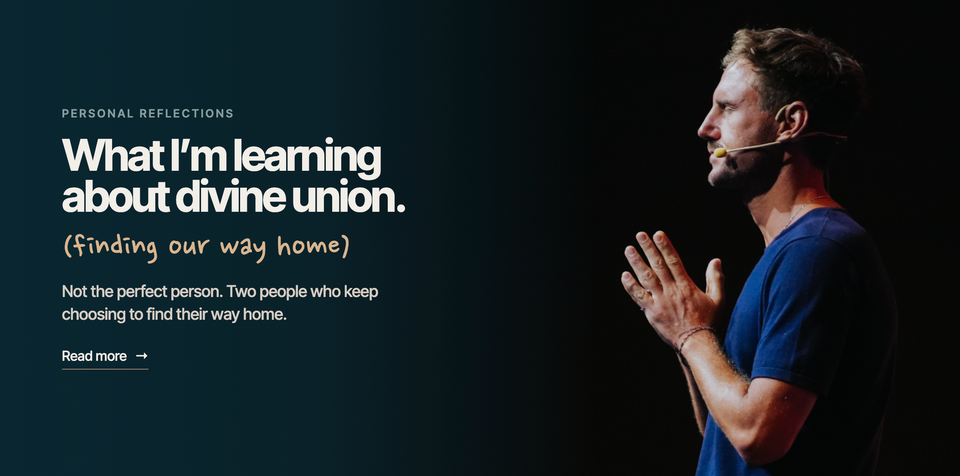
It's not about finding the perfect person. It's about two people who keep choosing to find their way home, to themselves, to each other, and to something greater than both.
A personal reflection.
I've spent much of my life studying love. Not only through books, psychology and spiritual teaching. Through living it. Loving deeply, building, losing, grieving. Through the moments that brought me closer to myself, and the ones that showed me how easily I can lose myself in another.
Some of my greatest teachers have been people who've shared a life together for decades. Marriage, children, success, failure, illness, grief, financial uncertainty, reinvention. The ordinary, beautiful, sometimes hard experience of growing older side by side.
Whenever I meet a couple like that, I ask the same question.
"What do you know that I don't?"
Their stories are all different. But their answers share something.
They don't describe a relationship that was always easy. They don't say they found someone who never triggered them. They describe something far more beautiful.
They learned to fall in love with themselves, and with each other, over and over again. Through every season. Every new version of the person beside them.
The question this piece answers
What makes love last, and deepen, over a lifetime?
The quick answer. From the couples I've learned from, lasting love isn't finding someone who never changes. It's loving the many versions of each other, repairing after rupture, tending three relationships (mine, yours and ours), caring for the essence rather than the image, and choosing each other again and again. If it's truly divine, it deepens.
What I experienced
Nobody stays the version we first met. We fall in love with a particular person. The chemistry, the curiosity, the possibility. But life doesn't leave anyone unchanged. The ambitious young man becomes a builder, then a leader, then a father carrying the weight of providing. One day he's grieving his own father, or rebuilding after failure, or learning to rest after decades of achieving. The woman we met may become a creator, a mother, a matriarch, someone discovering parts of herself beyond the roles she's carried. Seasons of expansion, exhaustion, grief and reinvention.
A lifelong partnership isn't one relationship with one unchanging person. It's a lifetime of discovering and loving the many versions of each other.
Can I stay curious about who you're becoming? Can I celebrate your evolution without feeling threatened by it? Can we keep discovering each other instead of assuming we already know?
What held them wasn't the absence of rupture. Many told me there were moments that could have broken them. Grief. Fear louder than love. Old patterns surfacing. Sometimes needing space. They weren't always graceful. They withdrew, reacted, misunderstood each other. But in the relationships I most admired, both people eventually looked inward, listened, owned their part, and found their way back. Rupture wasn't the defining feature of their relationship. Their mutual capacity for repair was.
What I learned
Not every rupture should lead to reconciliation. Staying through repeated dishonesty, coercion or harm isn't evidence of a more divine connection. Repair needs real accountability. Reconciliation needs mutual choice. Trust needs consistent behaviour. Suffering doesn't make love sacred. Responsibility can make it stronger.
Tend the three gardens. Every partnership holds three relationships: mine with myself, yours with yourself, and the one we create together. If one person keeps giving everything away, their roots go dry. If both focus only on themselves, the shared garden is neglected. Healthy union isn't two people disappearing into one identity. It's two whole people tending a third, living relationship.
Protect the essence, not the image. The couples I admire weren't trying to look like they had a perfect relationship. They were caring for the one they actually had. They didn't turn disagreements into public narratives. And when they needed help, many sought wise, independent support. Therapists, counsellors, mentors, people who could help them see their own patterns. The difference is whether we're seeking clarity, or recruiting people to confirm we're right. They weren't trying to win against each other. They were trying to understand what would help the relationship thrive.
Comfort isn't the same as avoidance. Intimacy shows us parts of ourselves we might never meet alone. A partnership can be a mirror. Not one that judges, but one that helps us see. Growth may ask for a hard conversation, an admitted mistake, a new way of communicating. It never requires tolerating repeated disrespect. The goal isn't choosing suffering over comfort. It's choosing truth and growth over the false comfort of avoidance. Comfort can be a beautiful place to rest. Avoidance can be where dreams quietly disappear.
Self-regulation and co-regulation belong together. I'm responsible for understanding my triggers and pausing before I react. But we aren't meant to do it all alone. A calm voice, a gentle touch, a willingness to listen. Our nervous systems steady each other. Mature partnership is knowing when to take space and when to come closer.
The wisdom I'd pass on
Look for amplification, not completion. When two people are aligned in their deeper values, they don't just add to each other's lives. They multiply possibility. One person's courage encourages the other's. One person's steadiness makes room for the other's expansion. I think of it as two waves meeting and amplifying each other. Light on light. They don't dim each other or compete for the spotlight. They shine light on each other's gifts.
Let the love reach outward. In the partnerships that inspire me most, love doesn't stop at the relationship's edge. It flows into their children, friendships, work and community. A child who grows up witnessing respect learns a different language of love. A home full of warmth becomes a place of belonging. That's what I mean by a kingdom within. Not power over anyone. A shared foundation of love, truth and character, a garden from which a forest can grow.
Don't perform it. Public celebration isn't evidence of private integrity. Divine union doesn't need an audience to exist. The deepest evidence is in the moments nobody sees. How two people speak to each other when they're tired. How they handle temptation. How they repair. (I explore privacy versus secrecy more in Private, Not Secret.)
Translate spiritual language into character. We can call avoidance surrender, intensity destiny, and inconsistency a spiritual test. Real consciousness is simpler. Can I tell the truth? Respect a no? Apologise and change? Spiritual language means very little if it doesn't become human character.
Keep choosing. The couples who've shared decades didn't choose each other once. They kept choosing, through different seasons, identities and challenges. Sometimes that looked like romance. Sometimes patience, space, a hard conversation, or sitting quietly with no words left. Lasting love isn't one decision made at the beginning. It's a relationship renewed through mutual choice. Not out of obligation or fear. Because, again and again, they freely recognise something worth choosing.
Where this does not reach
Staying isn't always the loving choice. Long partnerships are beautiful, but length isn't the measure of love. Some relationships need to end, and ending one can be the healthiest choice two people make.
Where there's harm, safety comes first. If a relationship involves abuse, coercion or fear, repair and "keep choosing" don't apply. Getting safe does.
This is one man's learning. These are lessons gathered from others and from my own relationships. I hold them as a student, not an expert.
The evidence, named and dated
- Aron, Norman, Aron, McKenna and Heyman (2000), Journal of Personality and Social Psychology. Couples who took part in novel, engaging activities together reported higher relationship quality than those doing familiar, pleasant ones. It supports staying curious about who each other is becoming.
- John Gottman's research on long-term couples has consistently found that how partners repair after conflict, and how they turn toward each other's everyday bids for connection, matters more than whether they argue.
- Personal, and labelled: "light on light" and "constructive interference" are metaphors, not physics. The three gardens and the kingdom within are my own framing.
The shift
I used to think divine union meant finding the right person.
Now I think it means two people who keep choosing to find their way home. If it's truly divine, it deepens.
One thing, for the next day
Ask someone who's loved another person for a long time: "What do you know that I don't?"
Then listen without interrupting.
The spine of it
Lasting couples fall in love over and over, with every new version of each other. Rupture happens. Repair defines them. Not every rupture should reconcile. Tend three gardens: mine, yours, ours. Protect the essence, not the image. Choose growth over avoidance. Regulate yourself and steady each other. Amplify, don't complete. Let love reach outward. Don't perform it. Keep choosing. If it's truly divine, it deepens.
Questions people ask
What's the secret to a lasting relationship? From couples who've shared decades, it's loving each other through change, repairing after conflict, and continuing to choose each other.
Is it normal for a partner to change over time? Yes. Long relationships involve many versions of each person. Curiosity about who they're becoming helps love last.
Does conflict mean a relationship is failing? No. What matters more is whether both people can take responsibility and repair.
Should couples get outside help? Often, yes. Seeking clarity from a therapist or counsellor can be an act of care, as long as it isn't about recruiting allies.
What is a divine partnership? Whatever you call it, it's recognisable in honesty, repair, mutual growth and the freedom to keep choosing each other.
Am I becoming someone capable of recognising, receiving, reciprocating and co-creating the love I say I want? And when another person meets me there, can we keep choosing to find our way home? Not once. Over and over again.
If it's truly divine, it deepens.