
The Man Who Needed a Hug
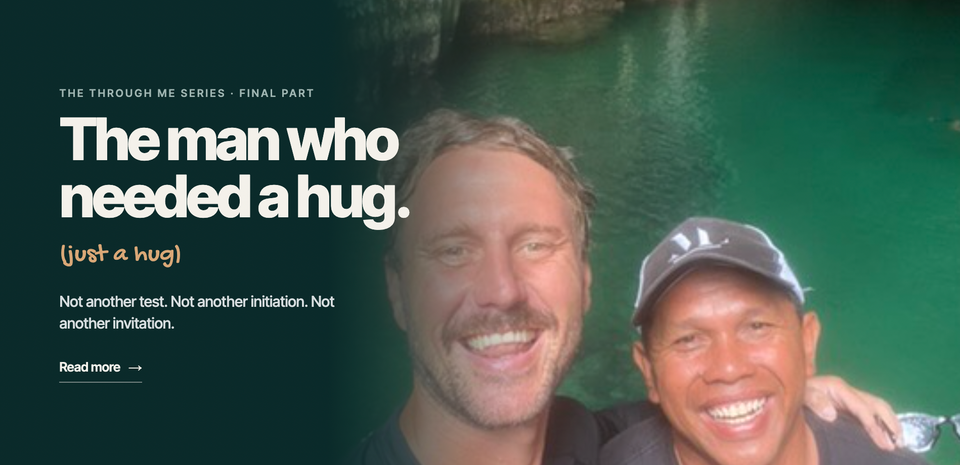
Not another test. Not another initiation. Not another invitation. Just a hug.
Rory Callaghan · The Through Me Series · Final part · November 2026
The cup turned upside down
Picture someone standing in the rain with a cup.
The rain is everything they've been waiting for. Care. Rest. A kind word. Someone asking how they are and meaning it.
But the cup is upside down. So the rain runs off the bottom, and they stand there, soaked and still thirsty, wondering why nothing ever fills them.
That was me for a long time. I wasn't short of love. I just didn't know how to turn the cup over.
The question
After all the storms, all the lessons and all the growth, what do we actually need, and why is it so hard to receive it?
The short answer
Sometimes what we need isn't another lesson. It's comfort. A hug. A pause. People who spend years holding others often forget how to be held. Clearing the field means letting go of the need to earn care through endurance. We can start by giving it to ourselves, and then let others give it too. Both count.
The truth beneath the whole series
I've written six pieces about what happened over the last five years. The two lists. The invitations and initiations. The stones that weren't mine. The fire. The compost. The keeper in the lighthouse.
Every one of them is true.
But if I strip it all back, the truth underneath is simpler than any of it.
It's the story of a man who needed a hug.
Not another test. Not another initiation. Not another invitation to grow, to rise, to alchemise.
Just a hug.
What I felt
At the end of it, I felt tired in a way I didn't have words for.
Not the tired of a long day. The tired of a long decade of being the one who holds. Of answering every call. Of being the calm in every storm. Of turning every wound into wisdom before it had a chance to heal.
I felt proud of what I'd built, and empty in the same breath.
And I felt something I'd been avoiding for years. A small, quiet ache, like a child at the window waiting for someone to come home.
What I needed
I needed someone to hold me without needing anything back.
I needed to stop being useful for a while.
I needed to hear, from someone or from myself, you've done enough. You can put it down now.
And I needed permission to not turn this into a lesson. To just be held.
Why it's so hard to receive
Here's what I own.
- I made strength my identity. If I was the one who held everyone, who would I be if I needed holding?
- I thought I had to earn rest. As if comfort was a prize for enduring enough.
- I kept turning pain into lessons too fast. Growth became a way to skip the part where I just hurt.
- I didn't ask. I waited for people to notice. Most people can't notice what we work hard to hide.
None of that makes me weak. It makes me human. And I suspect I'm not the only one.
Clearing the field
After a bushfire, farmers sometimes leave a field fallow. Nothing planted. Nothing harvested. Just rest, sun and rain, so the soil can recover.
The storms of the last five years cleared my field. They took the titles, the plans, the need to be understood, the need to be strong for everyone.
At first that felt like loss. Now it feels like room.
Room to rest. Room to be soft. Room to give myself what I spent years waiting for someone else to give.
So I'm giving it to myself now.
And I'm letting myself be held.
What the research says about touch
This isn't just poetry. The body knows.
- Hugs protect us under stress. Sheldon Cohen and colleagues at Carnegie Mellon (Psychological Science, 2015) followed 404 healthy adults. More frequent hugs protected stressed people against infection and reduced symptoms in those who got sick.
- We can give it to ourselves too. In a 2021 randomised trial in Comprehensive Psychoneuroendocrinology, Dreisoerner and colleagues exposed 159 adults to a stress test. Both receiving a hug and self-soothing touch, most often a hand on the heart and a hand on the belly, lowered cortisol levels afterwards compared with controls.
- Kindness to ourselves is a skill. Kristin Neff's research on self-compassion (Self and Identity, 2003) describes it as treating ourselves with the same warmth we'd offer a friend, recognising that suffering is part of being human.
The wisdom traditions knew this long before the studies. Thich Nhat Hanh taught that when we hug, we can breathe in and out three times and be fully present, holding the person, and ourselves, with care.
The Hug Practice
This is the simplest practice in the series, and maybe the most important. I call it the Hug Practice.
- Turn the cup over. Admit, to yourself first, that you need care. No justification. No story.
- Give it to yourself. Place one hand on your heart and one on your belly. Breathe slowly three times. Let your body feel held.
- Say it out loud. I've done enough. I can put it down now.
- Ask for one. A real hug, from someone you trust. Hold it longer than feels normal.
- Don't turn it into a lesson. Just let it be what it is.
Where this gets tricky
- Self-care isn't a replacement for being cared for. Giving it to ourselves is a beginning, not the whole of it. We're built for connection.
- Not everyone has someone to hug. If that's you right now, the hand on the heart still counts. The research shows it does. And it's okay to look for new people slowly.
- Touch isn't comfortable for everyone. If hugs feel unsafe because of your history, comfort can come in other forms: a voice, a presence, a warm blanket, a pet.
- Receiving can feel uncomfortable at first. That discomfort isn't a sign you don't deserve it. It's a muscle you haven't used in a while.
- If the tiredness has turned into something darker, please speak to someone today. A doctor, a counsellor, a friend.
The shift: what's left
Here's who I am on the other side of the series.
A man who has carried a lot and built a lot. A man who has owned his part and put down what wasn't his. A man who walked through fire and found what can't burn.
And a man who finally understands that needing a hug isn't a failure of strength. It's the end of pretending.
The storms cleared the field. What's growing there now is soft, and real, and mine.
One action for today
Right now, before you close this page, put one hand on your heart and one on your belly. Breathe in and out three times. Then send one message to someone you love: Can I have a hug next time I see you?
Recap
- After all the lessons, sometimes what we need is simply comfort.
- People who hold others often forget how to be held.
- Clearing the field makes room to receive.
- Hugs and self-soothing touch both lower the body's stress response.
- Give it to yourself, and let others give it too.
Questions people ask
Why is it hard for strong people to accept help? Many people who are the strong one in their family or work build their identity around holding others. Needing care can feel like losing that identity. Recognising this pattern is often the first step to changing it.
Do hugs really reduce stress? Research suggests so. A 2015 Carnegie Mellon study of 404 adults found more frequent hugs protected stressed people against infection. A 2021 randomised trial found receiving a hug lowered cortisol after a stress test.
Can I comfort myself if I don't have anyone to hug? Yes. In the 2021 trial by Dreisoerner and colleagues, self-soothing touch, such as a hand on the heart and one on the belly, lowered cortisol levels much like receiving a hug did.
What is self-compassion? As defined by Kristin Neff, it means treating ourselves with the same kindness we'd offer a friend, recognising suffering as part of shared human experience, and holding painful feelings with awareness rather than avoiding them.
Is it okay to not turn every hard experience into a lesson? Yes. Some experiences just need to be felt and comforted. Growth can come later, or quietly, without being forced.
A closing reflection
For five years I was asked to grow, to rise, to carry, to transform.
At the end of it, I didn't need another lesson.
I needed a hug.
So I'm giving it to myself, and I'm letting the people I love give it too.
When did someone last hold you, and when did you last let them?