
The Alchemy Cycle
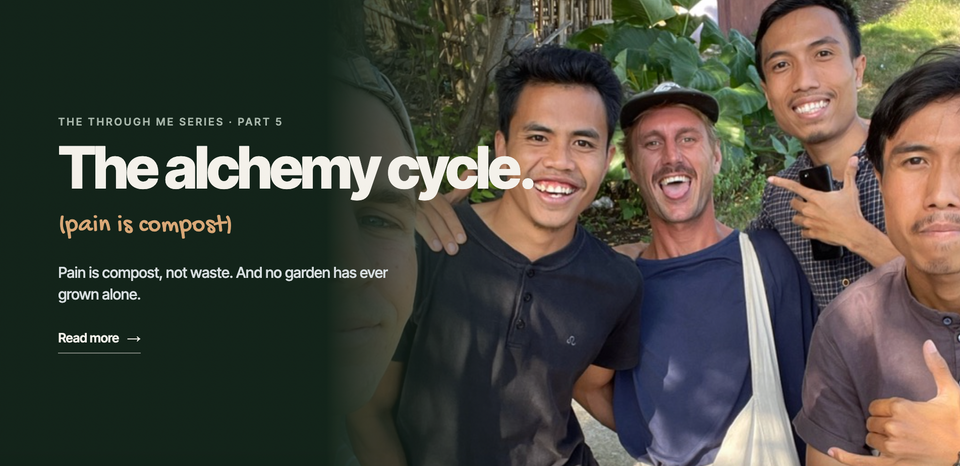
Pain is compost, not waste. And no garden has ever grown alone.
Rory Callaghan · The Through Me Series · November 2026
The compost heap
Every good garden has a compost heap in the corner.
It's not pretty. It smells. It's made of everything that's finished: peels, leaves, scraps, the things nobody wants. And yet, given time, heat and a little turning, it becomes the richest soil you'll ever put your hands in.
Nothing in it is wasted. It's just waiting to become something else.
That's the closest I can get to describing what happened to the pain of the last five years. It didn't disappear. It broke down. And things grew from it that couldn't have grown anywhere else.
The question
How does pain actually become purpose, and why can't we do it on our own?
The short answer
Pain becomes purpose when we let it break down into wisdom and offer that wisdom to someone else. Like compost, it needs time, heat and turning. And like compost, it needs more than one ingredient. Research shows social support is one of the strongest predictors of growth after hardship, and helping others helps the helper. Alchemy is always co-creation.
What I made from the heap
I won't list every project. Part 1 did that. Here's what it felt like from the inside.
The months I spent sitting beside someone I love in the dark became simple tools so others could care for themselves before they reached the edge.
My own fear of asking for help became a home for people just like me: gifted, stubborn, quietly drowning.
A partnership that broke became a new way of building, where everyone at the table wins. I built the bridge from the exact place the old one fell.
An empty bank account became an ecosystem.
Grief became a vision for a life built on presence, not proof.
Every one of those started as something rotting in the corner.
What I felt while making it
Purpose, real and strong. On the good days I felt more alive than I ever had.
But I also felt like I was cooking with the stove still on fire. I was turning pain into something useful while the pain was still arriving. That's a strange kind of tired. You're proud and hollow at the same time.
And there were days I wondered if I was creating or just running. Building so I didn't have to sit still with it.
What I needed
I needed the work to feed me, not just everyone else.
I needed people beside me in the garden, not just people eating the harvest.
And I needed to let the compost sit sometimes. Not every scrap has to become a project by next week.
What I own
- Sometimes I built to avoid feeling. Creating can be alchemy, or it can be running in a nicer outfit. I did both.
- I gave more than I let in. I was generous with my harvest and stingy with my own needs.
- I thought I had to do the turning alone. I carried the shovel for years before I let anyone else pick one up.
- I forgot to rest the soil. Gardens need fallow seasons. I skipped mine.
None of it was mine alone
Here's the truth I understand now.
Compost doesn't work with one ingredient. You need greens and browns, wet and dry, nitrogen and carbon. On its own, a pile of leaves just sits there. Mixed with other things, it comes alive.
That's what happened to me.
Clients guided me back to my heart while I guided them. Friends gave me a home when I didn't have one and showed me what a steady partnership looks like. Family held me while I held them. Teams, venues, partners, and everyone in every room who said yes. Even the hard relationships added something to the heap. They showed me where my edges were.
Under a forest, there's a hidden web of roots and fungi connecting the trees. Scientists have studied how it moves water and nutrients through the soil. Whatever the full story turns out to be, the picture stays with me. No tree in a healthy forest is truly alone.
Co-creation isn't a business model I invented. It's how I survived.
What the wise ones already knew
- Thich Nhat Hanh taught often that the gardener doesn't throw away the rubbish. They know it can become compost, and the compost can become flowers. Suffering and joy, he said, are made of the same stuff. No Mud, No Lotus (2014) is built on that idea.
- Ubuntu, the Southern African philosophy, is often translated as "I am because we are." Desmond Tutu described it as the idea that our humanity is bound up in each other's.
- Social support predicts growth. A large meta-analysis of 217 samples and nearly 48,000 people found a medium-sized positive link between social support and post-traumatic growth. The link was strongest among caregivers.
- Helping heals the helper. Frank Riessman described the helper therapy principle in 1965: people who help others with a shared struggle often benefit as much as those they help. It's one reason peer support groups work.
- The forest web is real, and still being studied. Suzanne Simard's work in Nature (1997) showed carbon moving between trees through underground fungal networks. Later reviews, including Karst and colleagues (2023), have argued some popular claims about it go further than the evidence. I use it here as an image, not a scientific claim.
The Compost Practice
When something painful is sitting in my corner now, I move through the Compost Practice.
- Gather it. Don't hide the scraps. Name what's finished, broken or rotting.
- Turn it. Reflect. Write. Talk it through. Compost that isn't turned just sits there and sours.
- Mix in others. Bring the pain to people who can add something: a friend, a mentor, a circle, a therapist. Growth needs more than one ingredient.
- Give it heat and time. Don't rush it. The breaking down is the work.
- Plant something for someone else. Ask what this pain knows that could help another person. Then offer it, small and simple.
This is the "forge" and "share" part of the Alchemy Cycle from the series pillar, slowed down and opened up.
Where this gets tricky
- Not every pain needs to become a product. Some compost is just for your own garden. That's enough.
- Purpose can become another pressure. If turning pain into something useful starts to feel like a debt, stop. Rest the soil.
- Creating isn't always healing. Notice whether you're building from overflow or from avoidance. Be honest with yourself about which.
- Helping others isn't a substitute for being helped. The helper still needs a helper.
- If the heap feels too heavy to turn alone, please speak to someone today. A counsellor, a friend, a doctor.
The shift
I used to think alchemy meant being strong enough to turn lead into gold by myself.
Now I know it's a garden. It needs many hands, some rest, and seasons where nothing seems to happen at all.
The pain was never waste. And I was never meant to turn it alone.
One action for today
Think of one painful thing you've been through. Ask: who could this help? Then send one message, to one person, offering one thing you learned.
Recap
- Pain is compost, not waste.
- It needs time, heat and turning to become something useful.
- It also needs other ingredients: other people.
- Social support predicts growth, and helping others helps the helper.
- Alchemy is always co-creation.
Questions people ask
What does it mean to turn pain into purpose? It means letting a painful experience become wisdom you can use and offer to others. It doesn't erase the pain. It gives it somewhere meaningful to go, often in service to people facing something similar.
Why does social support matter for growth after hardship? Research shows people with more support report more post-traumatic growth. Talking through hard experiences, being understood and feeling less alone all help us make meaning from what happened.
What is the helper therapy principle? Described by Frank Riessman in 1965, it's the finding that helping others with a shared struggle often benefits the helper too. It's part of why peer support and mutual aid groups are effective.
How do I know if I'm creating from healing or from avoidance? Notice how you feel when you stop. If rest feels peaceful, you're likely creating from overflow. If stillness feels unbearable, the work may be helping you avoid something that needs attention.
What is co-creation in personal growth? It's the idea that we grow with others, not alone. Mentors, friends, communities and even difficult relationships all contribute something to who we become.
A closing reflection
Everything that rotted in my corner became soil.
And every flower that grew from it had more than one gardener.
Who has been turning the compost with you, and have you told them?