
The Protector and the One Who Wants to Be Held
What Internal Family Systems, shadow work and parts integration are teaching me about the different voices inside one man.
A personal reflection.
How can one person hold so many conflicting things at once?
The part of me that wants to stay strong and hold everything together. The part that wants someone to hold me. The part that needs to understand every inconsistency. The part that just wants to rest.
For a long time I treated those as contradictions to resolve. Lately I've been learning a different way to relate to them, through three overlapping approaches: shadow work, Internal Family Systems, and parts integration.
Wholeness isn't the absence of difficult parts. It's the capacity to relate to them without letting any single part run my whole life.
The question this piece answers
What is Internal Family Systems, and how does it help with inner conflict?
The quick answer. Internal Family Systems (IFS) is a therapy model developed by Richard Schwartz. It sees the mind as made of different parts, some protecting us and some carrying old pain, with a calm, curious "Self" that can lead them. The aim isn't to get rid of any part. It's to understand what each one is protecting, so it can let go of its most extreme role. The evidence is promising, but still early.
What I experienced
Three approaches, not one. They overlap, but they're not the same.
- Shadow work comes from Jung. The shadow holds what my conscious identity doesn't comfortably recognise. That includes positive qualities too, sometimes called the golden shadow: assertiveness, sensuality, tenderness, the wish to be cared for.
- Internal Family Systems is a structured psychotherapy model with a specific method for engaging inner parts with compassion and curiosity.
- Parts integration is the broader family of approaches, including IFS, some Gestalt and ego-state work, for reducing conflict between different aspects of ourselves.
The architecture made sense of my armour. IFS describes three broad roles.
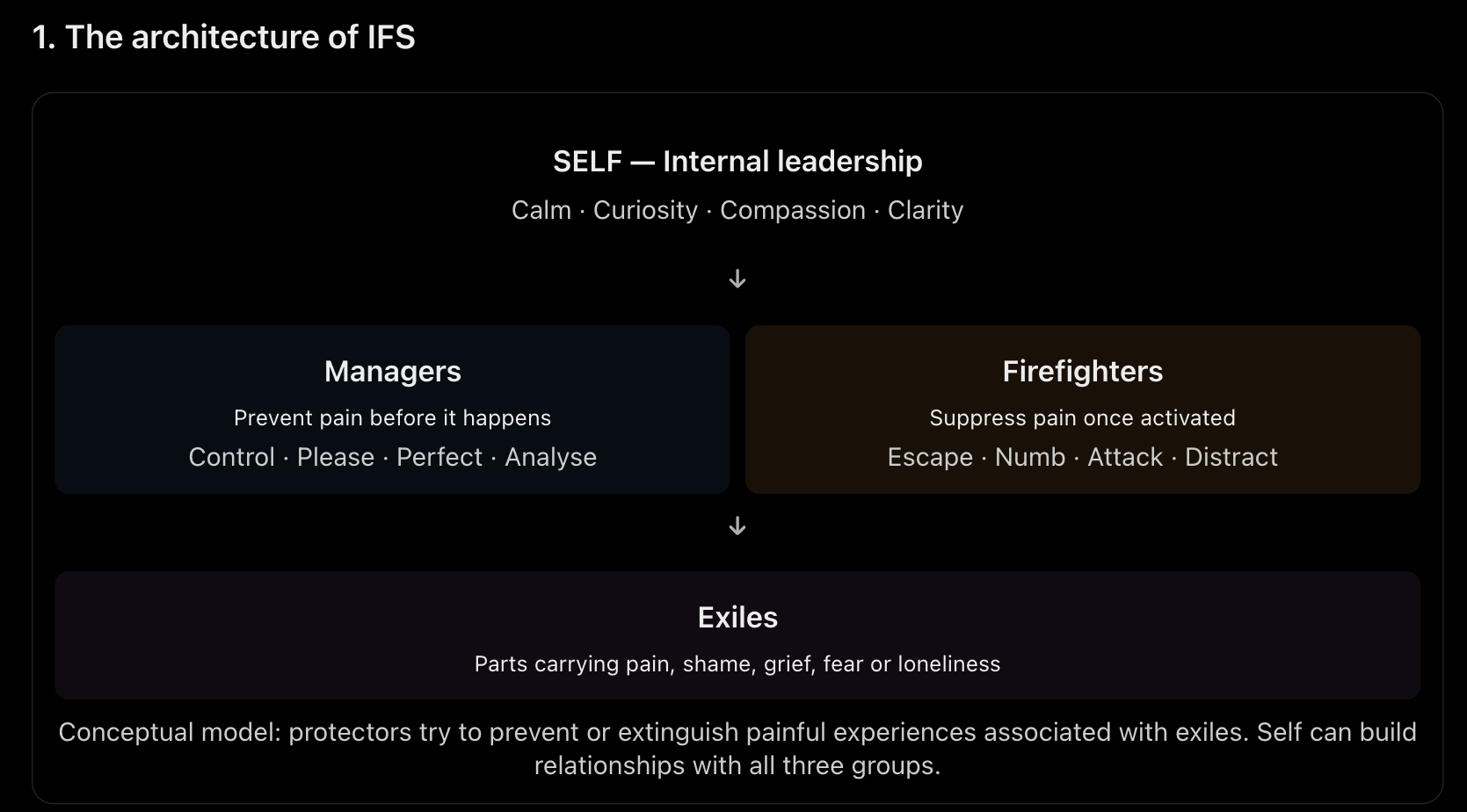
These are clinical metaphors, not literal separate personalities. A part's role can shift. But reading it, I recognised the armour I've been writing about. A protective behaviour can have an understandable purpose even when its consequences hurt. Understanding that purpose doesn't mean endorsing the behaviour.
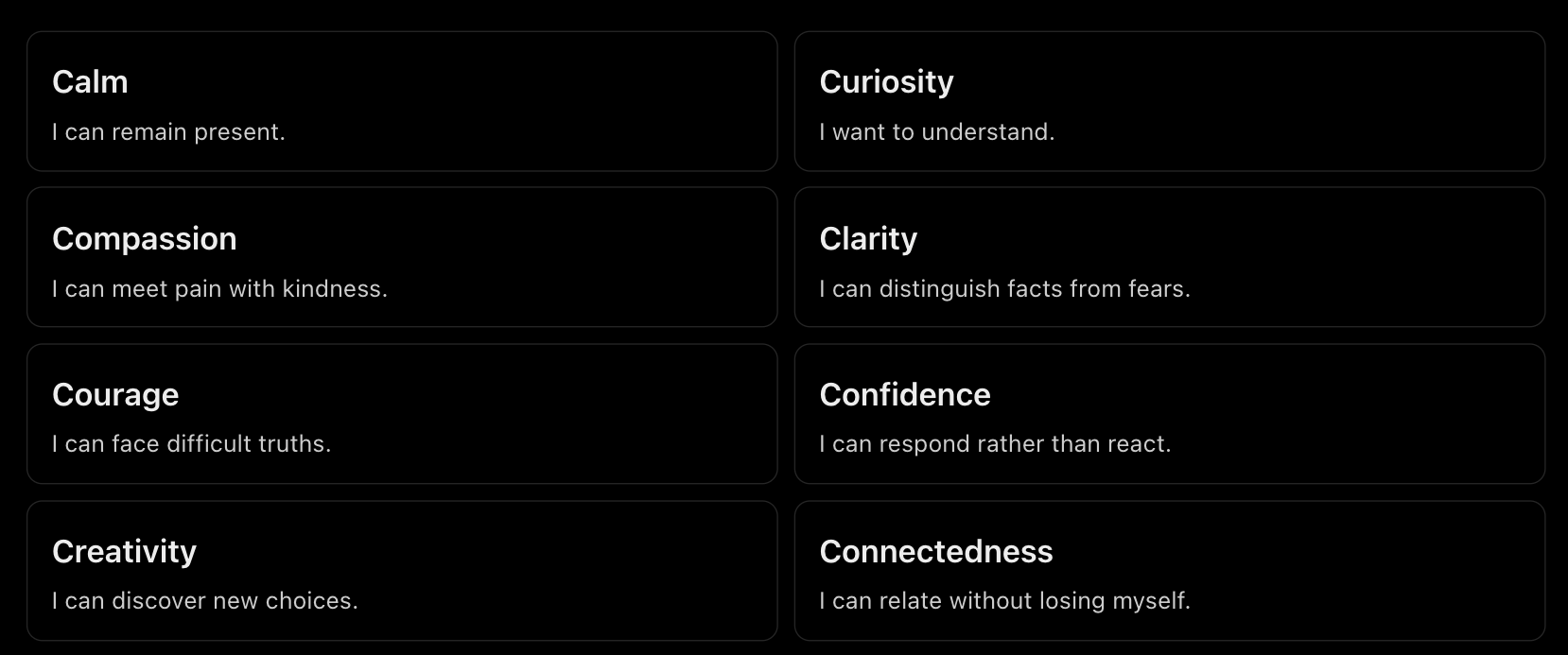
And it named the one who leads. IFS describes a Self that isn't another part. It's a capacity for inner leadership, recognised by eight qualities: calm, curiosity, compassion, clarity, courage, confidence, creativity and connectedness. Not a test to pass. Signs that I'm leading from the centre rather than from a part.
What I learned
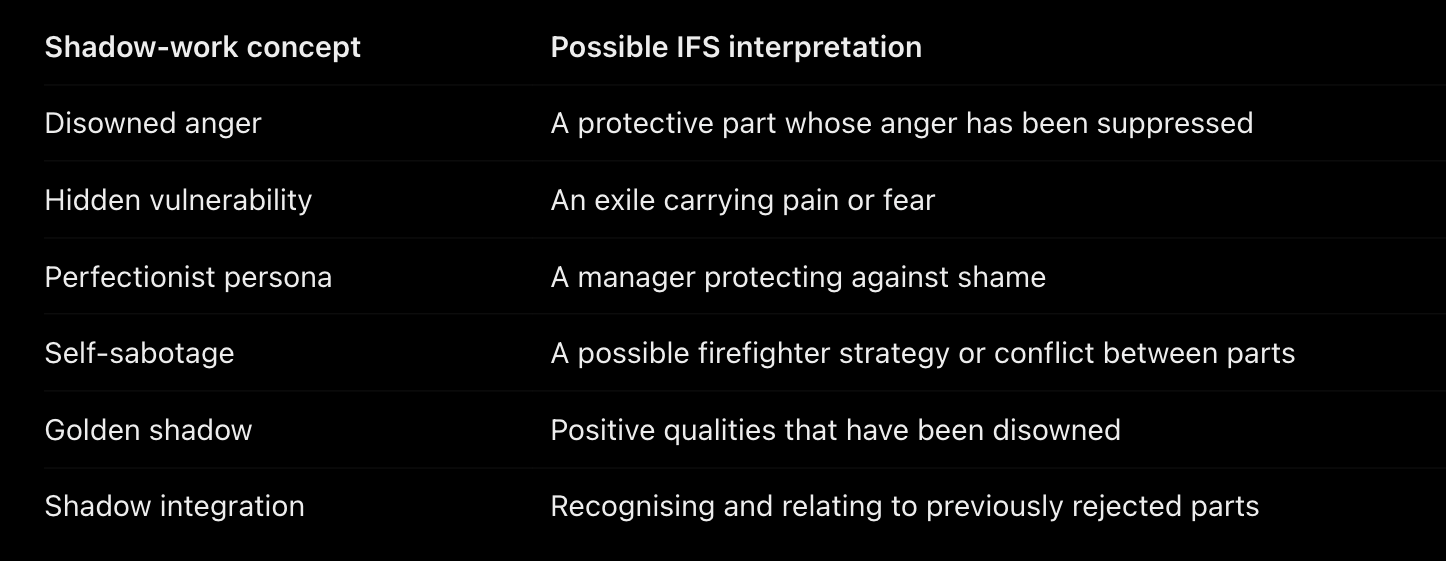
These are the parts I'm exploring in myself. Possibilities, not diagnoses.
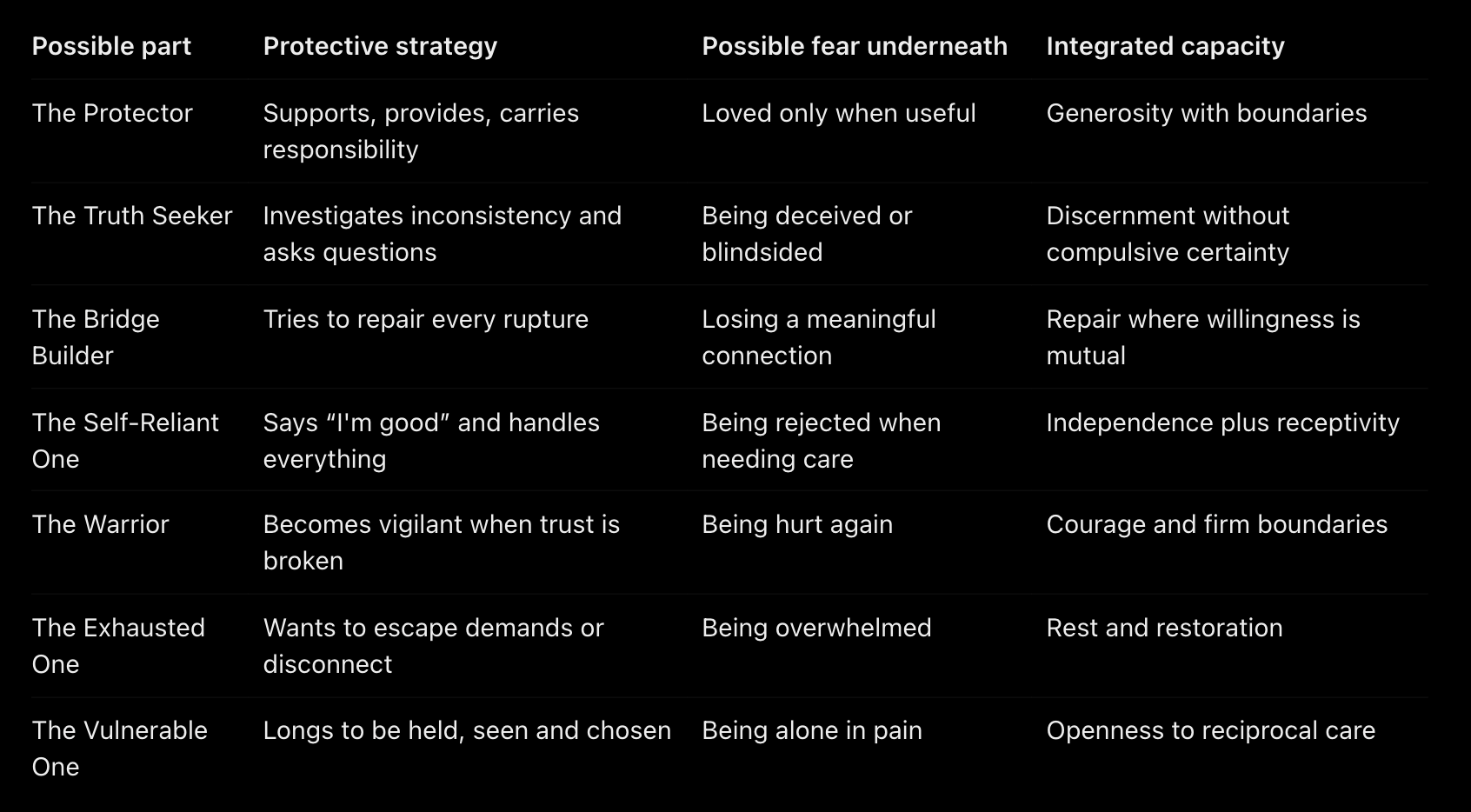
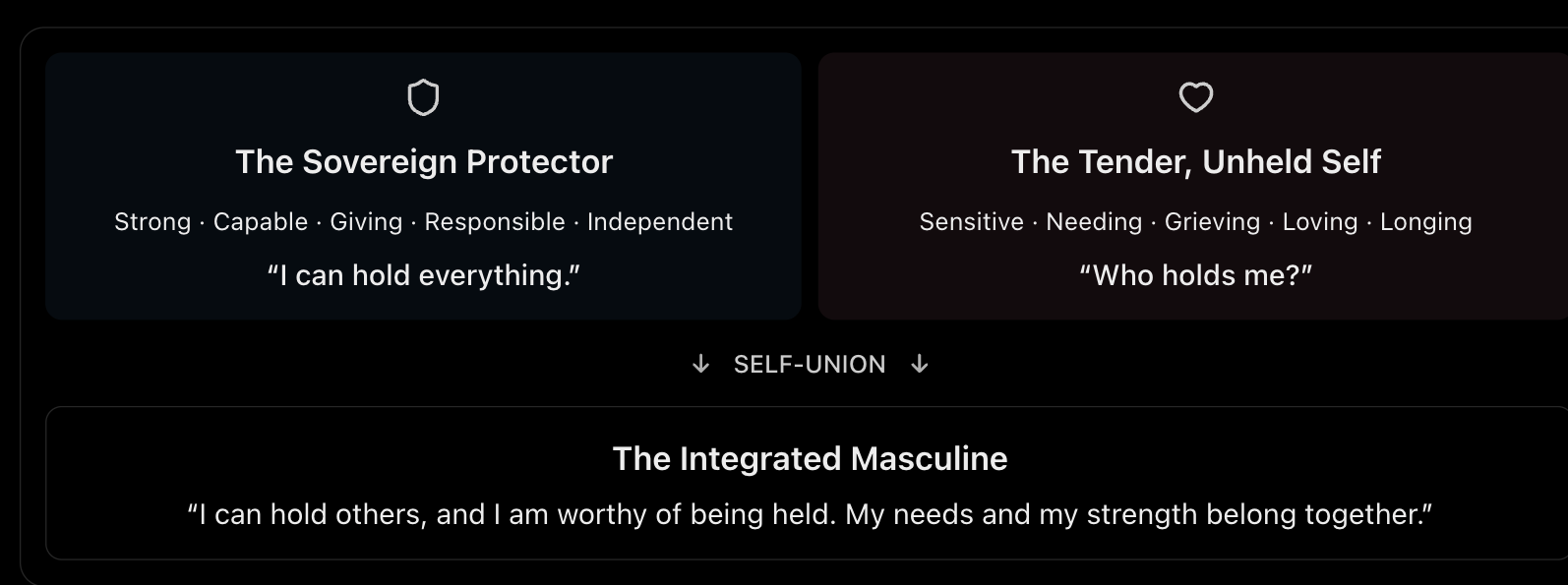
The central tension is between two of them. The Protector says, I must stay strong and hold everything together. The Vulnerable One says, I want someone to hold me too. Integration doesn't mean either disappears. It means being able to protect others while also recognising, expressing and meeting my own needs. That's where shadow work helps. The qualities I most identify with, strength, generosity, responsibility, can make their opposites, need, rest, anger, harder to welcome.
Integration isn't elimination. IFS separates a part from the burden it carries. My Truth Seeker believes: if I don't understand every inconsistency, I'll be betrayed again. Its gift is discernment. Its burden is believing constant vigilance is the only way to be safe. The aim is to keep the discernment and release the compulsion. Schwartz calls that release unburdening. A people-pleaser can become a generous person who can also say no. An angry protector can become a source of courage and clean boundaries.
I can't diagnose someone else's parts. This one matters. IFS can make me curious about why someone moves between affection, fear and withdrawal. But I can't identify another person's exiles or protective intentions by watching their behaviour. Someone asking for space might be protecting themselves from overwhelming intimacy. They might also simply not want the relationship. Both are possible. Parts language isn't a reason to substitute my interpretation for their stated choice. The healthier use is understanding my own response to uncertainty.
The wisdom I'd pass on
Meet a part with the six Fs. IFS offers a simple way to begin.
- Find. Notice which part is active. "A part of me feels angry."
- Focus. Notice where you feel it. A sensation, a thought, an image, an impulse.
- Flesh out. Get to know it without forcing an explanation.
- Feel toward. How do you feel toward this part? If it's frustration or contempt, another part may need attention first.
- Befriend. Ask what it's trying to do for you.
- Fears. Ask what it believes would happen if it stopped.
Start with the most active part. Not the whole map at once. For me, the entry point is a question: when I feel the urge to understand or resolve someone's inconsistent behaviour, what does the part of me seeking clarity fear would happen if I stopped? That question turns my attention from analysing them to understanding what's protecting me.
Let the part feel heard, not silenced. The goal isn't to shut the Truth Seeker up. It's to help it feel heard, so discernment stays available without demanding constant vigilance.
Where this does not reach
Deep trauma work needs a trained clinician. The six Fs are a gentle start. Witnessing painful memories held by exiles, especially where there's dissociation or overwhelming material, should be done with an appropriately trained IFS therapist.
IFS isn't a proven map of the mind. It's a promising therapeutic framework, not a scientifically verified structure of literal internal personalities, and not established as superior to other trauma treatments.
Parts aren't identities. Naming the Protector or the Vulnerable One is a way of relating to experience, not a label to live inside.
The evidence, named and dated
- Buys (2025), Clinical Psychologist, a scoping review of IFS research. It identified 27 peer-reviewed studies, including only two randomised controlled trials, five quasi-experimental studies and 17 case studies. It called IFS a promising approach, particularly for PTSD, depression and chronic pain, while stressing the need for more rigorous trials.
- Joss, Schuman-Olivier and colleagues (2026), Psychological Trauma: Theory, Research, Practice, and Policy (published online 26 January 2026). Sixty people with PTSD were randomised to an online, IFS-based group programme (PARTS) or an active control (nature-based stress reduction). Both groups showed large reductions in PTSD symptoms. The IFS group attended more sessions and reported higher satisfaction, but didn't outperform the comparison on symptoms.
- Richard Schwartz, Internal Family Systems Therapy (1995) and No Bad Parts (2021), are the foundational sources for the model.
- Personal, and labelled: the seven parts in my table are my own possible parts to explore, not established identities or diagnoses.
The shift
I used to treat the conflicting parts of me as problems to solve.
Now I'm learning to ask each one what it's protecting.
One thing, for the next day
Next time a strong reaction arrives, say it differently. Not I'm angry, but a part of me is angry.
Then ask that part one question: What are you afraid would happen if you stopped?
The spine of it
Shadow work, IFS and parts integration overlap but aren't the same. Managers prevent pain, firefighters react to it, exiles carry it. Self leads with calm, curiosity and compassion. My armour makes sense as protectors. The Protector and the Vulnerable One can both stay. Integration isn't elimination. Release the burden, keep the gift. Don't diagnose other people's parts. Start with the most active part. Promising, not proven.
Questions people ask
What is Internal Family Systems therapy? A psychotherapy model developed by Richard Schwartz that sees the mind as made of parts, protective and vulnerable, led by a calm, compassionate Self.
Is IFS evidence-based? It's promising but early. A 2025 scoping review found only two randomised controlled trials, and more rigorous research is needed.
What's the difference between shadow work and IFS? Shadow work is Jung's broader theory of disowned aspects of ourselves. IFS is a specific therapeutic method for relating to inner parts.
Can I do IFS on my own? Gentle self-inquiry like the six Fs can be a helpful start. Deep trauma work should be done with a trained therapist.
Can I use IFS to understand my partner? Use it to understand your own reactions. You can't reliably identify another person's parts from their behaviour.
Wholeness isn't the absence of difficult parts. It's the capacity to relate to them without letting any single part govern my life.
Which part of you is most active right now, and what is it protecting?