
The Divine Masculines Journey | My Shadow Family
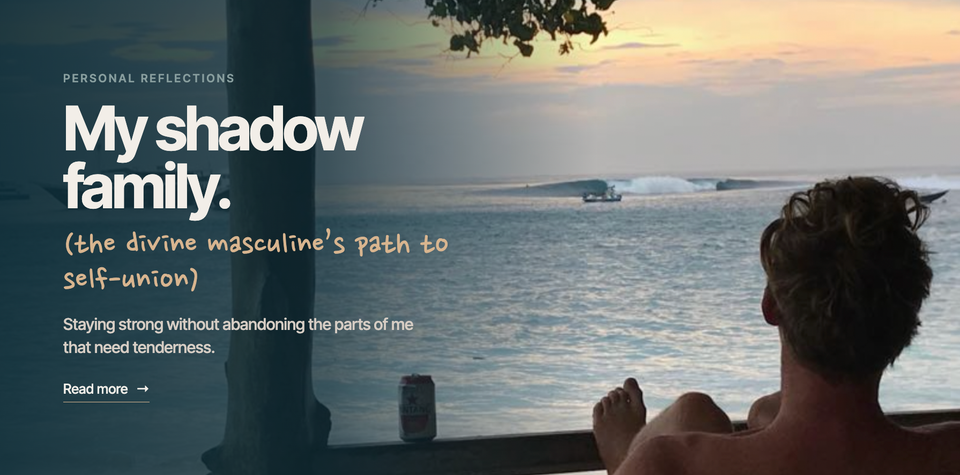
The divine masculine's path to self-union. Not learning to be a stronger man, but learning to stay strong without abandoning the parts of me that need tenderness.
A personal reflection.
I used to think my journey was about becoming a stronger man.
I don't think that anymore.
I've built real capacity. To hold responsibility, support others, create opportunities, get through adversity and repair what breaks. But the same strengths that carried me have also become ways I protect myself when my own needs feel threatened.
The journey isn't from weakness to strength. It's from strength as protection to strength that can live alongside tenderness, receptivity and needing other people.
What follows is a map I've been drawing of my own inner world, using shadow work, Internal Family Systems and the old masculine archetypes. It's a working map, not a diagnosis. Some of it I know is true. Some of it I'm still testing against how it actually feels.
The question this piece answers
What does shadow work look like for a man who has built his identity on being strong?
The quick answer. For me, it means meeting the parts of myself I've kept in the dark because they didn't fit the capable, giving, dependable man I became: need, grief, anger, rest, the longing to be held. Not to replace the protector, but to let him stop carrying everything. Self-union is when the warrior, lover, child and protector can all live in me without one silencing the others.
What I experienced
The central tension. On one side, the Sovereign Protector. Strong, capable, giving, responsible. "I can hold everything." On the other, the Tender, Unheld Self. Sensitive, grieving, loving, longing. "Who holds me?"
Integration is a third voice. "I can hold others, and I am worthy of being held. My needs and my strength belong together."
And the shadow isn't only the vulnerable self. It also holds anger, self-interest, limits, healthy dependence, desire, receptivity, and the ability to let someone else carry the load. Those feel uncomfortable precisely because my identity was built on being capable and dependable.
The shadows I've had to face.
Strength becoming self-abandonment. I've kept serving, mentoring and leading through bereavement, a business betrayal, financial pressure, physical recovery and relational grief. The protective voice says I'm capable. I'll be okay. The need underneath says I don't want to carry everything alone. The shadow appears when being capable becomes an unwritten rule against receiving.
Devotion becoming pursuit. My devotion is real. I value commitment, forgiveness and repair. But in at least one relationship, my wish to understand and repair kept going after the other person had asked for space. The protector believed that if I found the truth or explained my heart clearly enough, we wouldn't lose something beautiful. That's how love turns into persistence, and persistence into pursuit.
Truth-seeking becoming hypervigilance. After betrayal, I became highly sensitive to gaps between words and actions. That's useful. The shadow is when my mind needs to reconcile every contradiction before I can feel safe, and someone else's ambiguity occupies my attention long after I already know enough to choose.
Generosity becoming over-functioning. I see people's potential and invest in it. The shadow is taking responsibility for someone's growth beyond what they've asked for, and hoping my giving will make my own needs obvious instead of naming them.
Compassion becoming avoidance of anger. After betrayal I've felt the pull toward retaliation and chosen restraint. That restraint can be integrity. But there's a difference between choosing not to retaliate and being unable to acknowledge anger at all. The shadow says if I express my anger, I become the person who hurt me.
Sovereignty becoming isolation. I'm often the person others turn to, and I've found it harder to name who holds me. I've worried about burdening friends. The protector believes my pain is too much for others, so I should contain it.
The visionary attached to potential. I can see what people and projects could become. That's central to my work. In relationships, it can blur someone's present choices and capacity.
What I learned
My parts have names. These are working labels, not identities. In IFS the aim is to meet the actual part, not force it into a box.
Underneath may sit the exiles. These are possibilities to explore gently, not claims about buried memories. The Unheld Child: nobody is there when I need someone. The Unchosen Lover: I'm valued, but not fully chosen. The Unseen Man: people see my usefulness, not my humanity. The Betrayed One. The Grieving Son. The Exhausted One. The Ashamed One: I should have known better. The Lonely One: I have to face hard things by myself. The point isn't to convince myself these exist. It's to notice whether any of them actually arise in quiet, compassionate attention.
The old rules have new versions.
The wisdom I'd pass on
Let the four archetypes cooperate. The King, the Warrior, the Magician and the Lover are an old symbolic map of mature masculinity.
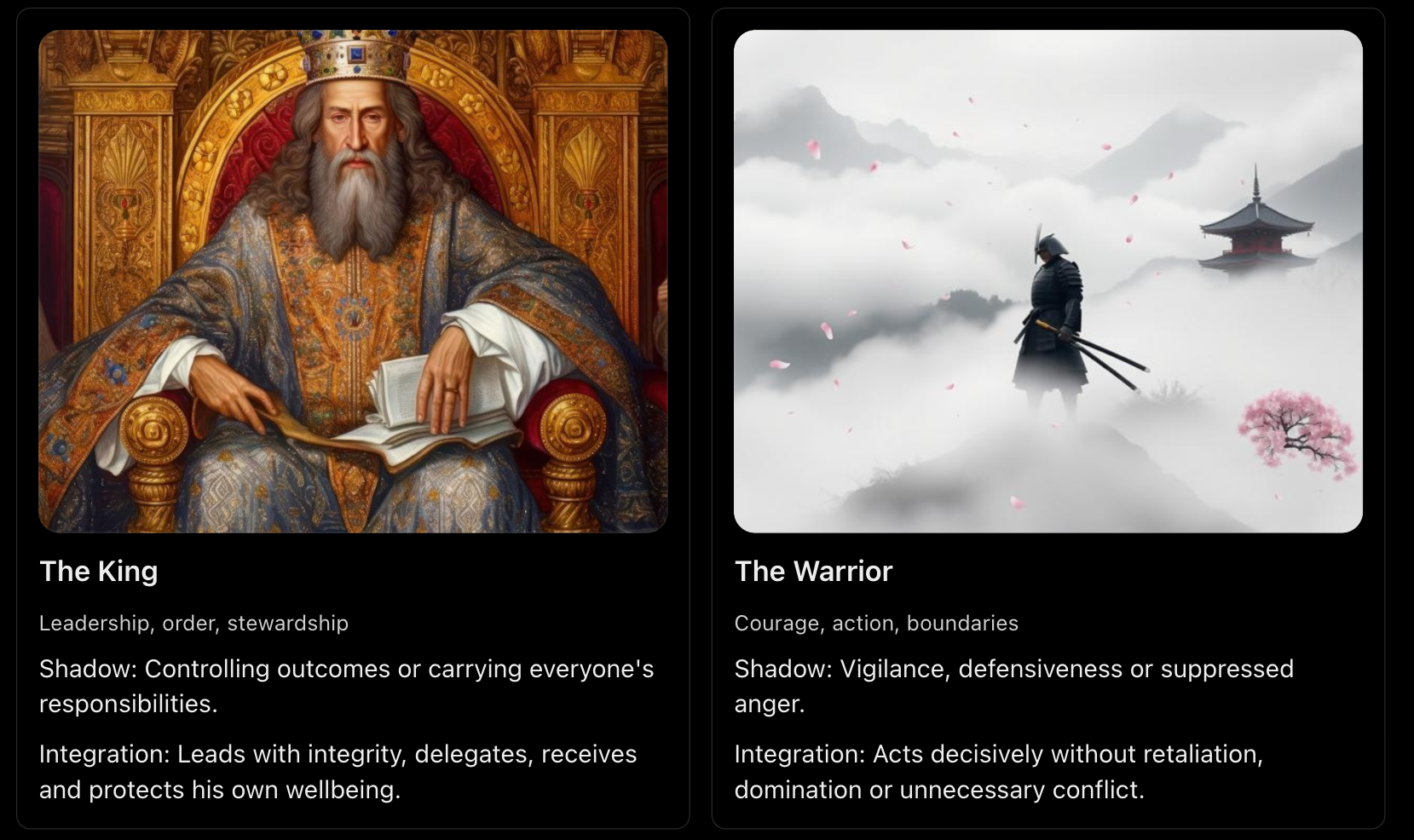
- The King leads and stewards. Shadow: controlling outcomes, carrying everyone. Integrated: leads with integrity, delegates, receives, protects his own wellbeing.
- The Warrior acts and holds boundaries. Shadow: vigilance, defensiveness, suppressed anger. Integrated: decisive without retaliation or needless conflict.
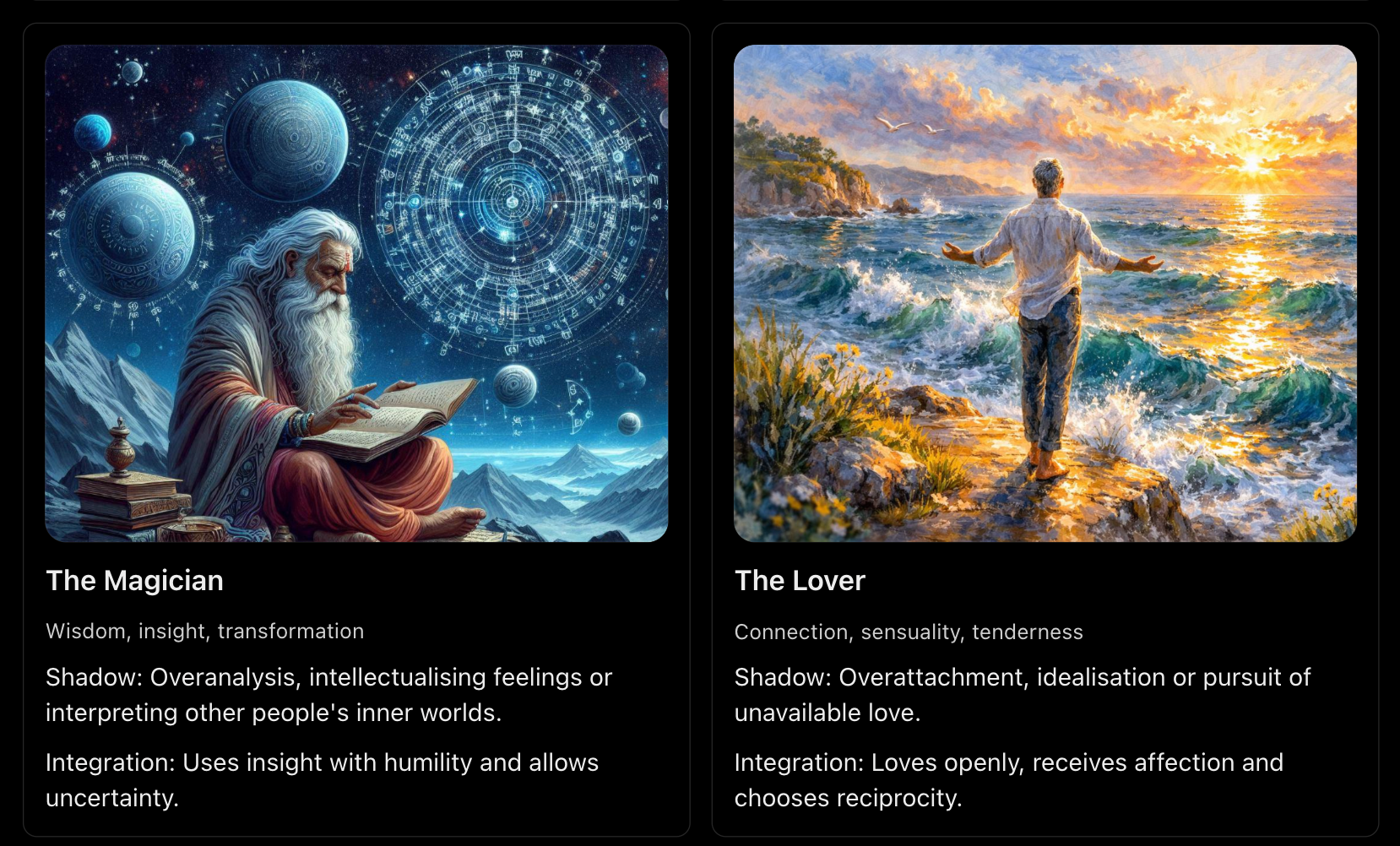
- The Magician brings insight. Shadow: overanalysis, intellectualising, interpreting other people's inner worlds. Integrated: uses insight humbly and allows uncertainty.
- The Lover connects. Shadow: idealisation, pursuing unavailable love. Integrated: loves openly, receives affection, chooses reciprocity.
Self-union is when they stop competing. The King doesn't silence the Lover. The Warrior doesn't overpower the grieving child. The Magician doesn't analyse every feeling into submission.
Meet one part at a time. Start with the Protector. Ask: What do you fear would happen if I stopped holding everything together? Notice what arises in the body, the feelings, the thoughts. Don't force an answer. Then ask: What do you want me to understand? For my Protector, the answer seems to be permission to rest and share the load.
Practise being ordinary in front of trusted people. Not the mentor, the leader, the healer, or the man who always knows. Just a man who can say I'm tired. I'm grieving. I need help. I'd love a hug. I don't know. Can you stay with me a while? And remain fully worthy of love.
The divine masculine doesn't have to transcend human need. He makes room for it.
Where this does not reach
This is a self-map, not a diagnosis. The parts and exiles are hypotheses I'm testing in my own experience. They're not a clinical assessment and shouldn't be read as one.
Stop if it overwhelms. If meeting a part brings overwhelming distress, traumatic memories or dissociation, stop and ground yourself. Deeper processing belongs with a qualified, IFS-informed therapist.
Archetypes are symbols. King, Warrior, Magician and Lover, and the divine masculine itself, are frameworks for reflection, not claims about how men must be.
The evidence, named and dated
- Robert Moore and Douglas Gillette, King, Warrior, Magician, Lover (1990). The source of the four masculine archetypes, drawing on Jungian psychology. A symbolic framework, not empirical research.
- Richard Schwartz's Internal Family Systems (from 1995) provides the language of protectors, firefighters, exiles and Self. A 2025 scoping review found its evidence promising but still early (see The Protector and the One Who Wants to Be Held).
- Personal, and labelled: the eighteen parts, seven shadows and integration rules are my own working map.
The shift
I used to think I had to be the one holding everything.
Now I'm learning I can hold others and still be held.
One thing, for the next day
Choose one part from the table that feels most alive in you this week.
Ask it one question: What are you protecting me from? Write down whatever comes, without editing.
The spine of it
The journey isn't from weak to strong. It's from strength as protection to strength that includes tenderness. The Protector and the Unheld Self belong together. Seven shadows: self-abandonment, pursuit, hypervigilance, over-functioning, avoided anger, isolation, attachment to potential. Eighteen parts, each with a gift and an overreach. The exiles are possibilities, not verdicts. King, Warrior, Magician and Lover cooperate. The divine masculine makes room for need.
Questions people ask
What is shadow work for men? Meeting the parts of yourself you've disowned because they didn't fit your idea of strength, like need, grief, anger or rest, and integrating them.
What are the four masculine archetypes? King, Warrior, Magician and Lover, from Moore and Gillette's 1990 book. Each has a mature form and a shadow form.
How do I know if my strength has become a defence? Notice where being capable stops you receiving help, where loyalty keeps you somewhere unhealthy, or where understanding everything feels like a condition for safety.
Is it safe to do parts work alone? Gentle inquiry can be helpful. If it brings up overwhelming distress or trauma, stop and work with a trained therapist.
What does self-union mean? All the parts of you, the strong and the tender, coexisting without any one of them dominating or silencing the others.
If I stopped being the protector, provider, healer, teacher and bridge builder for a moment, what part of me is afraid that nobody would choose to stay?
My path isn't from weakness to strength. It's toward strength that can be held.