
What Grief Taught Me About Love
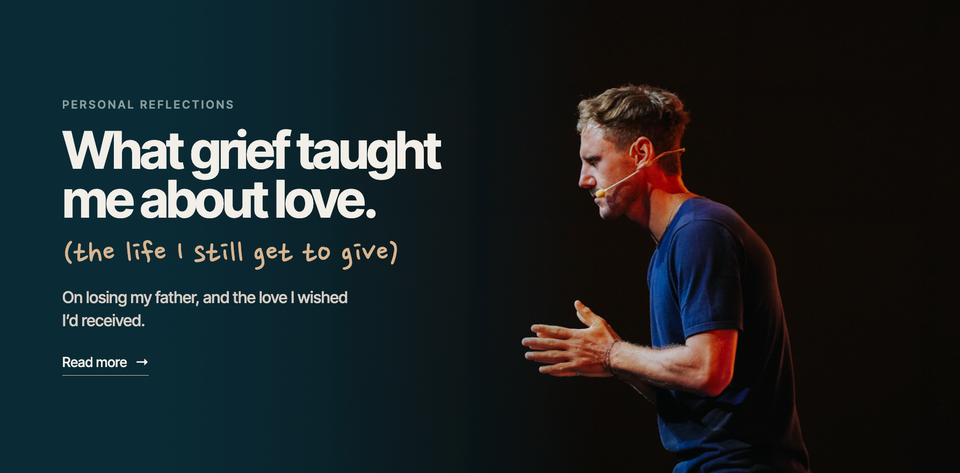
On losing my father, the love I wished I'd received, and the life I still get to give.
A personal reflection.
I've been reflecting on what grief has taught me about love.
Not the romantic version of grief. Not the idea that every loss happens for a reason. Not the belief that suffering is required for growth.
The kind of grief that changes how you see life. The kind that arrives when someone dies, a relationship ends, trust breaks, or a future you imagined will never come. The kind that shows how little we control, and how deeply we can love.
When my father died, something shifted. I started reflecting not only on the man he was, but on the man I'd become. What I received. What I missed. What I want to carry forward.
And I began to understand something.
Grief isn't only the pain of losing someone. It's also the pain of losing what we hoped the relationship might one day become.
The conversations we never had. The questions we never asked. The understanding we hoped we'd still reach.
We don't only grieve what was. We grieve what wasn't, and what now never will be.
The question this piece answers
What does grief teach us about love?
The quick answer. For me, grief taught me that love and disappointment can live together, that presence is love made visible, and that the strongest person still needs to be held. It showed me we mourn the future as much as the past, that love shouldn't be postponed, and that continuing to live fully isn't a betrayal of what we've lost.
What I experienced
Love and disappointment can coexist. I used to think loving someone fully meant accepting everything about them, and forgiving meant no longer feeling hurt. Grief taught me otherwise. I can love my father and acknowledge how his absence affected me. I can be grateful for the life he gave me and still wish parts of our relationship had been different. Love doesn't require me to deny reality. Sometimes it's the capacity to hold the whole truth without turning someone into a hero or a villain.
I mourned the future as much as the past. When someone dies, we grieve the birthdays, the ordinary afternoons, the chance to ask one more question. I've come to see this grief isn't only about death. We grieve a relationship that ended, a partnership we believed in, a business we poured ourselves into, a future we could see so clearly it felt real. Not because we were foolish to hope. Hope is part of how we love.
And I was the one holding everything. The calm one. The one who handles it, holds the family, keeps the business moving. I said I was fine and kept going. Then in the quiet moments I noticed how tired I was, and how much I longed for something simple. A hug. Someone to ask how my heart was. Someone who didn't need me to be useful.
The ability to hold others doesn't remove the need to be held.
What I learned
Presence is love made visible. I've spent much of my life holding space, mentoring, creating opportunities. I love that part of me. But grief reminded me that love isn't always about what I can do for someone. Sometimes it's just being with them. Putting the phone down. Not solving. Saying I'm here. You don't have to be strong right now. Not the promise that I'll always know what to do. The willingness to stay present when I don't.
Love isn't the same as responsibility. I can care deeply, encourage, listen and offer support. I can't live someone else's life, force honesty, or build a reciprocal relationship alone. Love isn't measured by how much of myself I'm willing to abandon. It can be generous without being limitless.
Their limits weren't a measure of my worth. As children we measure parents against what we needed. Growing older, I began to see the person behind the role. Someone shaped by experiences I'll never fully know. What I didn't receive wasn't proof I wasn't worthy of receiving it. That understanding brought me closer to compassion, for him and for myself.
Self-forgiveness isn't denying responsibility. For the conversations I didn't have. The time I thought we had. I can own my part, make amends where I can, and learn. But I don't have to turn my humanity into a lifelong punishment.
Love doesn't end when a relationship changes. It can become gratitude, wisdom, a boundary, a memory, or the choice to live differently. That's true of death, and of relationships that end while both people are still alive. I don't have to go back to someone to honour what they taught me.
The wisdom I'd pass on
Don't postpone love. We don't know how much time we have. With parents, partners, friends, even our dogs. We imagine there'll always be another visit, another conversation, another chance to say what matters. Sometimes there is. Sometimes there isn't. Not every relationship needs repairing, and I don't want to live in fear of loss. But love becomes meaningful through how we choose to express it while we can. I love you. I'm proud of you. I'm grateful you're here.
Let the sadness and the joy both have their place. I don't believe grief is something to conquer, or that healing means never feeling sad again. Sometimes grief is simply love meeting an absence it can't change. The invitation is to carry it gently while still taking part in life. To grieve and laugh. Remember and create. Continuing to live fully is not a betrayal of what we've lost.
Let love include you. Grief asked me a question I couldn't answer with another achievement. Can you offer yourself the love you offer everyone else? Can I rest without guilt? Ask for support? Let someone care for me? Believe I'm worthy of love when I have nothing to give? I don't want to be a man who nourishes everyone around him while quietly abandoning himself.
Live the legacy now. Death makes some things feel smaller. The arguments. The status. The need to prove myself. And it makes other things clearer. The people I love. My health. The ocean. Hugs. I don't want to build a legacy that costs me the life I'm here to live. I want the people I love to know what they mean to me before I'm gone.
Where this does not reach
Grief has no timeline. Nothing here is a schedule for feeling better. Some losses stay tender for a very long time.
Sometimes grief needs more than reflection. If grief feels stuck, overwhelming or unbearable for a long time, or you're having thoughts of not wanting to be here, please reach out to a doctor, a grief counsellor or a crisis line. Grief can be carried. It doesn't have to be carried alone.
Not every lesson needs to be found. You don't have to turn your loss into wisdom. Sometimes grief is just grief.
The evidence, named and dated
- Stroebe and Schut (1999), Death Studies, "The Dual Process Model of Coping with Bereavement." They describe healthy grieving as moving back and forth between facing the loss and re-engaging with life, rather than working through grief in one direction. It supports letting the sadness and the joy both have their place.
- Personal, and labelled: "grief is love meeting an absence it can't change" is my own line. The seed-and-forest reflection is explored more fully in My Father's Absence Taught Me Presence.
The shift
I used to think love was what I'd feel once someone was gone.
Now I think it's what I choose to embody while we're both here.
One thing, for the next day
Tell one person, today, one thing you'd want them to know if you didn't get another chance.
Keep it simple. I'm grateful you're here is enough.
The spine of it
Grief is losing what was, and what we hoped would be. Love and disappointment can coexist. We mourn the future as much as the past. The strongest still need to be held. Presence is love made visible. Love isn't responsibility. Their limits weren't my worth. Don't postpone love. Let sadness and joy both have their place. Living fully isn't betrayal. Let love include me.
Questions people ask
How do you grieve a parent you had a complicated relationship with? Let love, disappointment and gratitude all exist together. You don't have to resolve them into one feeling.
Is it normal to grieve the relationship I never had? Yes. Grief often includes mourning the future and the connection we hoped for, not only what was.
Is it wrong to feel happy while grieving? No. Research on bereavement suggests moving between grief and re-engaging with life is a healthy part of coping.
How do I stop feeling guilty about things I didn't say? Acknowledge it, take what you can from it, and offer yourself the compassion you'd offer a friend. Then say those things to the people still here.
When should I get help with grief? If grief feels stuck, unbearable or is affecting your safety or daily life for a long time, reach out to a professional.
Love isn't only what we feel when someone is gone. It's what we choose to embody while we're here.
Who would you want to know they matter to you, before there's no more time?