
My Father's Absence Taught Me Presence
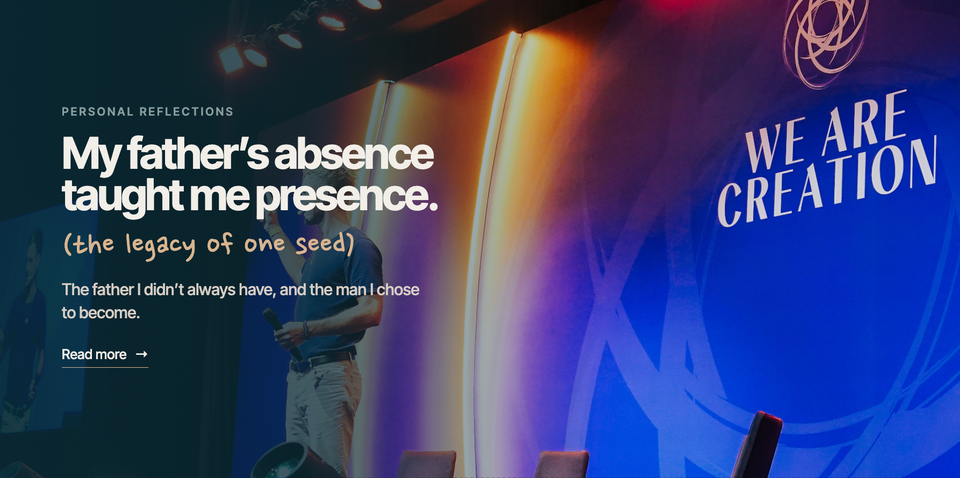
The father I didn't always have, the man I chose to become, and the legacy of one seed.
A personal reflection.
I've been reflecting on something since my father's passing. Something that has taken me much of my life to understand.
My father's absence taught me presence.
Not in the way I would have chosen. Not without pain, confusion, or moments I wished things had been different.
But in trying to understand his life, his struggles and the circumstances that shaped him, I began to understand my own. I learned compassion. Forgiveness. And, most of all, how to stop fighting the war within myself.
When we start seeing our parents not only as parents but as human beings, something shifts. They were once children too. With dreams, fears, wounds and unmet needs. Living their first lives. Learning as they went. Carrying things they never learned how to put down.
That understanding doesn't erase the consequences of their choices. It changes how we carry them.
The question this piece answers
How do you make peace with a father who wasn't fully present?
The quick answer. For me, it started with curiosity about the man behind the role. Understanding didn't mean excusing. I could love him and still wish things had been different. His absence became a blank canvas to choose the man I wanted to be. And I came to see his life differently: perhaps his purpose was to plant one seed, and that seed was me.
What I experienced
The grief of the distance. There's a particular grief in recognising the gap between the father I needed and the father I had. The guidance, the reassurance, the presence. Sometimes those things were there. Sometimes they weren't. Sometimes they arrived in forms I didn't know how to recognise. For years I measured him against an image of what a father should have been.
Eventually I asked a different question. Not why couldn't he be the father I needed? But what happened in his life that shaped the man he was capable of being? What had he inherited? What was he never taught? What fear did he carry? I may never know every answer, and I don't need to invent explanations to make the past easier. But curiosity let me see a man beyond the role. That changed something in me.
A blank canvas. Growing up without a consistent model of the man you want to become brings real uncertainty. No one showing you how to love, handle conflict, carry responsibility or respond to failure. You learn by trial and error. But I began to see another possibility. Without one fixed model to follow, I could consciously choose the kind of man I wanted to become. I didn't have to become a copy of my father. I didn't have to become his opposite either, because defining ourselves against someone can keep us just as bound to their story.
The world became my classroom. I learned from men whose character I respected, not necessarily the most successful or powerful. How they kept their word. How they treated their partners and children. How they carried themselves when nobody was watching. And I learned from what I didn't want to embody. Dishonesty taught me truth. Inconsistency taught me reliability. Absence taught me presence. Character became something I could practise, not just believe in.
What I learned
Understanding isn't excusing. Compassion isn't pretending everything was okay. Forgiveness isn't rewriting the past. And there's real pressure, especially in healing circles, to turn every painful experience into a beautiful story before we've grieved it. I can recognise my father was human and that his absence affected me. I can honour what he gave and grieve what he couldn't. I can love him and still wish some things had been different. Two truths can coexist without cancelling each other out. I don't need to make him a hero or a villain. I can let him be human, and let myself be one too.
The war within settled when I stopped fighting. For a long time I fought my own emotions, my need for love, my grief. I tried to become stronger, more successful, more independent, as if achieving enough might quiet the part of me that still felt something was missing. The deepest lesson was that I didn't need to spend my life proving I was different, or achieving enough to make up for what I didn't receive. I could take responsibility for my life without taking responsibility for everything that happened to me.
I can honour him without repeating his journey. I can carry forward what nourished me and consciously change what didn't. Not rejecting him, not idealising him. Choosing what continues through me. The greatest way to honour the past may be to take its lessons and create a more loving future.
I want to be present, not just there. I don't want to become a father who is simply there. I want to become one who is genuinely present. And I don't have to wait for children to start. I can practise presence now, in my friendships, my work, my community, and how I care for myself.
The wisdom I'd pass on
What if his purpose was one seed? This changed how I understand purpose. What if my father wasn't here to build a business, write a book or reach thousands of people? What if one of the most meaningful things his life gave was bringing me into the world? What if his purpose was to plant one seed, and that seed was me?
And if that seed went on to help people, and some of them helped others, whose purpose was greater? His, or mine?
The answer that comes to my heart is simple. Neither. Without the first seed, the next chapter doesn't exist. My father's life doesn't need to be measured against mine. His contribution doesn't need to be visible to thousands to have meaning. And I don't need to turn his life into a story of destiny to recognise what he gave. He gave me life, and that life became my chance to give something to others.
The value of a life isn't the size of its audience. We make purpose too complicated. A man's purpose can be as simple as loving his family well, keeping his word, or helping one person. A father who raises one child well may influence generations. The value of a seed can't be measured only by what it becomes in its own lifetime.
You can make peace with someone who's gone. Not through the conversation you finally get to have, or the apology you'll never receive. Through a deeper peace within. The story can stay unfinished in some ways while my relationship with it keeps evolving. I can stop waiting for the past to become different before letting my future become beautiful.
Where this does not reach
This isn't a script for forgiving every parent. Some absences involved harm, abuse or danger. Understanding a parent's history doesn't oblige anyone to forgive, reconcile or feel grateful.
Grief for a complicated parent is real grief. It can include love, anger, relief and longing all at once. None of it needs to be resolved quickly.
Some of this needs support. If a parent's absence still shapes your relationships in ways that hurt, a therapist who works with family history can help in ways reflection alone can't.
The evidence, named and dated
- Marinus van IJzendoorn (1995), Psychological Bulletin. His meta-analysis found that how parents make sense of their own childhood, the coherence of their story about it, predicts their children's attachment security. It supports the idea that what we pass forward depends partly on how we come to understand our past, not only on what happened.
- Klass, Silverman and Nickman (1996), Continuing Bonds. This work challenged the idea that grief means "letting go." It describes how relationships with people who've died can continue and change over time. It supports making peace with a father after he's gone.
- Personal, and labelled: "one seed" and the blank canvas are my own reflections. They're not claims about how purpose works for anyone else.
The shift
I used to measure my father by what wasn't there.
Now I see a man who planted a seed, and a son who gets to choose what grows.
One thing, for the next day
Write one sentence beginning: What I wish I'd had from my father was...
Then write a second: What I choose to give is...
The spine of it
A father's absence can teach presence. Get curious about the man behind the role. Understanding isn't excusing. Two truths can coexist. Absence can become a blank canvas. Character is practised, not claimed. Stop fighting the war within. Honour him without repeating his journey. Maybe his purpose was one seed. Neither purpose is greater. Peace with the past doesn't need the past to change.
Questions people ask
How do I heal from an absent father? Start by getting curious about his life and what shaped him, while still acknowledging what you missed. Understanding and grief can sit together.
Do I have to forgive my father? No. Forgiveness is a choice and runs on your own timeline. Understanding someone isn't the same as excusing them.
How do I avoid repeating my father's mistakes? Notice what you inherited, choose what to keep and what to change, and learn from men whose character you respect.
Can you make peace with a parent who has died? Yes. Research on continuing bonds suggests your relationship with them can keep evolving after they're gone.
What if my father's life seemed to have no purpose? A life's value isn't the size of its audience. Raising a child, keeping your word, or loving one person well can ripple further than anyone sees.
To my father
Dad,
I've been thinking about your life. The man you were. The things you carried, the things you gave, and the things you may never have known how to give.
For a long time I didn't understand. There are parts of your experience I may never fully know. But as I've grown older, I've learned to see you with more compassion. Not only as my father. As a man, trying to make sense of life in his own way.
I can acknowledge the moments I wished you were more present. And I can see how deeply they shaped what presence means to me. I can acknowledge what I missed and still be grateful for what I received.
Because you gave me life. And life gave me the chance to discover who I wanted to become.
I found teachers. Mentors. Men whose character I admired. Relationships that taught me about love, and hard seasons that taught me how to return to myself. I learned how to build, how to lead, how to forgive, how to set boundaries and stay open-hearted. And how to stop fighting myself.
I'm still learning. I always will be. I don't need to be a perfect man. I want to be one whose life reflects what he believes.
And Dad, I've realised something. Your purpose didn't need to look like mine. Perhaps one of the most meaningful things you ever did was plant a seed. And that seed was me. I don't believe that makes my purpose greater than yours. It reminds me we need one another, and that every generation gets to choose what it passes forward.
So thank you for the life you gave me. For the lessons I found along the way. For the chance to choose, to grow, and eventually to simply be.
I don't want to spend the rest of my life wishing the past had been different. I want to spend it creating a future that honours what I've learned. A present father, if that's given to me. A loving partner. A trustworthy friend. A man who doesn't just leave a legacy, but lives one.
Your absence taught me presence. Your humanity taught me compassion. And the life you gave me became the canvas on which I could choose the man I wanted to become.
You planted a seed. I'm helping grow a forest.
Neither purpose is greater. Both matter. Both belong.
Rest peacefully, Dad.
I'll keep living. I'll keep loving. I'll keep planting.