
When the Divine Feminine Calls Forth the Divine Masculine
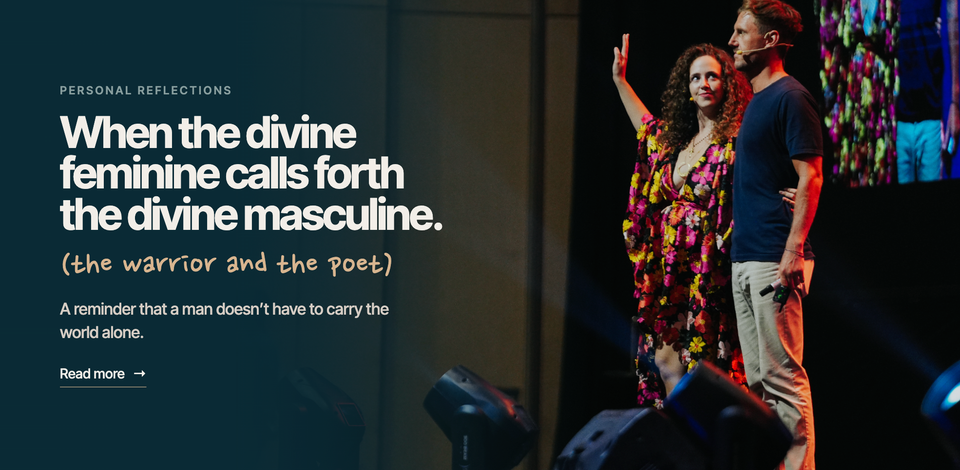
The warrior, the poet, and the reminder that a man doesn't have to carry the world alone.
A personal reflection.
There's something beautiful that happens when a woman sees past a man's armour.
Past his accomplishments, his leadership, his responsibilities, his reputation. Past the man who builds, provides, protects and holds so much together.
And sees the human being underneath. The tenderness. The longing. The playful boy. The poet. The heart that has loved deeply, lost deeply, and somehow stayed open.
Not because he's incomplete. Not because she's come to save him.
Because her presence reminds him he's allowed to be more than the man the world has needed him to become.
Maybe that's one of the most beautiful expressions of the divine feminine. Not the power to change a man. The capacity to invite him into a deeper experience of himself.
The question this piece answers
What does the divine feminine and divine masculine actually look like in a healthy relationship?
The quick answer. For me, it isn't fixed roles where he leads and she surrenders. It's two people inviting each other into their fullness. She can help him set down armour he no longer needs. He can show her that love and freedom can coexist. Both surrender protective performances, not sovereignty. And neither is responsible for awakening, rescuing or completing the other.
What I experienced
She saw the man behind the warrior. Some men spend most of their lives learning to be strong. To stay calm in the storm. To turn pain into purpose. People see the leader, the builder, the teacher. Fewer ask what it's like to be the man beneath it. What he's grieving. Where he feels safe enough to rest. Then sometimes someone looks past the armour and gets curious about his humanity. She sees the warrior. She also sees the poet. And she doesn't ask him to choose.
Not every wall is armour. You can't demand vulnerability from someone whose discernment was built through broken trust. Sometimes what looks like armour is wisdom. A boundary isn't always a wall. Caution isn't always fear. Sometimes the man who seems guarded has simply learned the difference between beautiful words and consistent behaviour. The divine feminine doesn't need to destroy his discernment to reach his heart. The armour doesn't have to be ripped away. It can be set down gently, when trust, consistency and care make that possible. And he offers her the same freedom.
The poet woke up. The deeper a man is rooted in his values, the less he needs to prove his strength. He becomes more comfortable with tenderness, affection, play. He doesn't lose his masculinity by becoming emotionally available. He expands it. The poetry. The silliness. Dancing in the kitchen. Disappearing into the ocean. An ordinary morning that somehow feels extraordinary. The warrior doesn't need to disappear for the poet to live. One brings discernment, the other wonder. One protects what matters, the other surrenders to beauty.
What I learned
Higher, not harder. There's a difference between a woman who inspires a man to become more himself and a relationship where he must keep proving his worth. One invites expansion. The other creates performance. When she truly sees his heart, she may not ask him to build a bigger kingdom or earn more. She may invite something braver. To rest. To receive. To play. To remember his purpose isn't his whole identity. She doesn't call him to become a greater performer. She calls him to become a more complete human being.
Roles aren't the sacred part. I love the language of masculine and feminine when it points to qualities we can all cultivate. Receptivity, presence, courage, clarity, devotion. But the essence gets lost when they harden into rules. The man always leads. The woman always surrenders. Real people are more beautiful than that. A woman can be fiercely courageous. A man can be profoundly tender. Both can lead, protect, nurture and rest. The sacred isn't in performing a masculine or feminine identity. It's in letting both people express their fullness.
Surrender flows both ways. We often imagine surrender as the feminine allowing herself to be led. But his surrender might be letting someone love him. Stopping the automatic I'm good. Admitting he's tired. Receiving comfort without feeling indebted. Her surrender might be staying present when closeness feels unfamiliar, communicating instead of disappearing. The deepest surrender is mutual. Not two people giving up sovereignty. Two people releasing the performances that stop them being known.
Meet, don't rescue. When the business is uncertain, grief arrives, or the man who holds everything doesn't know what to do next, love can look very simple. Sitting beside him. Holding his hand. Making him something to eat. Asking how his heart is. Not needing his pain to become beautiful before it's allowed to exist. Sometimes the most loving thing to offer a strong person is permission to be human without fixing them. And he can offer her the same.
Love invites change. It can't replace responsibility. She can inspire and encourage him. She can't do his inner work, make him emotionally available, or love him into integrity. And she shouldn't have to. The same is true the other way. Each person is responsible for their own growth.
The wisdom I'd pass on
Let discernment and surrender dance. There's a romantic idea that when true love arrives, we should throw away the rulebook. I understand it. Life can get overmanaged. But the deepest love doesn't ask us to abandon earned wisdom. The mind isn't always the obstacle to love. Sometimes it's checking whether what I feel matches what I experience. The heart isn't always irrational. Sometimes it's reminding me of possibilities I'd stopped considering. A beautiful partnership can be grounded enough to hold the wild, and wild enough to keep the grounded alive.
Make sanctuary both ways. What touches me most is coming home after giving everything, after a keynote, a retreat, a hard season, to someone who doesn't need the leader. Just the man who wants to take his shoes off, laugh, be held, share a meal, and fall asleep knowing he doesn't have to perform to deserve affection. And I want to offer her exactly the same. A place where she doesn't have to be beautiful, successful, strong or endlessly available. Where her worth is never measured by what she gives me.
I water her roots. She waters mine. Neither of us has to be depleted for the other to flourish.
Receive the invitation without making it a promise. Sometimes someone arrives and offers something extraordinary. A conversation. A moment of tenderness. A reminder of a part of yourself you'd neglected. That can be deeply meaningful. It doesn't automatically mean a shared future. Not every person who sees your heart is your partner. Sometimes the gift is simply being seen. The most beautiful invitation to love is one that leaves both people free.
Where this does not reach
These are metaphors, not gender rules. Divine masculine and feminine describe qualities anyone can carry, in any relationship. They aren't instructions for how men and women should behave.
Seeing someone's heart isn't a reason to stay. If a partner is consistently unavailable, unkind or unsafe, recognising their tenderness doesn't oblige you to keep waiting for it.
Some armour needs professional help to set down. Patterns built through trauma can need more than a loving relationship to soften.
The evidence, named and dated
- Sandra Bem (1974), Journal of Consulting and Clinical Psychology. Bem's work on psychological androgyny argued that "masculine" and "feminine" traits aren't opposite ends of one scale, and that people can hold both. It supports the idea that the sacred isn't in performing a fixed role. Limit: later research has refined and debated parts of her model.
- Personal, and labelled: divine masculine and feminine, the warrior and the poet, and "I water her roots" are my own spiritual and poetic language, held as metaphor, not evidence.
The shift
I used to think a man had to be strong to be worthy of love.
Now I think the right love reminds him he never had to be.
One thing, for the next day
Name one piece of armour you still carry. Then ask honestly: is this protection, or is it wisdom?
Keep what's wise. Notice what's ready to be set down.
The spine of it
She sees the poet as well as the warrior. Not every wall is armour, and discernment can be wisdom. The poet can live beside the warrior. Called higher, not harder. Roles aren't the sacred part. Surrender flows both ways. Meet, don't rescue. Love invites change but can't replace responsibility. Let discernment and surrender dance. Make sanctuary both ways. An invitation isn't always a promise.
Questions people ask
What is the divine masculine and divine feminine? Spiritual language for qualities like presence, receptivity, courage and devotion. They're best understood as qualities anyone can cultivate, not fixed gender roles.
How can a partner help a man be more vulnerable? By creating safety through consistency and care, not by demanding he drop his guard. Vulnerability can't be forced.
Does surrender in a relationship mean giving up control? Healthy surrender means letting go of protective performances, not your boundaries, voice or sovereignty. Both partners do it.
Can a woman change a man? She can inspire and support him, but each person is responsible for their own inner work.
Is it healthy to want a partner to be a sanctuary? Yes, when it flows both ways and neither person's worth depends on what they provide.
Perhaps the divine feminine's greatest gift isn't teaching the masculine to be stronger. It's reminding him he never needed to be strong to be worthy of love. And perhaps the masculine's is showing her, through consistent care, that love and freedom can coexist.
What would you set down if you knew you'd still be loved?