
When the King Lays Down His Armour
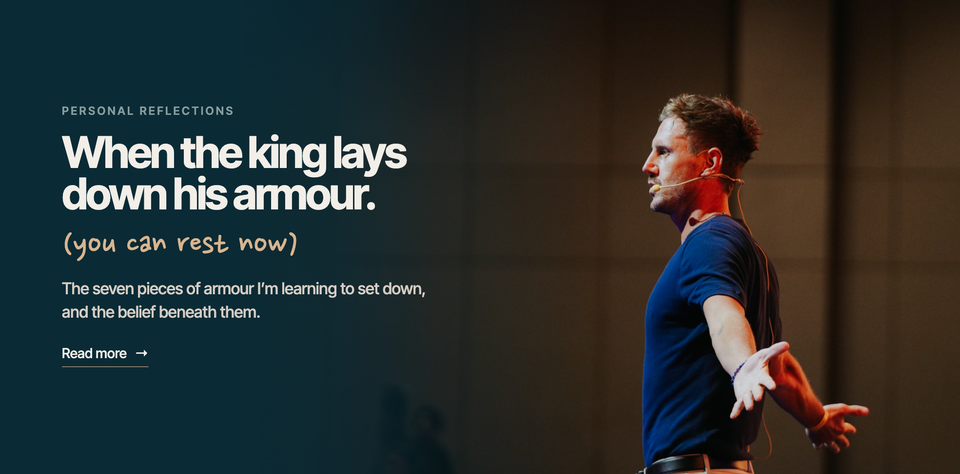
"You can rest now king". The seven pieces of armour I'm learning to set down, and the one belief underneath all of them.
A personal reflection.
I used to think the armour I needed to put down was around my ability to love.
It isn't. I've loved deeply, and often.
The deeper armour is around letting myself be loved, supported, protected and cared for without having to be the strong one first.
When I looked closely, it wasn't one piece. It was seven.
The question this piece answers
Why do strong, capable people struggle to receive love and support?
The quick answer. For me, it's because strength became protection. Self-sufficiency, holding everyone, constant vigilance, turning pain into meaning, being valued for usefulness, carrying the relationship, and waiting to be understood without asking. Underneath them all sat one belief: I'm safest when I hold myself. The new strength is knowing how to hold myself, and letting trustworthy people hold me too.
What I experienced
These are the seven pieces I found.
1. The self-sufficient man. "I've got this. I'll figure it out. I don't need anything." I've learned to navigate real responsibility, uncertainty and loss. I know how to regulate myself, find solutions and keep moving. That strength is real. But somewhere along the way, self-sufficiency stopped being only a skill and became protection against the disappointment of needing someone who might not show up.
2. The warrior and protector. "I'll hold everyone else. I'll make sure they're okay." I'm good at holding space for other people's pain. But even when I'm the one grieving, exhausted or frightened, I can find myself managing everyone else's experience of it.
3. Discernment becoming hypervigilance. "I need to understand everything before I can feel safe." My discernment was built through real experiences of broken trust, and much of it is valuable. I notice when words and actions don't match. But it gets exhausting when my mind keeps scanning for inconsistency or hidden meaning. The strategy underneath: if I can understand everything, maybe I can stop being hurt again.
4. The healer and meaning-maker. "I can turn this pain into purpose." It's one of my gifts. But can I let pain just be pain before I make it useful? Can grief exist without becoming an initiation? Can I feel hurt without immediately reaching for the higher perspective?
5. Being valued for usefulness. "People love the leader, the mentor, the creator. Would they love the man with nothing to give?" This may be the deepest layer. I've built a life around contribution, and I've often felt celebrated for my strength and generosity while unseen in my vulnerability. That leaves a quiet question: would someone still choose me if I weren't providing, leading or holding everything together?
6. Over-functioning in love. "If I understand them deeply enough and create enough safety, maybe we'll find our way through." Loyalty, patience and repair are strengths. But I've watched devotion become persistence, persistence become pursuit, and compassion become taking responsibility for someone else's growth. I can stay invested in someone's potential longer than their present behaviour supports.
7. Asking to be held. "I want someone to see what I need without my having to explain it." This is the most tender one. When people ask how I am, my first instinct is still I'm good, even when I'm not. Underneath is a longing for someone to notice the weight without my having to name it. And maybe a belief that if I have to ask for care, it counts for less.
What I learned
Each piece has something to set down and something to let in.
I'm not letting down my strength. Not my independence, discernment, purpose, boundaries or masculinity. Not the wisdom I've earned. I'm not being asked to trust someone just because they offer tenderness. I don't need to become less devoted. I need to stop doing the work of two people.
And someone can love me and still need me to tell them what would help. That one surprised me. Being deeply loved doesn't always mean being intuitively understood.
The wisdom I'd pass on
Name the belief underneath. If I distil all seven into one protective belief, it's this:
"I'm safest when I can hold myself, because I can't always trust that someone else will hold me."
That belief helped me survive. It made me capable, independent and resilient. But it doesn't need to govern every close relationship anymore.
The new strength isn't dependence. It isn't I need someone else to make me safe. It's:
"I know how to hold myself. And I can let trustworthy people hold me too."
Move from protection to choice.
Safety is discovered, not assumed. Someone offering tenderness may invite me to soften. That doesn't make them responsible for healing my armour, and it doesn't automatically make it safe to set it down. That safety is found through mutual consistency, over time.
Where this does not reach
Understanding isn't the same as changing. Hypervigilance, emotional self-reliance and difficulty receiving care often live in the body as much as the mind. A trauma-informed therapist can help in ways insight alone can't. That isn't a sign of disorder. It's how protective patterns soften.
Not everyone is safe to set armour down with. Discernment stays. Letting people in is meant for those who've shown, consistently, that they can be trusted.
These are my seven. Yours may be different, fewer or more. The table is a mirror, not a diagnosis.
The evidence, named and dated
- John Bowlby described "compulsive self-reliance" in his attachment work (Attachment and Loss, 1969 to 1980): a pattern where people who learned early that needs might not be met come to rely only on themselves. It's the research name for the first and deepest piece of armour here.
- Personal, and labelled: the seven pieces of armour and the core belief are my own reflection on my own patterns, not a clinical framework.
The shift
I used to believe I was safest holding myself.
Now I'm learning I can hold myself, and still let myself be held.
One thing, for the next day
The next time someone asks how you are, don't say I'm good on reflex.
Say one true thing. And if you can, ask for one small thing you need.
The spine of it
The armour isn't around loving. It's around being loved. Seven pieces: self-sufficiency, holding everyone, hypervigilance, meaning-making, usefulness, over-functioning, waiting to be understood. Each has something to set down and something to let in. The strength stays. One belief sits underneath: I'm safest holding myself. The new strength: I can hold myself, and let trustworthy people hold me too.
Questions people ask
Why is it so hard for strong people to receive help? Often because self-reliance became protection against being let down. Receiving can feel riskier than giving.
Is hypervigilance the same as good judgment? No. Discernment notices real patterns. Hypervigilance keeps scanning even when there's no sign of threat, and it's exhausting.
Does letting my guard down mean losing my boundaries? No. Setting armour down is about letting trustworthy people in, not dropping your standards.
Should a partner just know what I need? Not always. Someone can love you deeply and still need you to say what would help.
Can therapy help with emotional self-reliance? Yes. Trauma-informed therapy can help the body unlearn protective responses that insight alone doesn't shift.
What feels more vulnerable: trusting that someone won't leave, or letting them see how much you actually need love and tenderness?
Your answer may show you which piece of armour sits closest to your heart.
When the king lays down his armour, he can rest now.