
When the Lighthouse Goes Dark
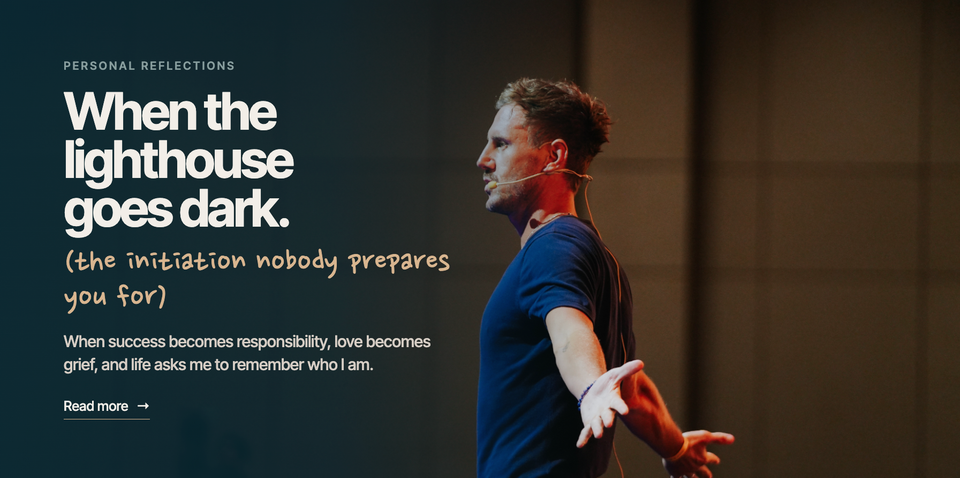
The initiation nobody prepares you for. When success becomes responsibility, love becomes grief, and life asks me to remember who I am without everything I've built.
A personal reflection.
Have you ever had a moment when you finally broke free?
I did. I left the life I was told I had to live. The nine-to-five. The expectations. The invisible rules about what success is supposed to look like.
I started creating value, serving people, building something that felt like my own. Freedom arrived. Adventure. Purpose. Connection.
Then something I didn't expect. Other people began to see what was possible through me. My life became an invitation. A lighthouse. A reminder that another way of living exists.
A decade passed, and I looked around at what I'd built with real gratitude.
But there's a part of this journey very few people talk about.
The lighthouse doesn't only attract those looking for their way home. It also becomes visible to those who want its light without understanding what it takes to keep it burning.
The question this piece answers
What happens when the person everyone leans on is the one who falls apart?
The quick answer. For me, it meant learning that strength is not the absence of need. After a season of grief, betrayal and a hospital bed, the lesson wasn't to become harder or shine brighter. It was to grieve honestly, become more discerning, keep my heart open, and finally let myself receive the care I'd spent years giving.
What I experienced
When I began creating from purpose, people saw possibility in me. My confidence. My generosity. My willingness to help.
And some began relating to me through what I could provide. The introduction. The opportunity. The money. The platform. The emotional support.
Because giving is my nature, I gave. I opened doors. I believed in people. I nourished roots, because beautiful things take time to grow.
Some people want to nourish the roots. Others mainly want the fruit.
I didn't always see the difference until the seasons changed. Until there was less fruit to share. Until I was the one who needed support.
Then I watched something I'd built from the heart become tangled in money, power, ownership and different memories of what was promised. What began as a shared dream became a source of grief. Not only for what was lost financially, but for the years, the trust and the future I thought we were building together.
I can rebuild a business. Rebuilding trust is a different kind of work.
And then there was a stretch with no space between any of it.
Three days.
My father died. A business I'd spent years building, already in the aftermath of a painful collapse, threw up another conflict when I was least equipped to meet it. A relationship that once held love and trust came back into my life in a way that left me more hurt and confused. And then an unexpected incident put me in hospital, under general anaesthetic.
None of the other responsibilities paused. Travelling home. My father's affairs. Family grief. Business obligations. Immigration. Finances. Recovery. Holding space for the people I love.
Somewhere inside all of it was a man who didn't want to be the strong one for a moment. Who simply wanted someone to ask:
How's your heart?
What do you need?
I'm here.
Not to solve my life. Just because even the lighthouse needs somewhere to rest.
What I learned
When losses arrive together, they don't stay separate. Losing a parent woke older losses. The betrayal shook my sense of trust. The relational rupture stirred fears about being known and chosen. The injury challenged my independence. And the practical load left almost no room to feel any of it. When my mind couldn't organise it into one story, my body carried it instead, in exhaustion, tension and broken sleep.
I don't have to find the lesson yet. There's no obligation to turn grief into wisdom before I've let myself grieve. Sometimes the most courageous thing is to say that something painful happened, and let that be true.
Strength is not the absence of need. People see capacity and mistake it for invulnerability. And I helped them, every time I said I'm good, I've got this, I'll figure it out. Being able to carry something doesn't mean I should carry it alone.
Solitude restores. Isolation adds weight. After a season like this I wanted to withdraw, and I think of that as entering the cave. Not punishment or disappearance. Space to hear myself again. But the cave can still have a doorway. Friends can visit. Love can reach me. I can leave when I'm ready, not when I'm perfectly healed.
The initiation isn't what happened. It's what I do with it. I can understand a hard season as a threshold. I don't need to believe the universe arranged a death, a betrayal or an injury to test me. Those things can be painful and unjust without being a spiritual exam. What makes it an initiation is how I respond. How I care for myself, protect my integrity, set boundaries, ask for help, and refuse to become the thing that hurt me.
I was worthy of love before I was useful to anyone. Being the lighthouse began as freedom and slowly became pressure. Always shine. Always inspire. Always turn pain into wisdom. Before the business, the impact and the platform, I was human. That was enough.
The wisdom I'd pass on
The way out is through, but through doesn't mean alone. Not around, not above, not through denial or distraction. Through the grief, the decisions, the acceptance of what can't change and the responsibility for what can. No one can walk it for me. That doesn't mean I walk it without company. I can be responsible for my healing without being alone in it. Sovereignty and interdependence were never opposites.
Dharma is the way through. Not as an escape from grief or another demand to stay productive. As a return to what feels true and what I'm here to offer. The danger after loss is letting it become the centre of who I am. The betrayed one. The grieving one. The one who survived. Those are part of my story. They are not all of me.
Keep the heart open and the gate discerning. After betrayal there's a pull to close, to stop giving, to protect through distance. I don't want someone else's behaviour to decide my character. What I want instead is clearer agreements, healthier boundaries, more attention to behaviour than to promises, and more willingness to ask hard questions early. I can forgive without reconciling. Understand without excusing. Love without pursuing. Support without rescuing. Wish someone well without granting them continued access to me.
A lighthouse is not responsible for every ship. Its power is that it stays grounded and keeps its light maintained. I can illuminate a path without walking it for someone. I can create opportunities without guaranteeing outcomes, and give generously without being depleted. A lighthouse that is never maintained can't keep serving the people who depend on it. Neither can I.
Let success change shape. Freedom, money, impact and adventure are beautiful. When life turns fragile the questions get clearer. Who is here when I have nothing to offer? Who can sit with me when there's nothing to fix? What kind of home do I want? The dream I hold now is not a life that looks extraordinary from the outside. It's one that feels nourishing to live.
Where this does not reach
Grief has no schedule. Nothing here is a timeline for getting over a parent's death or a broken partnership. Some of it may never feel fully resolved, and that is allowed.
This is not a substitute for support. If grief floods, numbs, or won't settle, it wants a person in the room. A friend, a doctor, a therapist, a crisis line. That isn't failure. It's the honest next step.
Discernment is not suspicion. The lesson isn't that everyone is dangerous. It's that trust is built through consistent action.
Suffering didn't make me more worthy. I'm not saying the losses were necessary or deserved. Only that I still get to choose how I live after them.
The evidence, named and dated
- Deliberately light. A personal reflection on one season of my own life.
- The phrase "the best way out is always through" comes from Robert Frost's poem A Servant to Servants (North of Boston, 1914). I use it here as a line I return to, not as evidence.
- Personal, and labelled: the lighthouse, the cave and "dharma is the way through" are my own images and convictions. They are not clinical claims about grief.
The shift
I used to think the light was something I had to keep burning for everyone else.
Now I think the light is the part of me that can still love life after life has hurt me.
One thing, for the next day
The next time someone asks how you are, don't answer I'm good on reflex.
Pause. Take one breath. Tell them one true thing about your heart.
The spine of it
Becoming a lighthouse brings hidden responsibility. Some people tend the roots, some only want the fruit. When losses arrive together, they stack, and the body carries what the mind can't sort. Strength is not the absence of need. The way out is through, but not alone. Dharma is the way through. Keep the heart open and the gate discerning. The lighthouse was never meant to burn itself out.
Questions people ask
How do you grieve when you're the one everyone relies on? Let at least one person see the real state of your heart, and hand over one practical task. Capacity doesn't cancel need.
What is "strong friend" burnout? The exhaustion that builds when someone known for coping keeps carrying everything because others assume they're fine.
How do I stay open-hearted after betrayal? Separate the heart from the gate. Keep generosity, and let trust be earned through consistent behaviour rather than promises.
Is withdrawing after a loss healthy? Solitude can restore you. It becomes isolation when no one is allowed in. Keep a door open.
Does a hard season have to mean something? Not straight away, and not necessarily. Meaning can come from how you respond, rather than from believing it happened for a reason.
The lighthouse was never only here to guide others home. It was also here to remind me that I deserve a home of my own.
When did someone last ask how your heart is, and did you tell them the truth?