
The Modern Rite of Passage: When a Man Becomes His Own Initiation
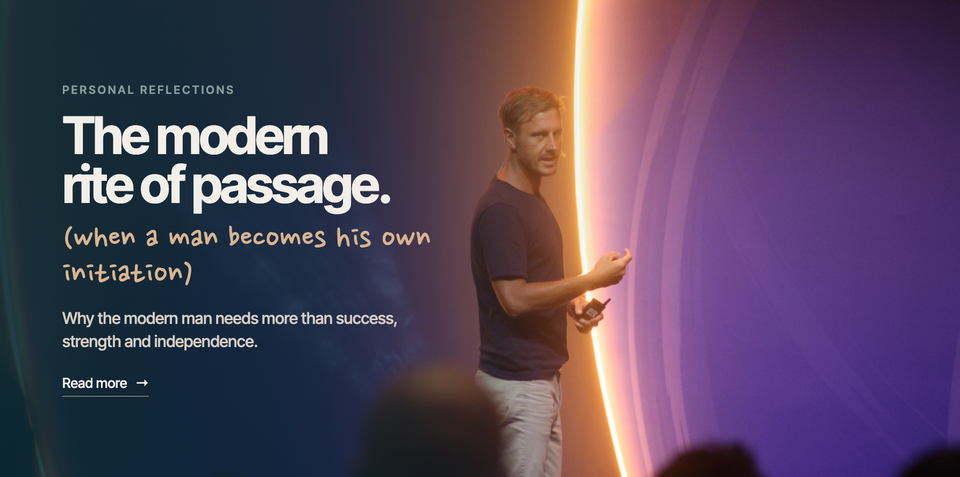
Why the modern man needs more than success, strength and independence, and why the journey into mature masculinity may be one of the most important conversations of our time.
A personal reflection.
I've been reflecting on something I think we need to talk about more openly.
What is the rite of passage for the modern man?
For thousands of years, cultures marked the move from boyhood into adulthood. Some through ceremonies, apprenticeships, solitude or tests of courage. Others through family roles, work or service. Many of those traditions were far more complex than the romantic versions we tell today.
But underneath many of them was a shared recognition.
Becoming a man wasn't something that happened just because you got older.
It meant learning to carry responsibility. To belong. To regulate power. To serve something beyond yourself.
Many of those structures have changed or disappeared. The need hasn't.
And I wonder whether some of the loneliness and confusion so many men carry comes down to one question. Who teaches us to become men, when the world taught us how to perform masculinity but not how to embody maturity?
The question this piece answers
What is a rite of passage for men today?
The quick answer. For me, it isn't one ceremony. It's a series of thresholds. Questioning the life I inherited. Losing the pillars I'd built on. Removing the armour. Learning what power is for. Moving from being needed to being loved. Learning to grieve, to play, and to depend on others well. Age makes a man older. Maturity is how he integrates what happens and chooses to live.
What I experienced
I learned to achieve before I learned to become. The script was familiar. Study, work hard, build a career, provide, protect, succeed, and somewhere along the way you'll become a man. But I watched what happens when men accomplish all of it and still feel disconnected. Financially successful, emotionally unavailable. Physically strong, unable to ask for support. Admired, not known.
A man can be successful without being emotionally responsible. Powerful without being wise. Independent without being secure.
The first threshold was breaking from the inherited script. Is this the life I want, or the life I was taught to want? That question led me out of the familiar path. I created something new, found my gifts, built ventures, and for the first time felt like the author of my own life. A real initiation. But the freedom I created slowly became another identity to maintain. The entrepreneur. The visionary. The one who always knows what to do.
The second came when the pillars fell. A partnership collapsed. Trust broke. My father died. My health turned vulnerable. Some of it arrived almost at once. The strategies that helped me succeed weren't enough. I couldn't solve grief through productivity. I couldn't force anyone to act with integrity. The question was no longer can I build something extraordinary? It was can I stay connected to myself when the extraordinary things I built start to disappear?
Not because suffering is required for manhood. Not because life was testing me. Because hard seasons show the limits of the identities we lean on, and ask for capacities we never needed before.
Then the cave. Across traditions there's the image of the cave, the wilderness, the descent. For me it's the moment a man can't escape himself through achievement or performance anymore. The noise settles. Grief, fear, shame and loneliness come up. The cave asks for a different courage. Not to conquer, but to feel. The cave isn't where a man proves how much pain he can endure. It's where he learns he no longer needs to fight himself. But it shouldn't become a prison. Solitude can nourish. Isolation can become dangerous. The journey is personal. It doesn't have to be unsupported.
What I learned
The thresholds kept coming. This is how I'd name them now.
The armour. Don't cry. Don't complain. Handle it. Those messages build real capacities: endurance, composure, the ability to provide. But I became excellent at holding everyone else and uncomfortable being held. I could solve complicated problems and struggle to say I'm hurting. I'm lonely. Can you just sit with me? A mature man can be capable and still need comfort. Strong enough to act, and secure enough to rest.
Power. Physical, financial, social, sexual, emotional. A man can be strong enough to intimidate and choose gentleness. Able to retaliate and choose restraint. Able to control and choose respect for someone's freedom. True strength isn't how much power I can exercise over others. It's how responsibly I use the power I have. That doesn't mean passivity. Restraint isn't avoiding necessary confrontation, and kindness isn't letting myself be mistreated.
Needed versus loved. Men often become valuable through what we provide. Over time, being needed can feel like belonging. Then the deeper questions arrive. Who stays when I'm no longer useful? Who asks how my heart is? Can I let myself be loved without doing something to deserve it? A man's worth cannot be reduced to his utility.
Grief. Many of us were taught to manage grief through action. Organise the funeral. Handle the finances. Look after the family. Stay strong. There's real love in that. But who holds the man who is holding everyone else? Grief isn't a failure of strength. It's what loving something deeply looks like when it's gone.
Play. Somewhere along the way many of us got very serious. Productive. Strategic. Disciplined. And forgot how to play. Becoming a mature man may mean remembering the boy who knew how to enjoy being alive. Not returning to irresponsibility. Integrating responsibility with aliveness.
Interdependence. Culture celebrates the self-made man, the lone wolf. But nobody is self-made. We're shaped by families, teachers, mentors and countless contributions we'll never see. Sovereignty isn't the absence of connection. It's the ability to stay myself within it.
The wisdom I'd pass on
We need new rites of passage. Not through humiliation, violence or proving who can suffer most. Through experiences that build responsibility, emotional maturity, belonging and service. Spaces where men learn to understand their bodies, express emotion, set healthy boundaries, communicate, take responsibility, receive care and contribute to something bigger. We don't need to recreate every ancestral ritual. We need to recover the wisdom of intentional transition and community responsibility, and adapt it to modern life.
Older men, share without pretending. Wisdom without claiming to have every answer. Younger men, ask without shame.
Measure strength by character. Communities where strength is recognised through character, not domination, and where a man's emotional wellbeing matters as much as his economic output.
Know the man you're becoming. Not the man who never breaks, but the one who knows how to care for himself when life is hard. Not the man who needs nobody, but the one who can stand on his own feet and still reach for another hand. I want to be the man who can build something extraordinary and still delight in an ordinary morning.
Where this does not reach
Suffering isn't required. No one should have to collapse to earn the right to be considered a man. Not every man needs a dramatic fall to mature.
The order isn't fixed. These thresholds don't arrive in sequence, and not every man meets all of them.
This isn't against women or other genders. Much of this applies to anyone. I'm writing from the inside of a man's experience because it's the one I know.
When a man is in real crisis, the cave needs company. If grief, isolation or despair become overwhelming, that's the moment to reach a friend, a doctor or a crisis line, not to go deeper alone.
The evidence, named and dated
- Arnold van Gennep, Les Rites de Passage (1909). Van Gennep described rites of passage in three phases: separation, transition and incorporation. The cave in this piece is that middle, liminal phase.
- Addis and Mahalik (2003), American Psychologist, "Men, Masculinity, and the Contexts of Help Seeking." Their review found that norms of self-reliance and emotional control help explain why men seek help less often. It supports the threshold of removing the armour.
- Personal, and labelled: the thresholds and the table are my own framing.
The shift
I used to think becoming a man meant becoming harder.
Now I think it means becoming whole.
One thing, for the next day
Reach out to one man in your life tomorrow. Not to fix or advise. Just ask: How's your heart, really?
Then listen.
The spine of it
Becoming a man isn't automatic with age. The modern rite of passage is a series of thresholds. Break the inherited script. Survive the fall of the pillars. Meet yourself in the cave, but not alone. Remove the armour. Learn what power is for. Move from needed to loved. Grieve. Play. Belong. Nourish life. We need new rites, built on character, not domination.
Questions people ask
What is a rite of passage for men today? For most men it isn't a single ceremony. It's a series of thresholds that build responsibility, emotional maturity and belonging.
Why do so many successful men feel empty? Often because achievement and maturity were treated as the same thing. Success can grow without the inner capacities that make it feel meaningful.
Is vulnerability a weakness in men? No. Vulnerability and strength coexist. A mature man can be capable and still need comfort.
Why do men struggle to grieve? Many learned to handle loss through action and responsibility. That carries love, but it can leave no room to actually mourn.
How can men build community? Through spaces built on honesty, mentorship and shared responsibility, where men can be challenged without being shamed.
The world doesn't simply need more powerful men. It needs men who know what their power is for.
What threshold are you standing at right now?