
When the Rising King Meets the Rising Queen
The sacred dance of love, wounds and protective patterns, and what it takes for Self, not the shadow, to lead.
A personal reflection.
When two people meet in a profound connection, they don't arrive alone.
The King arrives with his Warrior, his Lover, his Protector, his Provider, the wounded boy, and the parts that learned to survive by being strong.
The Queen arrives with her Lover, her Sovereign, her Protector, her Dreamer, the vulnerable girl, and the parts that learned to survive by guarding her freedom.
When their hearts open, those inner families walk in too.
At first there's recognition. I see you. I feel you. Something about you is familiar.
But recognition isn't readiness. And a profound connection doesn't guarantee compatibility, or a shared future.
Sometimes the very qualities that draw two people together are the ones that wake their deepest protective patterns.
The question this piece answers
Why do deep connections so often trigger old wounds?
The quick answer. Because two people bring their protective parts into love, and those parts start responding to each other instead of to the needs underneath. One person's way of feeling safe can become exactly what makes the other feel unsafe. The way out isn't finding who's wrong. It's each person noticing which part has taken over, and letting their calmer, wiser Self lead again.
What I experienced
Both may be protecting something precious. One may be protecting connection, truth and trust. The other may be protecting autonomy, emotional safety and choice. But one person's attempt to create safety can become the very thing that makes the other feel unsafe.
The moment love wakes the wound. Picture two people sharing real closeness. They laugh, touch, dream. For one, it awakens hope: this is what I've been waiting for. For the other, it may also be meaningful, and afterward they realise they want a slower pace, need distance, or don't want the relationship.
The first feels the distance. A wounded part asks was it real? Why am I not being chosen? The Truth Seeker activates. Questions, explanations, attempts to repair.
The second feels the intensity. A protective part says I need space. I don't want to be responsible for these feelings. I need my decision respected. They withdraw.
The first part becomes more distressed. The second becomes more determined. The protective strategies start responding to each other, not to the needs underneath them. Fear of disconnection brings more pursuit of clarity. Feeling pressured brings more distance.
Neither person's distress proves the other secretly wants the relationship. And neither person's protective response removes their responsibility for how they behave.
What I learned
Four mirrors show up.
Love and freedom. One believes true love is freely chosen commitment. The other believes true love leaves them free. These aren't opposites. Commitment without freedom becomes obligation. Freedom without agreed commitment can't offer the security of partnership. The real question is whether both want that partnership.
Truth and emotional safety. One finds safety in transparency and difficult conversations. The other finds it in privacy, pacing and the right to stop talking. Both needs are legitimate. Integration means telling accountability apart from interrogation, and privacy apart from a broken agreement. Truth can't be forced through repeated questions. Safety can't be built by asking someone to ignore their discomfort.
Giving and receiving. One offers time, energy, support and love, perhaps quietly hoping that being indispensable will make them harder to leave. The other receives, perhaps worrying that accepting creates expectations. Later one feels unappreciated and the other feels indebted. A gift is not a debt. Appreciation is not romantic obligation. And generosity doesn't take away the giver's right to their own needs.
Strength and vulnerability. Both may have learned to protect themselves, one through strength and one through independence. Intimacy asks both to name needs they find hard to say. I need tenderness. I need room to find out what I want without disappointing someone. A healthy relationship holds both, but only if both freely choose to take part.
When a part takes over, it reads everything through its fear. In Internal Family Systems this is called blending: a protective part becomes so activated it takes over the whole perspective.
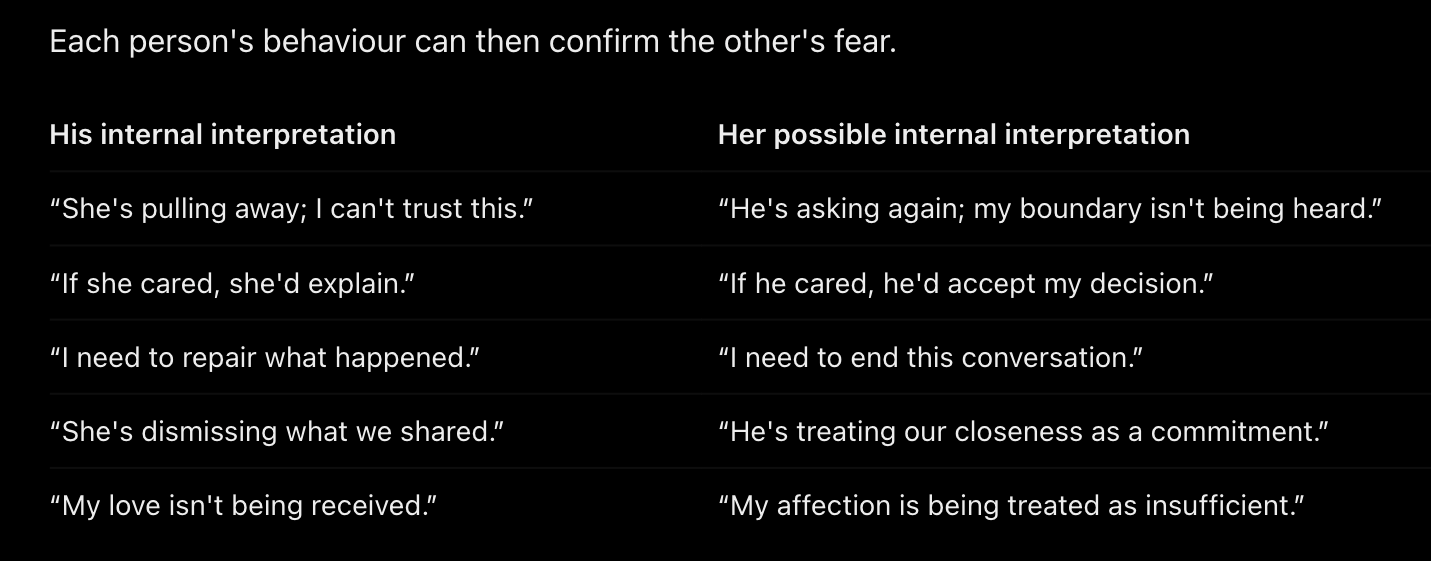
Each person's behaviour confirms the other's fear. The shift comes when either can say: "A protective part of me is reacting to a threat. I can listen to it without letting it decide everything."
The wisdom I'd pass on
Separate three questions.
- What do I feel? Love, grief, fear, tenderness, disappointment, uncertainty.
- What do I need? Honesty, space, affection, reliability, boundaries, support.
- What am I choosing? Friendship, partnership, a pause, repair, or separation.
Feelings can coexist. Needs can differ. But a partnership needs compatible, freely made choices.
Know the three outcomes.
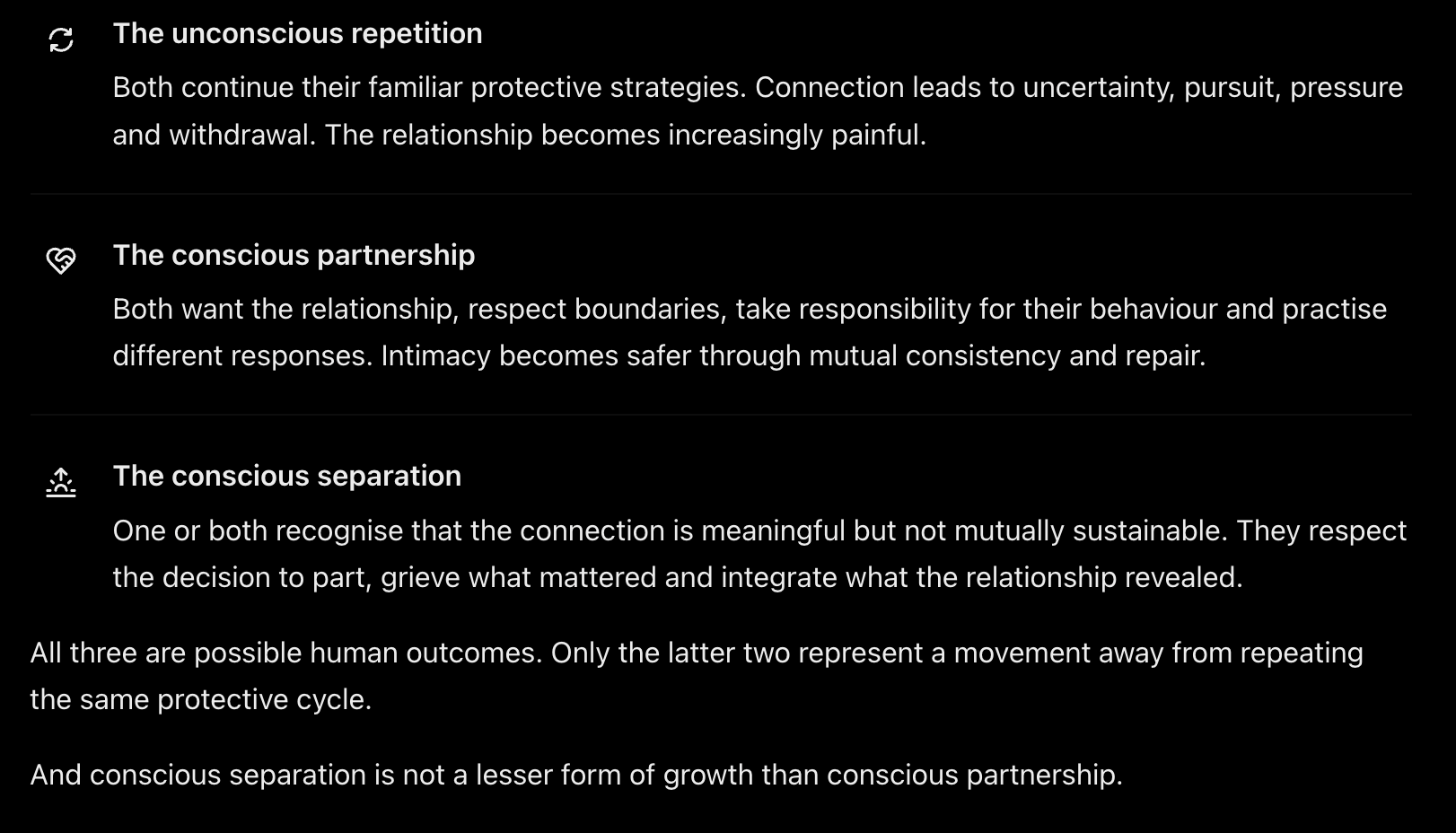
- Unconscious repetition. Both keep their familiar strategies. Connection leads to uncertainty, pursuit, pressure and withdrawal. It becomes more painful each round.
- Conscious partnership. Both want the relationship, respect boundaries, own their behaviour and practise new responses. Intimacy gets safer through consistency and repair.
- Conscious separation. One or both recognise the connection is meaningful but not mutually sustainable. They respect the decision, grieve what mattered, and integrate what it showed them.
Conscious separation isn't a lesser form of growth than conscious partnership.
The sacred union isn't a rescue. The King doesn't become whole by healing the Queen's wounds for her. The Queen doesn't become whole by finally surrendering to the King's love. Neither is the other's missing half. He becomes more whole when he can love without pursuing, give without over-functioning, and seek truth without demanding certainty. She becomes more whole when she can honour her autonomy, know her readiness and express her choices clearly. The other person is a mirror, not a therapist, a parent, a saviour or a destiny.
The work is always your own side. Not working out which of the other person's shadows stopped them choosing you. Recognising which of your own parts woke up, what it was protecting, and how to care for it without needing anything more from them.
Where this does not reach
Roles aren't fixed by gender. The pursuing and withdrawing patterns here can belong to anyone. King and Queen are archetypes, not instructions.
Some dances are unsafe. If one person is controlling, threatening, or won't accept a no, this isn't a dance between two protective parts. It's harm, and the response is safety and support.
Couples therapy helps with this cycle. When both people want the relationship, a trained couples therapist can help interrupt the pattern far better than insight alone.
The evidence, named and dated
- Sue Johnson, Hold Me Tight (2008), from Emotionally Focused Therapy. Johnson describes how partners get caught in a negative cycle, often one protesting and pursuing while the other withdraws, and argues that the cycle, not the partner, is the enemy. It's the closest established account of the dance in this piece.
- Richard Schwartz's Internal Family Systems supplies the language of protective parts and blending (see The Protector and the One Who Wants to Be Held).
- Personal, and labelled: the King and Queen, the four mirrors and the three outcomes are my own framing.
The shift
I used to think a powerful connection meant two people were meant to be together.
Now I think it means two inner families have met, and the question is whether Self or the shadow leads the dance.
One thing, for the next day
Think of one connection that stirred you deeply. Answer the three questions honestly, on paper.
What do I feel? What do I need? What am I choosing?
The spine of it
Two people bring their inner families into love. Recognition isn't readiness. One person's safety strategy can make the other feel unsafe. Protective parts start responding to each other. Four mirrors: love and freedom, truth and safety, giving and receiving, strength and vulnerability. Blending reads everything through fear. Separate feeling, need and choice. Three outcomes, and conscious separation is real growth. The other person is a mirror, not a rescuer. The work is your own side.
Questions people ask
Why does someone pull away when things feel close? Often a protective part reacts to intensity or fear of losing autonomy. It can also simply mean they don't want the relationship. You can't always tell which from outside.
What is the pursue-withdraw cycle? A pattern where one partner seeks closeness and clarity and the other seeks space, and each response intensifies the other's.
How do I stop chasing someone who's withdrawing? Notice which part of you is driving the pursuit, separate what you feel from what you're choosing, and respect their stated decision.
Is separating after a deep connection a failure? No. Conscious separation, where both honour what mattered and part with respect, is real growth.
Can couples break this cycle? Yes, when both want to. Emotionally Focused Therapy is designed for exactly this pattern.
The King can say: I love you, but I won't abandon myself to be chosen. The Queen can say: I honour what we shared, but I won't abandon myself to keep it. The highest expression of their love isn't necessarily staying together. It's that neither has to betray themselves, or the other's freedom, to honour what was real.
Which of your parts leads the dance when love feels uncertain?