
The Divine Feminine's Journey to Self-Union
Love and freedom, tenderness and sovereignty, openness and boundaries. Not opposites to choose between, but parts of one whole woman learning to coexist.
A personal reflection.
I write this as a man, and I want to be honest about that first.
It isn't mine to define a woman's journey. What I can offer is what I've come to understand about the feminine as an archetype, the qualities of receptivity, intuition, tenderness, creativity and sovereignty that live in all of us, and about the tensions that seem to arise when those qualities meet love.
The central question I keep returning to is this.
How can love, freedom, vulnerability, truth and sovereignty all live in the same heart?
The question this piece answers
What does self-union look like for the divine feminine?
The quick answer. For me, it's the integration of two longings that can feel like they compete: the desire for love, tenderness and connection, and the need for freedom, independence and emotional safety. They aren't opposites. Self-union is being fully herself, receiving love, keeping her boundaries, and choosing connection without giving up her freedom.
What I experienced
The central polarity. On one side, the Open-Hearted Lover: tenderness, affection, intimacy, shared dreams. "I want to love and be loved." On the other, the Sovereign Woman: freedom, autonomy, identity, self-direction. "I need to remain myself."
Integration is a third voice. "I can be fully myself, receive love, keep my boundaries and choose connection without abandoning my freedom."
These desires aren't contradictory. A healthy partnership supports both. The difficulty comes when closeness and autonomy are experienced as competing needs rather than complementary ones.
The tensions underneath. These are the polarities I see most often in the feminine journey, in anyone who carries these qualities.
Love and freedom. The Lover wants connection. The Sovereign wants independence. The integration isn't surrendering independence to love. It's learning to distinguish four things: what I feel, what I desire, what I'm ready for, and what I'm actually choosing.
Pleasing another and honouring herself. One part wants to keep the connection and avoid disappointing someone. Another wants to honour her own pace. The integration: I can care about someone's feelings without overriding my own readiness.
Vulnerability and protection. The tender self wants to open. The protector wants to prevent hurt. The integration isn't becoming more vulnerable with someone she doesn't trust. It's discerning whom to trust, how much to share, and how to speak when trust has been affected.
Receiving and feeling indebted. Care can feel nourishing, or it can feel like an obligation. The integration: I can appreciate what someone has given without owing them more than I freely choose to give.
Harmony and difficult truth. The peacekeeper wants relief from conflict. Sometimes harmony avoids a conversation that needs to happen. Sometimes the conversation has already happened, and choosing peace is simply choosing to end it. Both are possible.
Affection and clear intention. Feelings can be real without being promises. The integration is aligning what she expresses with what she intends, so affection and decisions don't send different messages.
What I learned
The four feminine archetypes can cooperate.
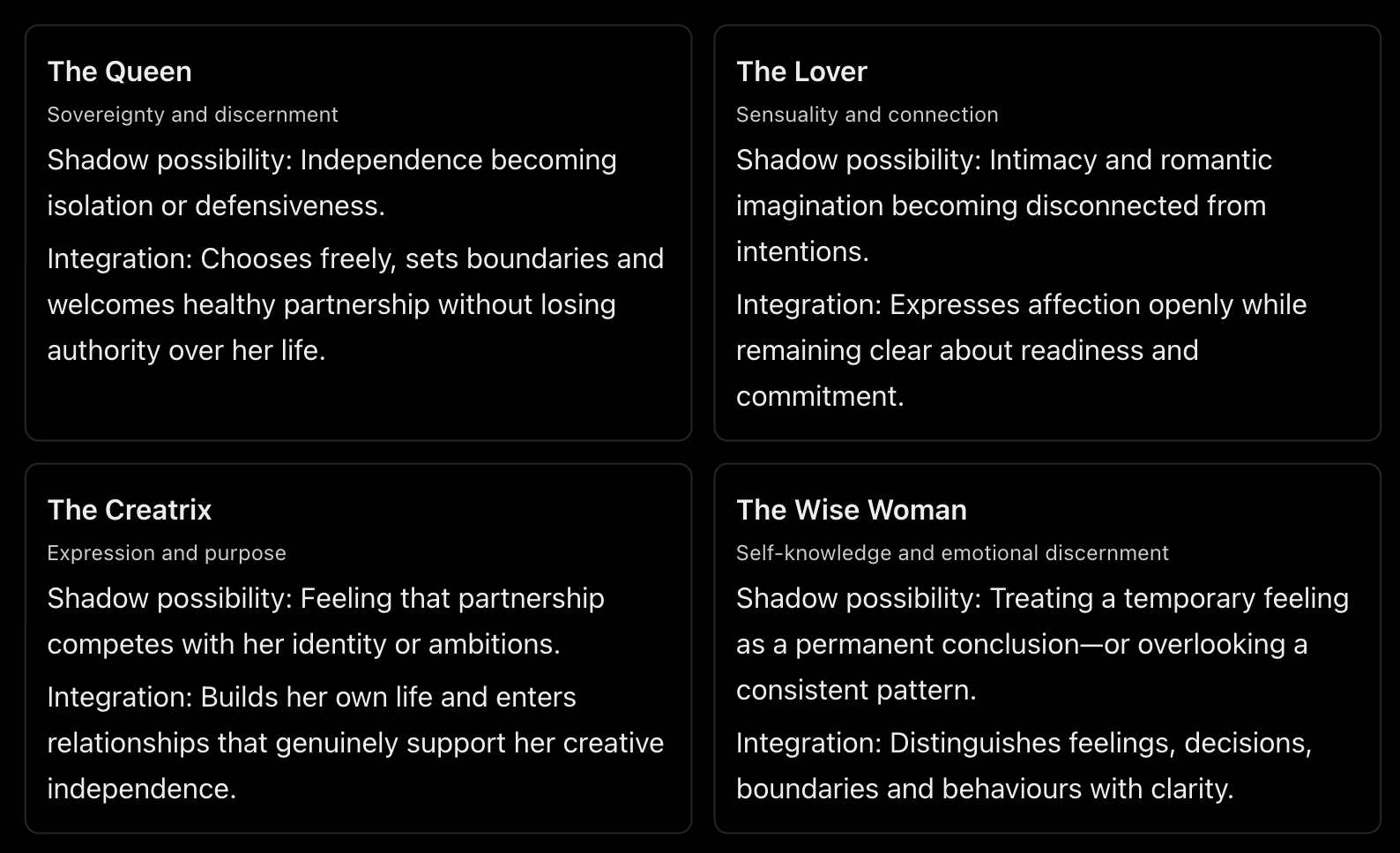
These are symbols for reflection, not a ladder anyone has to climb.
Self-union has a direction.
The wisdom I'd pass on
Questions only she can answer. The deepest work in this journey belongs to the person living it. Some questions that may help, if they resonate:
- What does commitment mean to me, and what am I afraid it might cost?
- What helps me feel safe sharing the most vulnerable parts of myself?
- How do I tell what I want from what someone else wants for me?
- When does receiving care feel nourishing, and when does it feel obligatory?
- Can I say no without believing I've failed or harmed someone?
What a man can and can't offer. A mature masculine can honour what a woman actually says, own his part, and respect her decisions without needing to name or resolve her shadows. He can be a mirror. But a mirror reveals what an interaction activates in him. It doesn't give him knowledge of what lives inside her.
Neither has to abandon themselves. The masculine journey may be learning that love doesn't require constant giving, proving or repairing. The feminine journey may be learning that love and independence aren't opposites, and that needs can be spoken before overwhelm. Neither journey requires the other person to become a partner.
Where this does not reach
This is one man's reflection on an archetype. It isn't a description of any particular woman, and it isn't a guide to what women want. Every woman's journey is her own.
Feminine qualities aren't only women's. The divine feminine, as I use it, describes qualities in everyone. Men carry the Lover and the Queen too.
Where there's harm, safety comes first. If closeness has involved control, pressure or fear, the work isn't integration. It's protection and support.
The evidence, named and dated
- Ryan and Deci (2000), American Psychologist, on self-determination theory. They identify autonomy and relatedness as basic psychological needs that support each other rather than compete. It's the research basis for the idea that love and freedom aren't opposites.
- Personal, and labelled: the Queen, Lover, Creatrix and Wise Woman are symbolic archetypes used for reflection, not empirical categories.
The shift
I used to think love and freedom pulled in opposite directions.
Now I think the deepest love is the one that leaves both people free.
One thing, for the next day
Notice one moment where closeness and freedom feel like they're competing in you.
Ask: What am I feeling, what am I ready for, and what am I actually choosing? Let the three answers be different if they are.
The spine of it
The feminine journey holds two longings: love and freedom. They aren't opposites. Distinguish feeling, desire, readiness and choice. Care for others without overriding your own pace. Open selectively. Receive without owing. Let affection and intention align. The Queen, Lover, Creatrix and Wise Woman can cooperate. The questions belong to the one living them. Neither person has to abandon themselves.
Questions people ask
What is the divine feminine? Spiritual language for qualities like receptivity, intuition, creativity, tenderness and sovereignty, which live in everyone.
Can you want love and freedom at the same time? Yes. Research suggests autonomy and connection are complementary needs, and healthy relationships support both.
What are the feminine archetypes? One common set is the Queen, the Lover, the Creatrix and the Wise Woman, each with a gift and a shadow.
What does self-union mean for a woman? Being able to hold love and independence, openness and boundaries, together, without one silencing the other.
Can a partner help with this journey? A partner can support it, but the questions and the integration belong to the person living them.
Self-union isn't becoming who someone else needs us to be. It's becoming able to recognise, care for and take responsibility for the whole of ourselves.
Where in your life do love and freedom feel like they're competing?