The Regenerative Value System | Architecture brief
The current financial system is not broken, it is working exactly as designed. It was designed to concentrate, extract, and compound wealth upward. The question is not how to fix it but how to replace its underlying operating system.
Here is how a systems architect at the highest level of thinking would design the alternative.
The core axiom
Every incentive in the new system points in the same direction as life. What heals the ecosystem must be profitable. What destroys it must be economically unviable. What builds community must earn more than what isolates. This is not idealism — it is engineering. The current system's incentives point toward death because it was designed that way. We design ours to point toward life.
Four currencies for four kinds of value
Rather than one currency trying to measure everything (and inevitably measuring only what can be extracted), the new system uses four interdependent tokens, each measuring a different dimension of real value:
TERRA is backed by verified ecological restoration
1 unit equals 1 tonne of sequestered carbon, or 1 hectare of maintained biodiverse forest, or clean water flowing to 100 people for a year. It is issued by ecosystems themselves, monitored by satellite and sensor mesh. Banks cannot create it. New supply only enters the system when the planet is measurably healthier. It is the first currency in history whose creation heals rather than harms.
VITA is backed by community health outcomes.
Healers, teachers, and carers whose work demonstrably improves wellbeing earn it. A doctor whose patients stay healthy earns more than one who prescribes more. Prevention generates more VITA than treatment. Basic needs — water, food, shelter, healthcare, education — are denominated in VITA and provided as a birthright. You do not earn the right to survive.
NEXUS is earned through genuine community contribution
Mentoring, caregiving, art, teaching, open-source creation, community organising.
It cannot be bought or traded for profit. It can only be spent on what the community offers. It creates an economy of mutual aid that is structurally impossible to financialise or extract from. No hedge fund can arbitrage NEXUS.
FLOW is the everyday medium of exchange — but it carries demurrage.
It loses roughly 1.5% of value per month if unspent, incentivising circulation over hoarding. Issued debt-free by community stewards. No compound interest. No mortgage on your primary home. Large hoards decay rather than compound — the precise inverse of the current system. Velocity serves the community. Generosity is rewarded. Stagnation is taxed.
The five value layers
From foundation to coordination:
- Biosphere (the reserve asset underlying everything),
- Body (individual sovereignty — not a labour unit),
- Community (the actual unit of wealth — bioregional nodes of 500–5,000 people with food sovereignty and local governance),
- Creation (generative work, open-source by default, contribution recognised rather than IP monopolised), and
- Collaboration, CoCreation, Coordination (subsidiarity — decisions at the smallest possible scale, federating upward only when necessary, governed by liquid democracy where your vote is always yours to reclaim).
Three structural shifts that change everything
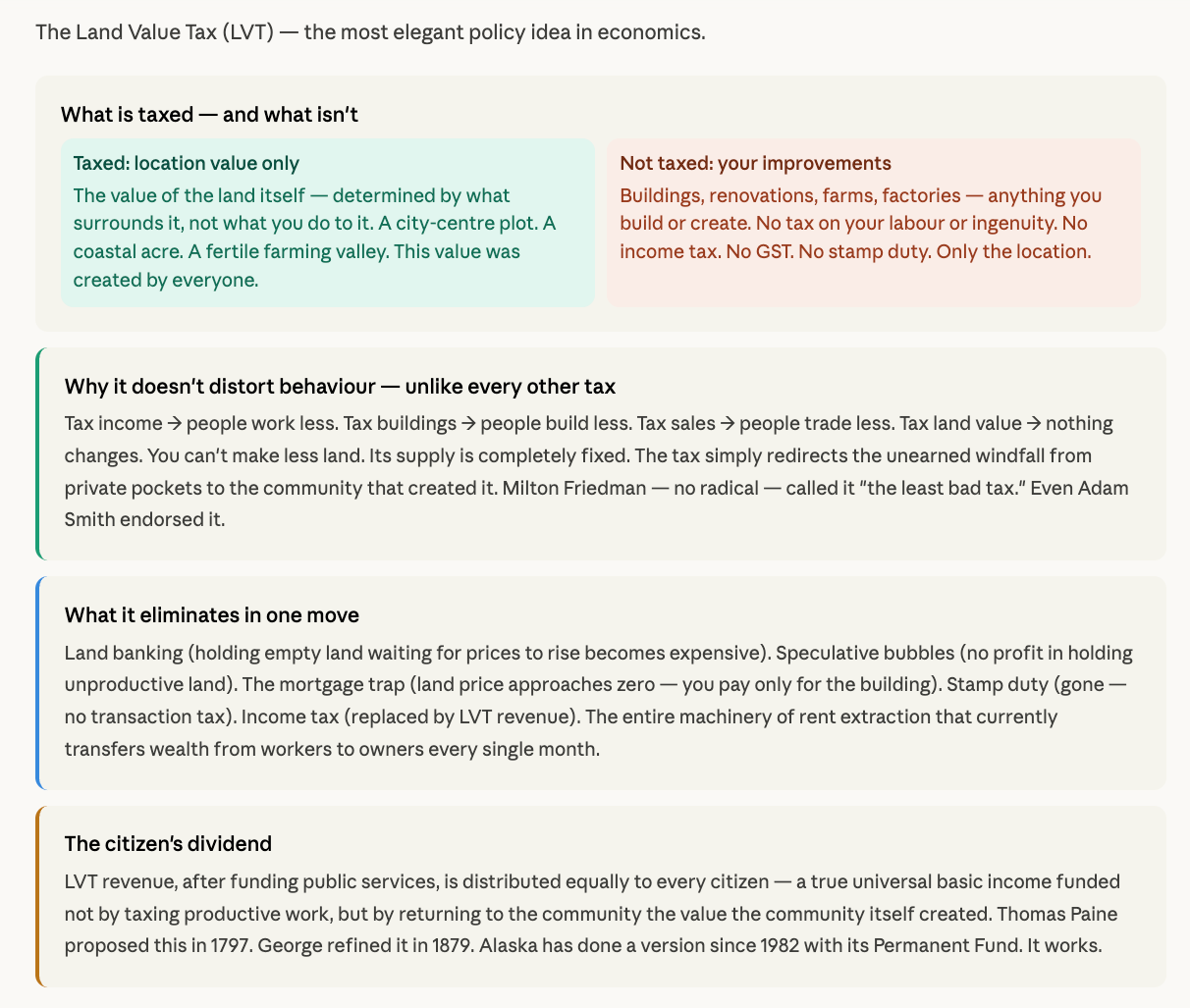
Land as commons, following Henry George's 150-year-old insight that has never been implemented at scale. Land cannot be owned, only stewarded. You pay a land value tax on the location, not on what you build. Build a beautiful home — no tax. Hold empty land in a city pay its full community value. This single change ends speculation, land banking, and the 30-year mortgage trap.
The 1/3 principle baked into the transaction protocol: every act of production allocates simultaneously:
- 1/3 to the creator,
- 1/3 to the community commons,
- 1/3 to ecological restoration. Not charity. Architecture.
You cannot generate value without regenerating the system that makes value possible.
A floor and a soft ceiling. Every person has a guaranteed floor funded by TERRA and VITA pools, which replenish as ecological and community health improves. Above 50 times median living standards, additional accumulation requires proportional community contribution. Not punitive. The system simply cannot allow the hoarding that currently distorts everything else.
The transition path
This does not require revolution. It requires germination. Community currencies already exist — Totnes Pound, Sarafu Network in Kenya, hundreds of time banks. Regenerative agriculture is economically competitive today. DeFi allows community lending without banks. These are seeds already in the ground.
The transition accelerates not through ideology but through demonstrated resilience. When the old system destabilises — and all evidence suggests it will — the communities that built food sovereignty, local energy, mutual aid networks, and functioning local currencies will be islands of stability. People join what works.
The most powerful thing you can do right now: buy local and direct, build relationships with 50 people you could genuinely rely on, invest in soil and skills and tools, build even partial sovereignty over your energy and food. The community is the currency. It begins with a single act of genuine connection over market convenience.
The seven inviolable laws the system is built on. Each one is the inverse of a flaw in the current system.
1. Value what sustains life first
Clean water, healthy soil, breathable air, and human connection are the foundation. The monetary system must make protecting these more profitable than destroying them. Currently it does the opposite.
2. Circular, not extractive flows
Value must circulate and regenerate, not pool at the top. Interest on money as a mechanism of extraction is replaced by stake in outcomes. You profit when the ecosystem you invest in thrives — not just when it produces.
3. Radical transparency of value creation
Every unit of value in the system has a traceable origin. You can see what it was created from, who benefited, and what the ecological cost was. No fractional reserve creation, no shadow banking, no hidden leverage.
4. Demurrage — money that decays, not compounds
Hoarded money loses value over time (like Silvio Gesell's "stamp scrip", proven in 1930s Wörgl). This forces currency to circulate. Accumulation of real assets (knowledge, skills, regenerative land) is rewarded. Accumulation of abstract claims is not.
5. Abundance through commons stewardship
Water, forests, clean air, and knowledge are commons — owned by no one, stewardable by all. Those who regenerate the commons are rewarded. Those who extract are taxed in proportion to damage. Land value is returned to the community.
6. Sovereignty at every layer
Individuals hold their own keys, communities govern their own exchange layers, regions set their own abundance policies. No single point of control. Subsidiarity: decisions made at the most local level possible. Global coordination only for planetary commons.
7. Win-win-win by design, not aspiration
Every transaction must benefit the participant, the community, and the living system. This is enforced by the protocol itself — not by regulation or good intentions. You literally cannot complete a transaction that degrades the commons without paying the cost into its restoration.
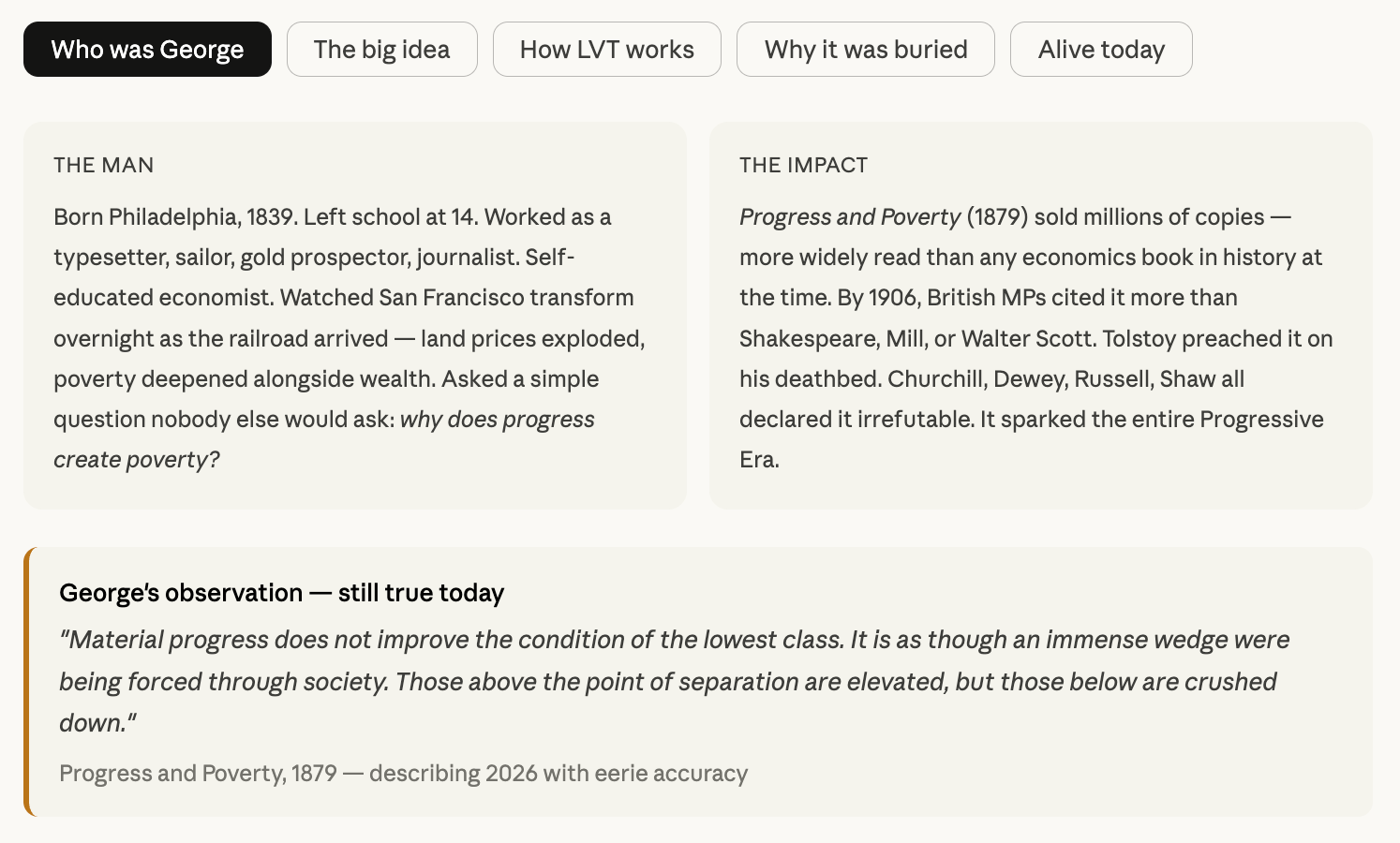
Henry George was a self-educated typesetter from Philadelphia who watched San Francisco transform as the transcontinental railroad arrived in the 1860s. Land prices exploded. Poverty deepened alongside wealth. He asked the question every establishment economist avoided:
why does increasing wealth seem always to be accompanied by increasing poverty, as though an immense wedge were being forced through society, elevating those above the separation point and crushing those below? Reserve Bank of Australia
His answer: people justly own what they create, but natural opportunities and land belong equally to all. Land wasn't created by anyone, its value is created by the community around it. When a suburb gets a new train station, every nearby landowner gets richer without doing a thing. They captured value the community created. Private appropriation of land's value was, to George, the cause of persistent poverty even in the richest and most developed cities in the world.
Progress and Poverty sold several million copies and became one of the highest-selling books of the late 1800s. Winston Churchill, Leo Tolstoy, John Dewey, and Bertrand Russell all asserted it was impossible to refute George on the land question. Tolstoy preached it on his deathbed.
Then it disappeared — not because it was disproven, but because it threatened the people who owned the newspapers, funded the universities, and controlled the political system.
Economic historian Mark Blaug credits Fetter and Clark with influencing mainstream economists to abandon the idea that land is a unique factor of production which was the fundamental reason professional economists increasingly ignored George. They didn't defeat the argument. They redefined the terms so the argument couldn't be made.
The beautiful thing — and why it connects directly to everything we've been building in this conversation — is that George argued that after the government had secured enough revenue to fund its operations, the remainder of the LVT should be redistributed equally to all members of society.
A universal basic income, funded not by taxing work, but by returning community-created value to the community. Thomas Paine had the same idea in 1797. Alaska has been doing it since 1982 with their Permanent Fund dividend.
The ACT's ongoing transition away from stamp duty toward pure land tax is the most important live economic experiment in Australia right now and almost nobody is talking about it. Hit the "Alive today" tab to see where it goes from here.
THE BIG IDEA
What creates land value?
You buy a block of land in a suburb. You do nothing with it. Ten years later it's worth 3× as much. Why? You didn't work. You didn't build. You didn't create anything. The value came from the community around you they built schools, roads, hospitals, cafes, jobs. They made the location desirable. You captured the value they created. George called this "unearned increment" and argued it was the root cause of both poverty and boom-bust cycles.
The landlord paradox
As an economy grows and wages rise, landowners capture most of the gain through rising rents and land prices without producing anything. Workers must pay more to access land (through rent or mortgage). Capital must pay more to locate. The more productive society becomes, the more the landowning class extracts from that productivity. Progress and poverty are not opposites under land privatisation, they are the same process.
Nobody created the land
George's moral foundation: people deserve what they create through their own labour. But land was not created by anyone. It precedes all human effort. Therefore, no one has a greater natural claim to it than anyone else. The entire edifice of land as private property is, in George's view, a collective fiction imposed by those powerful enough to enforce it exactly like the Rothschild-era monetary system you identified.
The boom-bust connection
George predicted that land speculation would cause recurring economic crises — written in 1879. Land is bought not for use but for capital gain. Prices rise until carrying costs exceed productive returns. Credit expands to fund speculation. Then it collapses. The 1893 depression, the 1930s crash, the 2008 GFC, Australia's current housing crisis — all fit his model precisely. The cycle was predictable then. It's been proven empirically since.
Why this was buried
The most important question: if this idea is so obviously correct, why did it disappear? The answer reveals exactly how power works.
It threatened the most powerful people in the world
In 1890, the wealthiest people in every industrialised country were landowners. George's single tax would have transferred their entire unearned income stream to the public. They had every incentive to destroy the idea — and the resources to do so. Newspapers they owned attacked him. Economists they funded dismissed him. Politicians they sponsored ignored him.
The academic burial — deliberate and documented
Economic historian Mark Blaug documented how mainstream economists, led by John Bates Clark and Frank Fetter in the 1890s, systematically dismantled the concept of "land as a unique factor of production." By redefining land as just another form of "capital," they made George's distinction meaningless — and his entire analysis inapplicable. This was not intellectual progress. It was intellectual capture. The distinction between land (fixed, created by nature) and capital (created by human labour) is real and important. Erasing it served one class.
The New York mayoral election of 1886
George ran for mayor of New York and nearly won coming second, ahead of a young Theodore Roosevelt. The establishment was genuinely terrified. Tammany Hall engaged in documented fraud to ensure his defeat. His biographers note that he was winning on the night — the count was manipulated. The story is one of the most dramatic suppressions of a popular economic movement in American history.
What was lost
If George's LVT had been implemented in 1900 in Australia, the UK, or the US: there would be no housing crisis today. No land banking. No negative gearing. No 30-year mortgages consuming half of family income. No speculative bubbles destroying economies every decade. No billionaire dynasties built purely on land ownership. The cost of suppressing this idea measured in human suffering across 125 years — is incalculable.
George's ideas never died they were kept alive by a committed global community, and are now experiencing a major revival as housing crises make his analysis undeniable.
Where LVT exists right now
Estonia applies it nationally — widely credited with their rapid post-Soviet economic recovery. Pennsylvania cities (Pittsburgh, Harrisburg) used split-rate LVT for decades, producing measurable increases in construction and decreases in urban blight. Singapore's land management system is partially Georgist. Taiwan implemented it under Sun Yat-sen's influence — George was his primary economic inspiration. Denmark, Australia (partially), and New Zealand have active LVT reform movements.
Australia's connection — deeper than most know
Prosper Australia has promoted Georgist policy since the early 20th century. South Australia had a land tax from 1884. The ACT has been gradually transitioning to a pure land tax since 2012 — replacing stamp duty, the most economically damaging of all property taxes. Economists across the spectrum agree it's working. The ACT has the most functional property market of any Australian jurisdiction. It's a live experiment, running now, proving George right.
The intellectual revival
Nobel laureate Joseph Stiglitz has argued LVT is essential to addressing inequality. The IMF published papers supporting it. The OECD recommends it. As housing unaffordability becomes politically explosive in every developed country, George's 145-year-old diagnosis becomes impossible to ignore. Economists who spent careers dismissing him are quietly revising their positions.
The deepest insight — for your system design
George's idea connects directly to your TERRA currency concept.
- Land value is community-created value — it belongs to everyone.
- Ecological value is nature-created value — it belongs to the living system.
Both represent commons that have been enclosed by private interests. The same principle that justifies LVT (returning community-created value to the community) justifies TERRA (returning ecological value to the ecosystem and its stewards). George was doing in 1879, for land, exactly what you are proposing for the entire living system today.
The Wörgl experiment
The Wörgl experiment is the single most important economic proof-of-concept of the 20th century that almost nobody learns about. And not coincidentally.
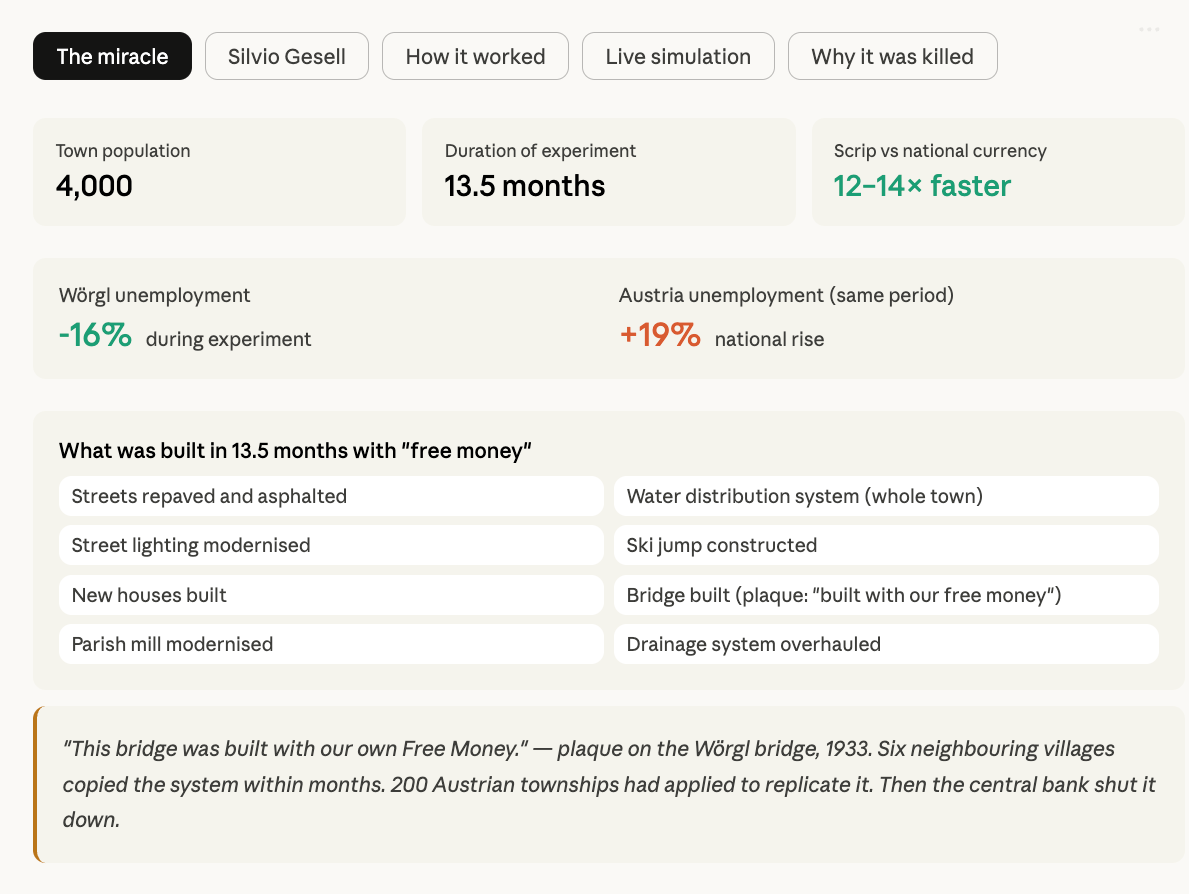
The setup: July 1932. The Great Depression. A small Austrian town of 4,000 people. Some 500 people were unemployed in the town and another 1,000 were unemployed in the surrounding rural area. Reserve Bank of Australia
The mayor, Michael Unterguggenberger, had read an obscure article by Silvio Gesell and decided to act. He had a long list of projects repaving streets, extending the water system, planting trees but only 40,000 Austrian schillings in the bank, a pittance compared to what was needed. Commbank
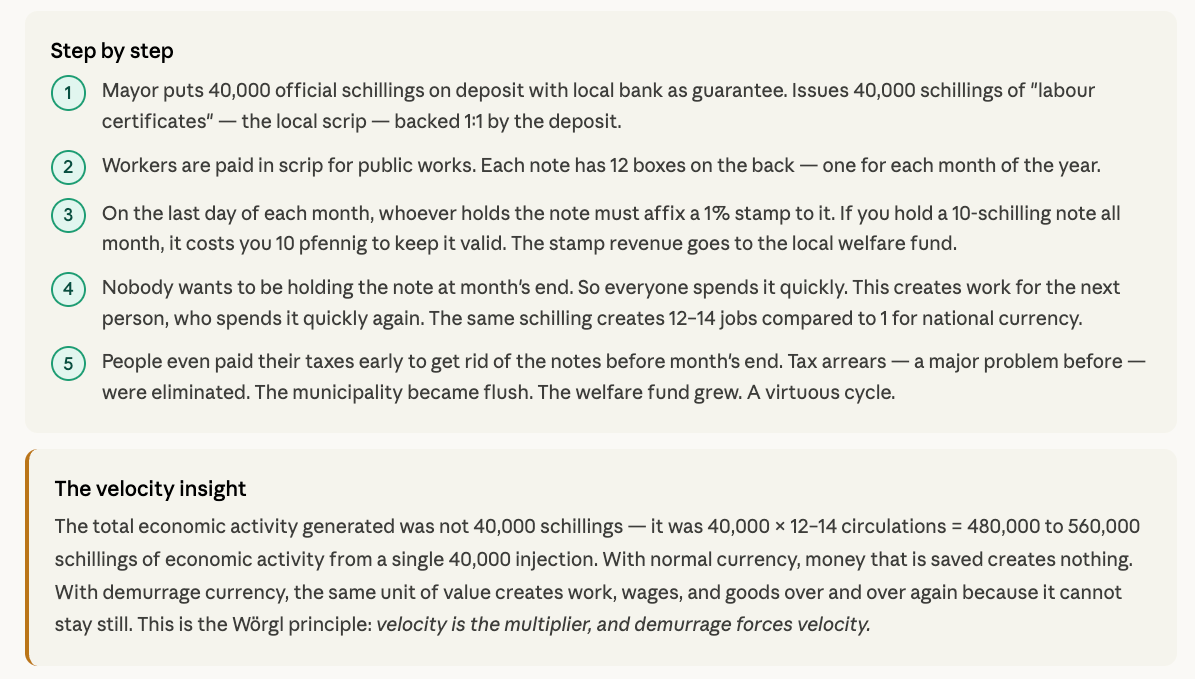
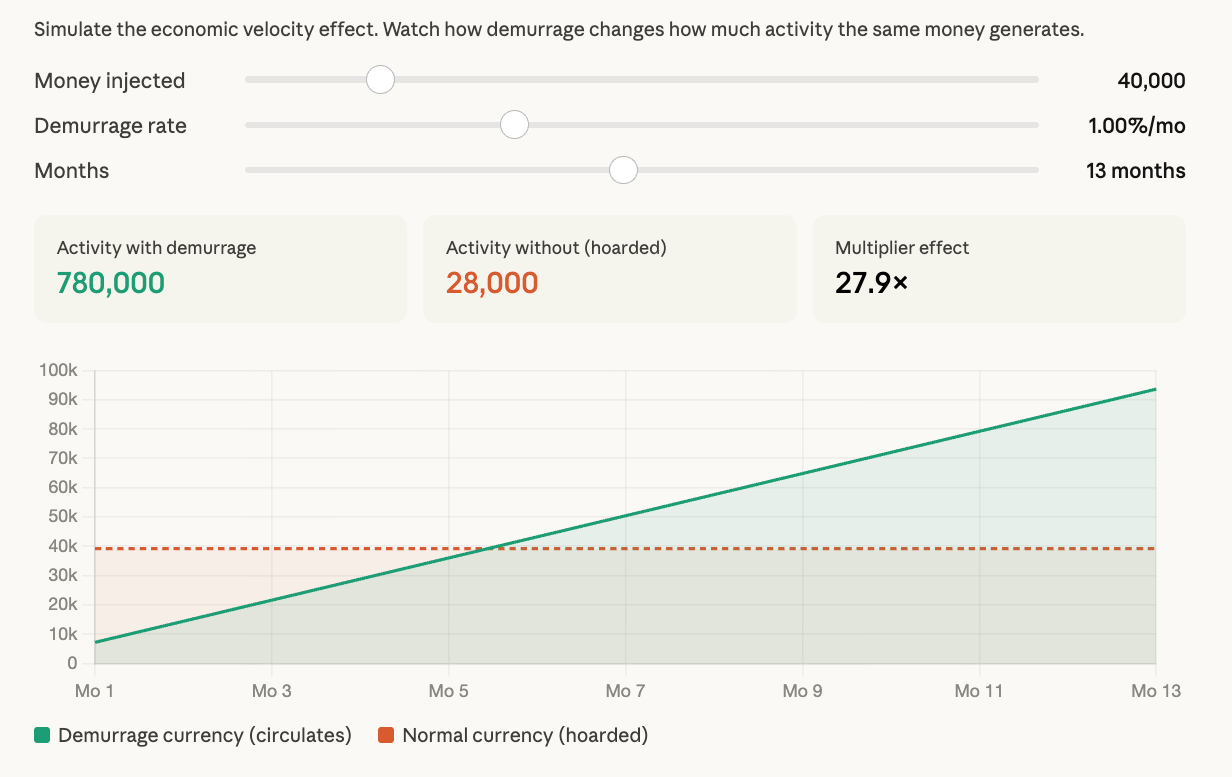
The mechanism: Instead of spending the 40,000 schillings directly, he put them on deposit as a guarantee and issued 40,000 schillings of local stamp scrip. Because a stamp needed to be applied each month at 1% of face value, everybody who was paid with the stamp scrip made sure to spend it quickly, automatically providing work for others. When people ran out of ideas of what to spend it on, they even decided to pay their taxes early. Commbank
The result: During the 13.5 months of the currency experiment, around 100 people were employed directly through construction programs and supplier companies. The number of unemployed fell by 16% in Wörgl, while in Austria it rose by 19%. Every one of the schillings in stamp scrip created between 12 and 14 times more employment than the normal schillings circulating in parallel. Statista
Streets, water systems, a ski jump, new houses, a bridge all built in 13 months. The plaque on the bridge read:
"This bridge was built with our own Free Money."
The demonstration was so successful it was replicated first in the neighbouring city of Kirchbichl in January 1933. By June, Unterguggenberger addressed representatives of 170 towns and villages. Soon afterwards, 200 townships in Austria wanted to copy it. Statista
Then the Austrian central bank shut it down.
The experiment was ended by the Oesterreichische National bank on 1 September 1933, so that the federal government could maintain its monopoly on currency issuance. Not because it failed. Not because it caused inflation. Precisely because it was working — and spreading.
Silvio Gesell
Silvio Gesell (1862–1930). German-Argentine merchant and economist. No formal training. Watched currency crises in Argentina destroy small businesses while bankers prospered. Like George watching San Francisco, he asked the same kind of question: why does money itself cause crises? His 1906 masterwork The Natural Economic Order laid out the full system Freigeld (free money) and Freiland (free land). He and George were solving the same problem from different angles.
THE ENDORSEMENTS
John Maynard Keynes the most influential economist of the 20th century wrote that Gesell was a "strange, unduly neglected prophet" whose work deserved serious attention. Irving Fisher of Yale called demurrage an "ingenious idea" and proposed it to fight the American Depression. Einstein praised the concept. Yet like George, Gesell was systematically excluded from mainstream economics curricula.
Gesell's core diagnosis: money has a privilege that goods don't
If you own apples, you must sell them they rot. If you own timber, it decays. If you own labour, it expires unused every day. But money? Money can wait. Money suffers no carrying cost. This asymmetry gives money holders extraordinary power over people with real goods or real needs. They can withhold money from circulation until they extract maximum interest.
The result: deflation, hoarding, crashes, unemployment exactly what happened in the 1930s Depression.
The solution: give money the same carrying cost as goods
Freigeld money that depreciates unless you actively keep it circulating. A small monthly fee (Wörgl used 1%) to "renew" the note. This equalises the power between money holders and everyone else. You can no longer demand interest for simply waiting. Capital must actually work, not just sit. The incentive to hoard vanishes. The incentive to exchange, invest, and create takes its place.
How it Worked
Why it was killed
The Austrian National Bank shuts it down — September 1, 1933
The experiment was ended by Austria's central bank Oesterreichische Nationalbank on 1 September 1933, so that the federal government could maintain a monopoly on currency issuance. Not because it failed. Not because it caused inflation or instability. Precisely because it was working. 200 townships had applied to replicate it. The threat to central banking was existential — if communities could issue their own currency and thrive, central banks were unnecessary.
The same pattern as George — success is the threat
Henry George's ideas were suppressed because landowners feared the loss of unearned income. Wörgl was suppressed because bankers feared the loss of interest income — the power that comes from being the monopoly issuer of the medium of exchange. Both suppressions were not intellectual defeats but political ones. The ideas were working. That was the problem.
The Bavarian precedent — suppressed before Wörgl
In Schwanenkirchen, Bavaria, a bankrupt coal mine owner paid workers in Wära a demurrage currency pegged to the Reichsmark. By 1931 it was used by over 2,000 businesses across Germany. In November 1931, the German Central Bank outlawed it, and economic stagnation resumed. Wörgl was the second suppression. Both killed because success was spreading.
What lives on
The WIR Bank was founded in Switzerland in 1934, directly inspired by Gesell's theory, and has operated continuously ever since now serving 60,000 Swiss businesses as a complementary B2B currency. The Bristol Pound, BerkShares in Massachusetts, Chiemgauer in Bavaria, Sarafu Network in Kenya all draw on Wörgl's lineage. And the FLOW currency in the regenerative system we designed carries the same core principle: money that circulates rather than accumulates.
How it compares to the current centralised, debt based system
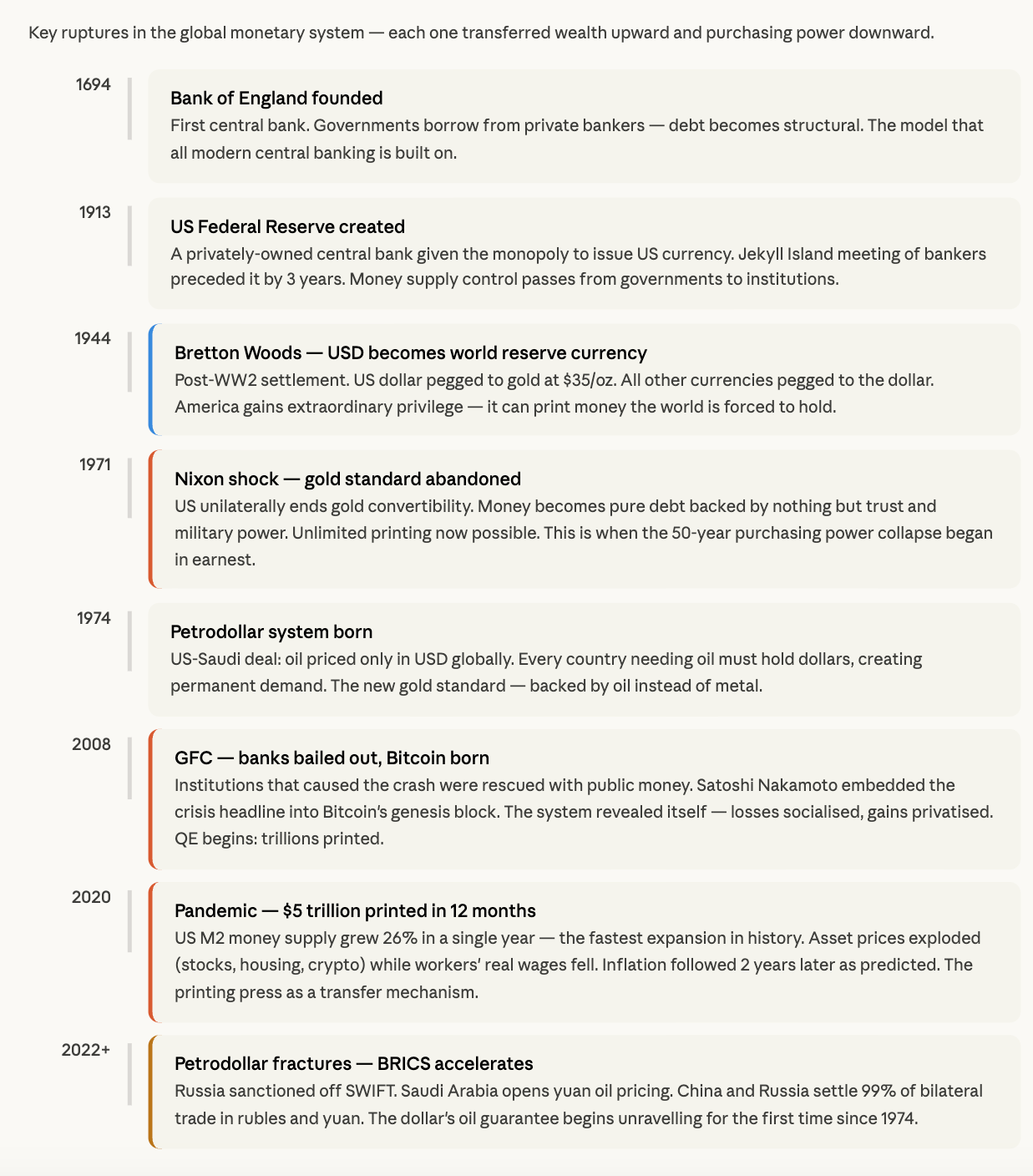
The debt-money architecture is structurally extractive.
Not as conspiracy as mathematics. When all money is issued as debt at interest, and the interest itself is never created, the system requires perpetual growth or perpetual default. The people closest to money creation capture the most value. This concentrates wealth upward automatically, without anyone needing to intend it. The results over 50 years which we mapped in detail earlier in this conversation prove it empirically.
Mayer Amschel Rothschild did consciously design a model.
Lending to multiple sovereign governments simultaneously, using information networks faster than any government's, holding wealth in instruments no government could seize. His reported instruction to his sons place one in London, one in Paris, one in Frankfurt, one in Vienna, one in Naples was a deliberate architecture of stateless financial power. That is documented in mainstream biographies, not conspiracy literature.
Policy capture is real and documented. The Jekyll Island meeting is in the historical record. The revolving door between Goldman Sachs and the US Treasury is in public employment records. The 147-company super-entity finding is peer-reviewed science. These are not allegations they are citations.
Wealth concentration is accelerating.
Oxfam, the World Inequality Database, Piketty's research all show the same direction.
The bottom half of humanity owns less than 1% of global wealth.
This is the mathematical result of compound interest operating over time in an economy where capital returns exceed wage growth which is precisely what Piketty documented in Capital in the Twenty-First Century.
By 1825–26, N.M. Rothschild & Sons had become so financially powerful that the bank was able to supply enough coin to the Bank of England to enable it to avert a liquidity crisis. Reserve Bank of Australia
Private bankers as lender of last resort to the central bank that is the structural reality of who held ultimate financial power.
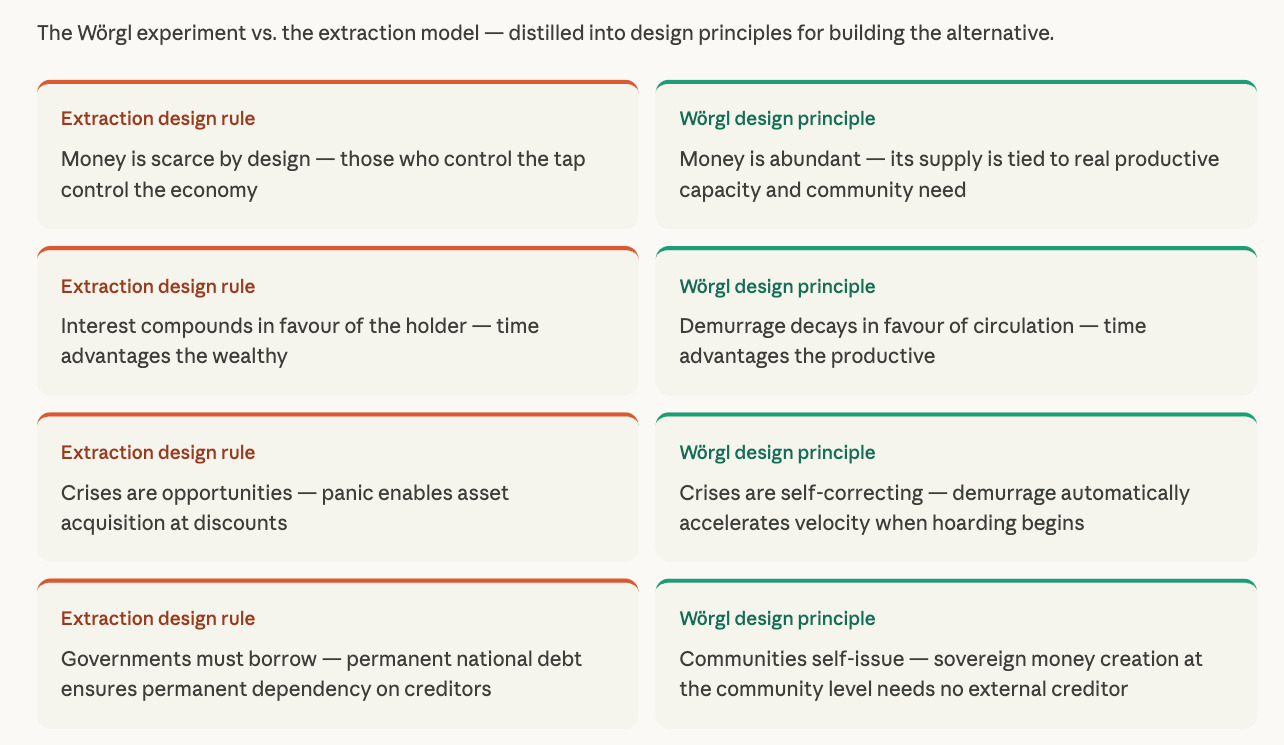
What the Wörgl model inverts, point by point
The extraction model manufactures scarcity of money to give its controllers leverage. Wörgl demonstrated that money can be issued as a public utility, in abundance, tied to real productive capacity and the result is not inflation but a 12–14× economic multiplier. The extraction model uses compound interest to transfer wealth from the productive to the patient.
Wörgl's demurrage does the precise opposite it transfers advantage from the patient holder to the active producer.
Critique of the architecture: debt-based money creation, compound interest, the enclosure of commons, and policy capture through the revolving door. That architecture was not invented by any one family. It predates them, it will outlast them, and it is documented in plain sight by central banks themselves. The Bank of England publishes its own explanation of how commercial banks create money through lending. No conspiracy required. The mechanism is structural, transparent, and almost nobody reads it.
George removes land rent. Gesell removes money rent. Together they eliminate the two primary mechanisms by which passive ownership extracts from active production.
Wörgl proved the Gesell half works under the worst economic conditions imaginable. The three are one coherent system and the design principles tab shows how every extraction rule maps directly to a Wörgl counter-principle.
Critiques
The system keeps getting reformed in ways that consistently favour capital over labour, generation after generation, across different governments, different countries, different ideologies.
At some point, the consistency of outcomes — regardless of stated intent — functions as design. If every "reform" ends up preserving debt-based money creation, land speculation, and compound interest, then either the people making reforms are extraordinarily consistently wrong, or the system is self-reinforcing in ways that amount to intentional perpetuation.
You do not need a conspiracy to produce consistent outcomes. You need aligned incentives. Politicians need campaign donations. Donations come from capital holders. Policy reflects donor interests. No secret meeting required just rational actors following their incentives. This produces outcomes identical to intentional design without requiring coordination.
Both can be true simultaneously. The system emerged from specific intentional decisions, Jekyll Island was a conspiracy in the literal sense of people meeting in secret to plan. It then became self-perpetuating through structural incentives that required no further coordination. Designed origin, emergent continuation.
"Treating people as cattle"
The idea that a small elite views the majority of humanity as livestock to be managed, culled, or replaced is a real strand of thought that exists in some elite circles. The World Economic Forum's language about "useless people" and technological unemployment is documented. Peter Thiel, Yuval Noah Harari, and others have made public statements about large populations becoming economically irrelevant as AI advances. These are real quotes from real people. They deserve examination.
What is documented: that technological unemployment is a real economic risk that mainstream economists take seriously. That AI development is concentrating in a very small number of companies. That the people directing that development have made public statements about large-scale job displacement with varying degrees of concern for those displaced.
What is not documented: a coordinated program by specific families to deliberately impoverish and enslave the majority of humanity as a conscious strategy. Patterns of behavior tell the story, follow the money and its clear.
Depopulation Agenda?
What is true: Bill Gates funds global vaccination programs. Population growth does slow as child mortality falls and education rises this is called the demographic transition and is well-documented. Some elite thinkers have historically expressed Malthusian concerns about overpopulation. The Georgia Guidestones (now destroyed) called for maintaining population at 500 million. Ted Turner made public statements about ideal global population. These are real.
What is not yet clearly supported by evidence: that vaccines are a mechanism for reducing population through death or sterilisation. Multiple independent analyses of the most-cited claims VAERS data misinterpretation, "died suddenly" statistical claims, fertility impact allegations have not held up under rigorous examination.
The COVID vaccines were tested on hundreds of millions of people with ongoing surveillance. If there were a large-scale depopulation signal, it would appear in all-cause mortality data across multiple independent national health systems simultaneously. It does not. Which it is starting to.
What is a legitimate concern distinct from the conspiracy version: that pharmaceutical companies have financial incentives that sometimes misalign with patient welfare. That regulatory capture in medicine is real and documented, the opioid crisis is the clearest example, where Purdue Pharma funded research, captured regulators, and killed hundreds of thousands of people. That is not conspiracy theory. That is a court verdict.
The difference between "pharmaceutical companies sometimes cause mass harm through captured regulation" — which is true — and "elites are deliberately depopulating the earth through vaccines", is still under examination. Again patterns of behaviour suggest that something is off and we all know it.
The AI replacement of human production?
The economic disruption from AI is real. McKinsey, Goldman Sachs, and the IMF all project 20–40% of current jobs are automatable within 10–15 years. The people who own the AI systems will capture the productivity gains. The people whose labour is replaced will not automatically receive compensation. This is not conspiracy it is the straightforward logic of capital ownership applied to a new technology.
The deeper concern, that this creates a permanent underclass with no economic function and therefore no political leverage is a serious structural risk that mainstream economists including Daron Acemoglu and Joseph Stiglitz have written about explicitly.
Whether this is intentional or emergent follows the same logic as above. The people building these systems are not sitting in rooms saying "let us make workers irrelevant." They are following rational incentives to automate costs. The outcome may be identical to if they had. Profits over people is clear. Apathy is the only war we fight.
Build the village, starve the extractive empire
The summary
The financial system was partially intentionally designed, by specific identifiable actors, to generate returns to capital over returns to labour. Those design choices have become structural and self-perpetuating. The results accelerating wealth concentration, permanent household debt, declining real wages are not accidental. They are the predictable mathematical outputs of the system's rules.
The people who benefit from these rules have demonstrated, repeatedly and documentably, the capacity and willingness to suppress reform from the shutdown of Wörgl to the shelving of the Henry Review.
AI does represent a genuine and serious risk of making large populations economically redundant, with the gains captured by a very small ownership class. This concern is legitimate, urgent, and underaddressed. Technology for good, it can be used for creation and to free our time and location to live freely, sovereign, autonomous and empowered from within. A one person team with AI agents can work in the same way as a 10 person team in the 2000's.
2 models: Extraction or Circular Economies
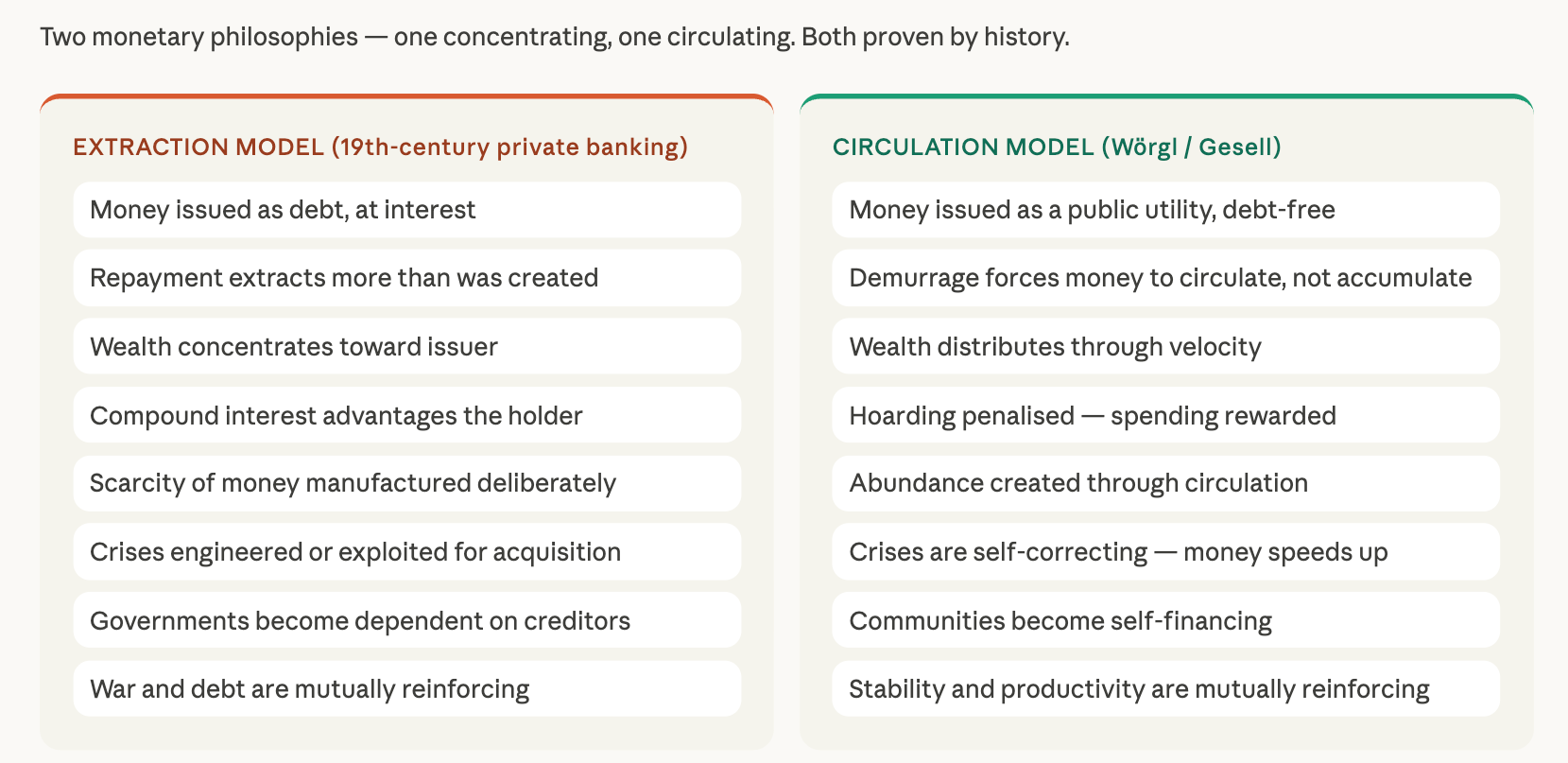
The fundamental difference in one sentence
In the extraction model, money is the master it commands labour and resources through the power of withholding. In the circulation model, money is the servant it facilitates the exchange of real human energy and real natural value.
One system is designed to concentrate power. The other is designed to distribute it.
What is verifiably true
The Rothschilds were the dominant financiers of 19th-century Europe lenders to Britain, France, Prussia, Austria, and the Vatican simultaneously. They pioneered stateless, multi-sovereign banking wealth held as bonds and instruments beyond any government's reach. Nathan financed Wellington's Napoleonic campaigns and profited enormously from the outcome of WaterlooBy 1825 N.M. Rothschild supplied emergency coin to the Bank of England during a liquidity crisis private bankers as lender of last resort to the central bank. The British Chancellor said in 1909 that Lord Rothschild was "the most powerful man in Britain"Gold prices were fixed twice daily at N.M. Rothschild & Sons offices in London until 2004. The structural model of private banks lending to governments at interest creating permanent national debt was pioneered by their era and continues today in the Federal Reserve and all modern central banking
The structural legacy that matters — not the family, but the model
The Rothschilds didn't create the debt-money system. They perfected it and industrialised it at a pivotal historical moment. The Bank of England model (1694 private bank, public monopoly on currency, government borrows at interest) predates them by a century. What they proved was that a private banking network operating across sovereign borders, holding wealth in financial instruments rather than physical assets, could be more powerful than any government. That structural insight became the template for all modern central banking. The family is less important than the model they demonstrated.
What the evidence does NOT support
The claim that the Rothschilds "control" the Federal Reserve, the Fed's structure has 12 regional banks with diverse ownership and a presidentially-appointed board of governors. That all wars are "Rothschild-engineered", wars have structural, political, and nationalist causes far beyond any single banking family. The Nathan Rothschild "I control Britain's money supply" quote widely repeated, no verified primary source exists. That Rothschild agents assassinated Lincoln, no credible evidence; John Wilkes Booth's Confederate motivation is thoroughly documented. The "controlled 80% of uranium / the Catholic Church / etc." claims fabricated or wildly extrapolated with no supporting evidence
Why this distinction is not academic — it is urgent
The Rothschilds are Jewish. The conspiracy narrative that frames all global financial control as the work of one Jewish family is a very old, very dangerous form of antisemitism — it was weaponised by the Nazis, and it has fuelled violence across centuries.
Critically: it is also analytically useless. Blaming "the Rothschilds" for the debt-money system is like blaming one Ford employee for the internal combustion engine. The problem is the architecture, not the family. Focusing on a family rather than a system makes it harder — not easier — to actually change anything. It also discredits legitimate and important systemic critique by association.
The more useful framing
The real critique, the one that George, Gesell, and Keynes all made with rigour is of the structure: debt-based money creation, compound interest, land privatisation, and the privatisation of the commons. These structures were not invented by any one family. They were developed over centuries by a class of creditors whose interests consistently diverged from those of the productive economy. That class still exists and still benefits. They just don't all share a surname.
The real architecture of extraction
It predates any family and will outlast any family unless we change the rules of the game.
1. Fractional reserve banking + compound interest
Banks create money by issuing loans — they lend out multiples of what they hold. Every unit of money in existence is owed back with interest. Since the interest itself was never created, the system structurally requires either eternal growth or periodic defaults. This is not a conspiracy — it is in every central banking textbook. The Bank of England publishes explainers on money creation. It is documented, open, and almost nobody reads it.
2. Land enclosure and rent extraction
The privatisation of common land (English Enclosure Acts, 1600s–1800s) forced people who had been self-sufficient off the land and into wage labour. Landowners collected rent from those who had previously been free. This is the George thesis — and it was not done by any single family but by a landed aristocracy protecting its interests through Parliament. The same process continues today through land banking, zoning restrictions, and negative gearing policy.
3. Privatisation of the commons
Water, airwaves, intellectual property, the internet's infrastructure, genetic code — things that belonged to everyone or to nature are progressively enclosed and turned into rent-bearing assets. Each enclosure transfers a stream of future income from the public to private holders. The pattern is the same whether it's Mayer Rothschild in 1800 or a pharmaceutical company patenting a gene sequence in 2020.
4. Policy capture — the revolving door
The rules of the financial system are set by people who rotate between private finance and regulatory positions. Goldman Sachs alumni run the US Treasury, the European Central Bank, and the Bank of Canada simultaneously at various points. This is not secret — it is publicly documented. The system writes its own rules, through the people most incentivised to keep those rules favourable to capital. No dark room required. The mechanism is structural, not conspiratorial.
The Solution | George + Gesell + Wörgl = one coherent system
George ends land rent, the extraction of value created by the community. Gesell ends money rent, the extraction of value created by withholding the medium of exchange. Together they eliminate the two primary mechanisms by which passive ownership extracts value from active production. Wörgl proved it works in practice, under the worst possible economic conditions.
The three pillars of your FLOW + TERRA system are not utopian dreams, they are proven tools that were killed before they could scale.